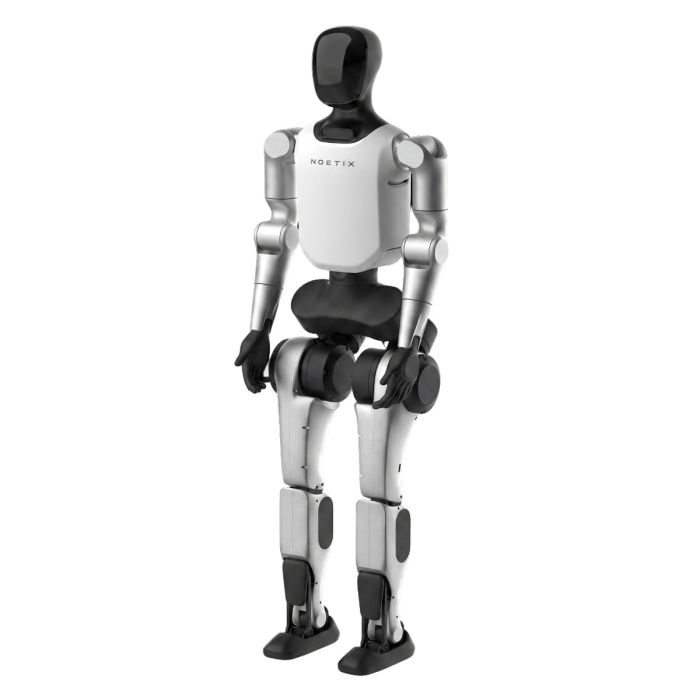
Noetix E1 EDU Embodied Intelligence Humanoid Robot
Disponible
- MARCA:
- NOETIX
- MODELO:
- E1 EDU
- NÚMERO DE PIEZA #:
- E1
- ORIGIN:
- China
- AVAILABILITY:
- SUBJECT TO AVAILABILITY
- SKU:
- Noetix-E1-EDU
Noetix E1 EDU Embodied Intelligence Humanoid Robot
Noetix E1 Embodied Intelligence Humanoid Robot USA: The Education and Research Platform Guide
The Noetix official product page describes the E1 as featuring "highly localized core components, combining high cost performance with mid-to-high-end performance," and explicitly lists its intended application scenarios as family companionship, exhibition guidance, corporate services, and education and research. The secondary development capability, which allows users to access both high-level and low-level control interfaces and deploy custom algorithms, is a key differentiating feature of the E1 for research and education users in the United States.
.webp)
Form Factor for Education and Research Environments
The E1's 1.36-meter height and 21-plus degree-of-freedom body are chosen with adult human-scale research and interaction in mind. In university laboratory settings, a robot at this height facilitates natural interaction studies at a height comparable to a seated adult, operates comfortably in lab spaces designed for human occupation, and can demonstrate bipedal locomotion at a scale where gait parameters are directly comparable to adult human data. For interactive AI research, having the robot at near-adult height ensures that studies of conversational AI, gaze behavior, and social gesture produce data generalizable to eventual full-size deployments.
The E1's 1.36-meter height is taller than the N2 (118 cm) and substantially taller than the Bumi (94 cm), placing it at the upper end of the "sub-full-size" humanoid category. This height means standard doorways, laboratory furniture, and research station heights are all compatible with the robot's operation, reducing the environment modification typically required to deploy a full-size 170-centimeter humanoid.
Waist Degree of Freedom
The E1 includes a dedicated waist degree of freedom that its smaller sibling, the N2, does not have. This joint allows the upper body to rotate and tilt independently of the lower body and legs, producing the kind of natural twisting and turning that humans perform constantly during conversation, gesture, and upper-body task execution. For research applications in human-robot interaction, this waist mobility is significant: studies have shown that robots with natural torso rotation are perceived as more socially intelligent and engaging than robots that must rotate their entire body to face a conversation partner.
Three Color Options and Appearance Customization
The E1 is available in three exterior color options: Flowing Purple, Moonlight White, and Space Gray. Noetix's product materials indicate that the appearance, walking speed, and persona of the E1 can be customized by operators, which is particularly relevant for researchers studying the effect of robot appearance and behavior on human interaction quality, and for educational institutions that want to configure the robot's persona to match their specific curriculum or institutional identity.
Technology and Specifications
Degrees of Freedom: Baseline and Expansion
The E1 ships in a baseline configuration with 21 degrees of freedom, with the following distribution: two in the head and neck, four per arm in the standard arm configuration, six per leg, and one in the waist. This baseline supports natural bipedal locomotion, conversational gesture, and upper-body coordination.
The modular upgrade to seven degrees of freedom per arm substantially expands the arm's reach and pose diversity, enabling the robot to access a wider range of approach angles for manipulation tasks and produce more naturalistically varied arm movements during interaction. Combined with the five-finger dexterous hand upgrade, the fully expanded E1 configuration reaches approximately 29 total degrees of freedom, covering five fingers with individual joint actuation per hand.
A key technical point that distinguishes the E1's educational value from simpler robots is that these 29 degrees of freedom span a complexity range suitable for studying the full spectrum of humanoid control problems, from low-level joint position control and torque-based compliance, through gait planning and balance control, to high-level task planning and natural language instruction following.
Computing Tiers
The E1 is available in two computing configurations. The standard configuration uses a processor appropriate for the robot's baseline interaction and locomotion functions. The developer configuration upgrades to an NVIDIA Jetson Orin Nano Super processor, described by American Satellite's product listing as enabling compute tiers appropriate for advanced research use, including running larger AI models for vision, language, and manipulation planning on-device without cloud dependency.
The NVIDIA Jetson Orin Nano Super delivers up to 67 TOPS of AI inference performance, providing the compute foundation for running the perception, language, and motion planning models required for research-level embodied AI development. At this compute level, researchers can run real-time object detection, depth estimation, natural language model inference, and motion planning simultaneously within the robot's own processing budget.
Sensing and Perception
The E1's standard sensing configuration includes a depth camera for three-dimensional visual perception and an IMU (inertial measurement unit) for balance and motion sensing. The depth camera provides the spatial perception required for obstacle detection, object identification, and person tracking during interaction.
The optional LiDAR module, available as a modular expansion, adds 360-degree spatial mapping capability for larger-scale environment mapping and autonomous navigation in complex indoor spaces. For research groups studying simultaneous localization and mapping (SLAM), autonomous navigation in dynamic environments, or long-range environmental awareness, the LiDAR-equipped E1 configuration is the more capable research platform.
Multimodal AI: Language, Expression, and Memory
The E1 runs a multimodal AI interaction stack on its 48V low-power computing system, described by Noetix as supporting three synchronized output channels: large language model-based voice interaction for multilingual speech, expressive facial animation for social gesture, and fluid body movement for whole-body gesture coordination. The synchronization of these three channels at low latency produces the coherent, human-like communication quality that makes the E1 effective in real interaction research settings.
The memory and personality development features allow the robot to retain conversational context across sessions and build a consistent persona over time. For educational research into human-robot interaction, these features are directly relevant: studies of long-term human-robot relationships, trust development, and the effect of robot memory on user experience require a platform that can actually maintain continuity across interactions.
Secondary Development: APIs and Control Hierarchy
For research and development use, the E1 provides access to both high-level and low-level motion control interfaces. High-level interfaces allow developers to send velocity and motion commands in natural terms without managing individual joint control, which is appropriate for application developers building interaction scenarios or educational demonstrations. Low-level interfaces allow direct joint-level control and algorithm deployment, which is required for researchers developing custom gait controllers, manipulation policies, or balance algorithms.
This two-tier interface structure, described in RBTX's product listing as providing "standard secondary development interface" capability, mirrors the control architecture used in research humanoid platforms from other manufacturers but at a substantially lower price point. The platform is compatible with Python, C++, and ROS (Robot Operating System), the standard toolchain in academic robotics research, allowing researchers to use the E1 within existing development workflows without adopting a proprietary control environment.
Applications and Use Cases in US Education and Research
University Robotics and AI Engineering Programs
The E1's primary deployment context in US institutions is university-level engineering and computer science programs where students work on bipedal locomotion, embodied AI, human-robot interaction, and manipulation research. The ROS compatibility and two-tier control interface allow senior undergraduate and graduate students to work with the robot using the same tools they would use for any other robotics research platform, reducing the learning overhead of adding the E1 to a lab's toolkit.
Specific research applications well-supported by the E1's hardware and software include gait optimization and learning, reinforcement learning for humanoid locomotion, natural language grounding in physical robotic bodies, social robot behavior design and evaluation, and multimodal sensor fusion for robust perception. The modular dexterous hand and seven-DOF arm upgrade open additional research threads in grasp planning, teleoperation, and bimanual manipulation.
Embodied AI Research
The concept of embodied AI, which the E1 is explicitly designed to support, refers to the development of AI systems that perceive and act in the physical world rather than operating only in digital environments. Research in this area has gained significant attention as the limits of purely software-based AI become apparent in domains requiring physical reasoning, contextual perception, and interaction with unstructured environments. The E1 provides a platform for exploring how large language models, visual perception systems, and motion planning algorithms behave when deployed in a physical humanoid body, which is research that is impossible to conduct in simulation alone.
Interactive Exhibition and Demonstration
University open days, science fairs, robotics competitions, and technology exhibitions represent an important secondary use case for the E1 in US educational settings. The robot's 1.36-meter height, natural conversational capability, and physical expressiveness make it an effective demonstration platform that communicates the state of AI and robotics research to non-specialist audiences in a tangible and memorable way. Noetix's marketing materials specifically list exhibition guidance and interactive visitor scenarios among the E1's supported use cases.
Museum and Science Center Educational Programs
Science museums and children's museums in the United States that run hands-on STEM programming for visiting school groups represent an application context where the E1's height, interaction capability, and visual appeal create strong educational engagement. A robot that can converse naturally, answer questions about its own operation, and demonstrate different styles of movement while a museum educator provides context gives students an interactive experience with AI and robotics that textbooks cannot replicate.
Human-Robot Interaction Studies
For US psychology, communications, and social science departments studying human responses to humanoid robots, the E1's combination of human-proportioned body, expressive facial animation, LLM-based natural language capability, and memory persistence creates a more ecologically valid interaction partner than screen-based AI systems or purely mechanical robots. Research on trust, social presence, anthropomorphism, and the effect of robot personality on user behavior can be conducted with the E1 in conditions that more closely resemble real-world human-robot interaction.
Noetix's Education Philosophy: Democratizing Embodied AI
Noetix founder Jiang Zheyuan has consistently described the company's mission as making humanoid robotics accessible, not just technically capable. The same Xiaomi-style thin-margin pricing philosophy that produced the Bumi at $1,380 and the N2 at approximately $5,500 applies to the E1, which Noetix describes as combining "mid-to-high-end performance at an affordable price" through the use of highly localized domestic Chinese components. The company's partnership with Coding Cat, a programming education platform serving 43 million students across 70,000 schools in China, demonstrates the depth of Noetix's investment in building an educational ecosystem around its robots, an ecosystem that US organizations can participate in through the E1's ROS and Python developer interfaces.
The practical implication for US university buyers is that the E1's price point, while not as dramatically low as the Bumi, represents a significant reduction from the $30,000 to $100,000-plus cost of comparable-capability research humanoids from Western manufacturers. This reduction does not come through specification compromise but through manufacturing efficiency, supply chain localization, and a deliberate decision to operate on thin margins to build market presence.
Advantages and Benefits for US Education and Research Buyers
Human-adult-proportioned form factor at a sub-$10,000 entry price: The E1 at approximately $5,500 entry is among the few human-proportioned bipedal humanoids available to US researchers at a cost accessible to university department budgets. Full-size humanoids from Western manufacturers in the same DOF range typically cost $30,000 to $100,000 or more.
Two-tier control interface for pedagogically rich access: The combination of high-level API access for application developers and low-level joint control for algorithm researchers means the E1 can be used simultaneously in introductory robotics courses and advanced graduate research labs within the same institution, with different students accessing the system at the appropriate level of abstraction.
Modular upgrade path from 21 to 29 DOF: Institutions can begin with the baseline E1 for locomotion and interaction research and add dexterous hands, seven-DOF arms, and LiDAR as research programs mature, protecting the initial hardware investment while expanding capability over time.
ROS compatibility and Python/C++ API support: Direct integration with the dominant academic robotics development toolchain means the E1 works with existing university software infrastructure, simulation environments, and curriculum materials without requiring students to learn a proprietary control interface.
LLM-based multilingual interaction with memory: The natural language capability and session memory allow the E1 to be used in genuine social and educational interaction research, not just motor control studies, expanding the platform's research relevance across multiple departments.
Manufacturer track record of rapid product delivery: Noetix's ability to ship the N2 from concept to continuous backflip demonstration in six months, followed by the Bumi's sellout in 48 hours, establishes a production execution track record that provides US buyers with confidence in order fulfillment.
Comparison with Alternative Education and Research Humanoids
Noetix E1 vs. Noetix Bumi EDU
The Bumi EDU (94 cm, approximately $1,380 to $2,000 in China, with international pricing higher) is Noetix's dedicated K-12 and beginner education robot. It includes graphical programming, ROS support, Python and C++ interfaces, and at the EDU tier, lower-level joint control access. The Bumi EDU is appropriate for STEM education programs up to introductory undergraduate robotics. The E1 is the appropriate platform for advanced undergraduate and graduate research, university engineering labs, and organizations requiring adult-height proportions, multimodal AI interaction, optional manipulation capability, and NVIDIA Jetson Orin compute performance.
Noetix E1 vs. Unitree G1
The Unitree G1 (23 to 43 DOF depending on configuration, approximately $16,000 to $21,600) is the most commonly cited competitor to the E1 in the US university research market. The G1's higher price reflects a more established US distribution network and a broader US developer community. The E1 differentiates through its taller height for adult-scale interaction research, LLM-based multilingual AI with memory, the waist degree of freedom, and the modular upgrade path to dexterous hands and LiDAR. For US buyers who prioritize existing community support and US-accessible after-sales service, the G1 has current advantages. For those prioritizing interaction AI quality, height-appropriate adult interaction research, and modular hardware expansion, the E1 offers distinct capabilities at a lower price.
Noetix E1 vs. Agility Robotics Digit
Agility Robotics' Digit is a US-manufactured bipedal humanoid designed for warehouse logistics applications at approximately $250,000. It is a full-production industrial robot with a different target buyer and use case than the E1. For US university labs seeking affordable research access to a human-proportioned bipedal platform for interaction and embodied AI research (not industrial logistics), the E1 is the more practically accessible option.
Summary
The Noetix E1 Embodied Intelligence Humanoid Robot represents one of the most technically capable and cost-accessible full-body bipedal humanoids available to US university research departments, engineering programs, and science education organizations in 2026. Its 1.36-meter adult-proportioned body, 21 to 29 modular degrees of freedom, two-tier ROS-compatible control interface, NVIDIA Jetson Orin Nano Super developer compute option, LLM-based multilingual AI with session memory, and upgrade paths to dexterous hands and LiDAR collectively provide a research and education platform that covers the full scope of embodied AI development from locomotion through interaction and manipulation. Noetix's Series B-backed financial stability, Beijing government institutional support, and demonstrated ability to deliver technically ambitious humanoid robots at accessible price points through a domestic supply chain give US institutional buyers reasonable confidence in the platform's long-term viability. For US organizations seeking a human-proportioned bipedal humanoid robot for embodied AI research, advanced STEM education, interactive demonstration, or human-robot interaction studies, the Noetix E1 is the most competitively priced option with this combination of physical capability, AI sophistication, and modular expandability currently accessible in the US market.
Frequently Asked Questions (FAQ)
What is the Noetix E1 Embodied Intelligence Humanoid Robot?
The Noetix E1 (Geek Pioneer E1) is a bipedal humanoid robot developed by Beijing Noetix Robotics Technology Co., Ltd. for embodied AI research, advanced STEM education, human-robot interaction studies, and interactive demonstration. It stands 1.36 meters tall with 21 degrees of freedom in its baseline configuration, expandable to approximately 29 DOF with optional seven-DOF arms and five-finger dexterous hands. The E1 uses LLM-based multilingual voice interaction, expressive facial animation, and whole-body gesture, all coordinated through a 48V AI computing system. A developer-tier configuration provides an NVIDIA Jetson Orin Nano Super processor with up to 67 TOPS of AI inference.
How does the Noetix E1 support secondary development and research?
The E1 provides two levels of control access for research and development. High-level interfaces allow developers to send velocity and motion commands without managing individual joint states, appropriate for building interaction scenarios and educational demonstrations. Low-level interfaces enable direct joint-level control and custom algorithm deployment, required for researchers working on gait controllers, reinforcement learning policies, and manipulation planning. The platform supports Python, C++, and ROS, enabling integration with existing academic robotics development workflows, simulation environments, and curriculum materials. The optional NVIDIA Jetson Orin Nano Super compute module enables on-device execution of demanding perception and language models without cloud dependency.
Why is the Noetix E1 important for US university research programs?
The E1 is significant for US university programs because it brings human-proportioned bipedal humanoid research capability to a price point accessible to department-level budgets. Full-size research humanoids from Western manufacturers capable of similar DOF ranges and AI stack sophistication typically cost $30,000 to $100,000 or more. The E1's entry price of approximately $5,500 and its modular upgrade path allow institutions to begin with core locomotion and interaction research and expand to manipulation and autonomous navigation as research programs mature. Its ROS compatibility means students can use existing tooling and curriculum without adopting a proprietary control environment.
What is the difference between the Noetix E1 and the Noetix Bumi EDU for education?
The Bumi EDU (94 cm, approximately $1,380 to $2,000) and the E1 serve different tiers of education. The Bumi EDU is designed for K-12 STEM programs, university introductory robotics courses, makerspaces, and family education use. It provides graphical programming, voice interaction, and at the EDU tier, lower-level joint control access through ROS, Python, and C++. The E1 (136 cm, 21-29 DOF) is designed for advanced undergraduate and graduate research, university engineering labs, and institutions studying embodied AI, human-robot interaction, gait control, and manipulation. It provides a taller adult-proportioned body, NVIDIA Jetson Orin Nano Super compute, LLM-based multimodal AI with memory, and modular dexterous hands and LiDAR. The Bumi EDU is the entry point for robotics education; the E1 is the platform for robotics research and advanced development.
Does the Noetix E1 support ROS and standard programming languages?
Yes. The Noetix E1 is compatible with ROS (Robot Operating System), Python, and C++, the standard toolchain for academic and professional robotics development. The platform's control interface provides both high-level motion command access and, through the secondary development system, low-level joint control for researchers who need to deploy custom algorithms. This compatibility means researchers and students can use existing simulation environments, grasping libraries, navigation packages, and motion planning tools without adapting them to a proprietary robot API. RBTX's product listing for the N-series platforms describes this as "standard secondary development interface" capability, allowing both high-level velocity commands and low-level joint-level algorithm deployment.