
Unitree R1-A7-D Smart C Humanoid Robot
Na zalihi
- MARKA:
- UNITREE ROBOTICS
- MODEL:
- R1-A7-D-SMART-C
- DIO #:
- R1-A7-D-Smart-C
- ORIGIN:
- Kina
- Warranty:
- 12 MONTHS
- AVAILABILITY:
- SUBJECT TO AVAILABILITY
- SKU:
- Unitree-R1-A7-D-Smart-C
Buy now, pay later
Unitree R1-A7-D Smart C Humanoid Robot
Force control tells the hand how hard it is squeezing. Tactile sensing tells it what is happening at the fingertips. If your research is about contact rather than about gripping known objects, that second thing is the entire point — and these are the most capable hands in the range.
What it is
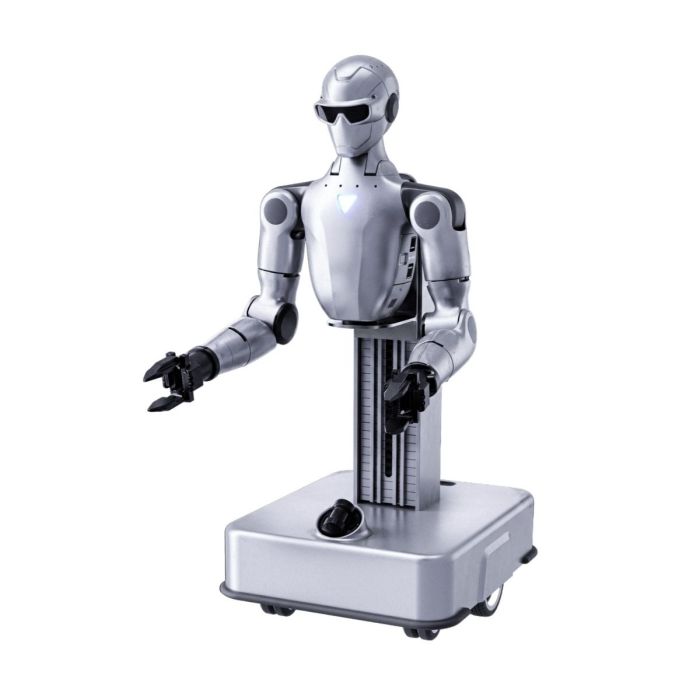
The Unitree R1-A7-D Smart C is a compact dual-arm mobile manipulation platform from Unitree's R1 family: two 7-DOF arms, a waist, a head and a lifting pillar on a wheeled chassis, with 20 degrees of freedom excluding the hands, fitted with two Dex3-1 force-controlled three-finger dexterous hands with tactile sensing. AI compute is an NVIDIA Jetson Orin Nano at 40 TOPS. It is sold as a development platform with documented interfaces rather than as a closed product.
What "R1-A7-D Smart" actually means
Four independent things are encoded in that name, and almost every buying mistake in this range comes from reading only some of them.
| Part of the name | What it decides |
|---|---|
| R1 | The Unitree R1 family — the compact, lightweight end of Unitree's humanoid range |
| A7 | Seven degrees of freedom in each arm. The A5 models have simpler arms; the extra axis gives the redundancy that complex manipulation needs |
| D | A wheeled mobile chassis instead of a fixed mount, with MID360 LiDAR for navigation and a removable chassis battery |
| Smart | The compute trim: an NVIDIA Jetson Orin Nano at 40 TOPS. The Ultimate trim is the same robot with an Orin NX at 100 TOPS |
| The final letter | Which hands it wears — eight options, from a simple gripper to tactile five-finger hands |
So the robot is identical across all eight letters; only the end effectors change. And the only difference between a Smart configuration and the matching Ultimate one is the compute module.
Smart or Ultimate? The honest answer
This is the one decision worth getting right, because it is the easiest money to waste in either direction, and the robots are otherwise identical — same arms, same chassis, same sensors, same hands, same frame.
Buy the Smart trim if your models train and run on a workstation and the robot executes commands, if your work is navigation, teleoperation, data collection or classical manipulation, or if you are buying several units and the per-robot saving compounds. Buy Ultimate instead if you intend to run large perception or policy models on the robot itself, untethered, where 40 TOPS becomes the bottleneck.
Put plainly: most buyers of this platform are not compute-bound, and the Smart trim is the better buy for them. If you are unsure, tell us what you plan to run and we will say which way to go — including when that means recommending the dearer one.
Thirty kilos changes what you can do with it
This is the detail worth dwelling on. A full-size mobile humanoid weighs upwards of 80 kg; this one is around 30, and folds to 683 × 520 × 440 mm. Two people can lift it into a van. It fits through a normal doorway and into a normal lift. You can take it to a conference, a classroom or a customer site without a pallet truck and a risk assessment for the lifting itself.
The trade-off is honest: a modest 2 to 4 kg per arm depending on extension, and roughly an hour and a half of battery rather than a full day. For research, teaching and demonstration work that is usually the right side of the bargain. For continuous production handling it is not.
The eight hand options
Listed cheapest first, which is also roughly the order of increasing capability. Each is available on both the Smart and the Ultimate trim.
| Letter | Hands | Tactile sensing |
|---|---|---|
| A | Dex1-1 two-finger gripper | No |
| H | Tendon-driven dexterous hands with wrist-mounted RGB cameras | No |
| F | LinkerBot O6 hands | No |
| G | LinkerBot O6 hands with tactile sensing | Yes |
| D | BrainCo Revo 2 Basic five-finger hands | No |
| B | Dex3-1 force-controlled three-finger hands | No |
| E | BrainCo Revo 2 five-finger hands with tactile sensing | Yes |
| C | Dex3-1 force-controlled three-finger hands with tactile sensing | Yes |
Decide the hands from what the robot needs to hold, and the trim from where your models run. The two choices price independently.
Where this configuration sits
The Smart C is the 40 TOPS trim fitted with two Dex3-1 force-controlled three-finger dexterous hands with tactile sensing. Its direct counterpart is the Ultimate C — the identical robot with an Orin NX at 100 TOPS. It is the top of the Smart range; the Smart E sits just below it. The Smart B is the same hands without tactile sensing. The wider range is listed under Unitree R1-A7-D and Unitree humanoid robots.
Unitree R1-A7-D Smart C specifications
| Specification | Value |
|---|---|
| Total degrees of freedom | 20, excluding hands |
| DOF breakdown | 7 per arm × 2, plus 1 waist, 2 head, 1 pillar, 2 base |
| Hands | Dex3-1 force-controlled three-finger hands with tactile sensing |
| Tactile sensing | Yes |
| Arm payload | 2 to 4 kg per arm, varying considerably with arm extension |
| Arm length | 555 mm (upper arm plus forearm) |
| Weight | About 30–32 kg with battery, varying by hand option |
| Dimensions, raised | 1,323 × 520 × 440 mm |
| Dimensions, collapsed | 683 × 520 × 440 mm |
| Mobility | Wheeled mobile chassis |
| AI compute | NVIDIA Jetson Orin Nano, 40 TOPS |
| Onboard compute | 8-core CPU in body and head |
| Perception | MID360 3D LiDAR, head stereo camera |
| Battery life | About 1.5 hours, removable chassis battery |
| Development | Documented interfaces for secondary development |
Figures follow published specifications for this configuration and vary by production batch. Confirm the exact build on your quotation before ordering.
Who buys it
- Contact-rich mobile manipulation and slip-detection research
- Compliant grasping of fragile or deformable objects
- Tactile learning and multimodal perception work
- Groups publishing on force and touch sensing
How to choose
Buy the Smart C if you need two Dex3-1 force-controlled three-finger dexterous hands with tactile sensing and your models run on a workstation rather than on the robot. Step up to the Ultimate C if they must run onboard — it is the same robot and the only change is the compute module. Save money by dropping tactile sensing with the Smart B. If you need more arm payload or a longer working day, look at the larger platforms in our humanoid robots category.
Safety and standards
The R1-A7-D is research and development equipment. The industrial robot safety standards — ISO 10218 and the ANSI/RIA R15.06 family — and the mobile robot standard R15.08 do not cover it, so the duty of care sits with the operator. Define and mark a working area, keep untrained people outside it, keep a trained operator with the emergency stop within reach, and complete a written risk assessment before any public demonstration. A driving robot with two moving arms needs that discipline even at this modest size.
Lithium batteries are regulated dangerous goods in transit, which affects how spares ship and how quickly.
Deployment and running costs
Budget for at least one spare chassis battery: endurance is about an hour and a half, so a single pack means a lab that works in bursts. Beyond that the platform asks very little — reasonably flat, clear floor to drive on and somewhere to store it folded. End-effector spares are worth planning for, since hands are the most frequently damaged part of any manipulation platform; related parts are listed under robot accessories. International buyers should add duty and import charges. Current pricing is shown on the listing above; for quantities, grant purchases or bundles, request a written quotation.
Import and delivery
Units ship from the manufacturer and lead times follow production batches rather than a fixed schedule. Lithium batteries restrict some routes and add documentation. The folded size does at least make this one of the easier humanoids to ship. Tell us the destination country when you enquire and we will confirm delivered cost, a realistic lead time and the paperwork required before you commit.
Support before and after the sale
Before you buy, our team will confirm that your work genuinely reads tactile data. If it does not, the B option is the same robot for less. We will also check the compute trim with you, since that is the easiest money to waste in either direction. After delivery, we help with training, set up and ongoing support. The specifics for your order are confirmed on your quotation.
Where to buy
This configuration is listed above with current price and availability, alongside the rest of the R1-A7-D Smart range and the Ultimate trim so you can compare before committing. Order directly, or contact our team for a formal quotation including delivery to your country. Universities and institutions buying against a purchase order should request a written quotation first.
Frequently asked questions
How much does a Unitree R1-A7-D Smart C cost?
Current pricing is shown on the listing above. Request a quotation for delivered pricing or quantities.
What is the difference between Smart C and Ultimate C?
Only the compute module. Smart carries an NVIDIA Jetson Orin Nano at 40 TOPS; Ultimate carries an Orin NX at 100 TOPS. The robot is otherwise identical.
Is 40 TOPS enough?
For navigation, teleoperation, data collection and classical manipulation, generally yes. If you intend to run large perception or policy models on the robot itself, choose the Ultimate trim.
What does the A7 in the name mean?
Seven degrees of freedom in each arm. The A5 models have simpler arms; the extra axis gives the redundancy that complex manipulation needs.
What does the D mean?
A wheeled mobile chassis rather than a fixed mount, with MID360 LiDAR for navigation and a removable chassis battery.
What hands does the Smart C have?
Dex3-1 force-controlled three-finger hands with tactile sensing.
How many degrees of freedom does it have?
20 excluding the hands: 7 per arm, plus 1 in the waist, 2 in the head, 1 in the pillar and 2 in the base.
Does it walk?
No. The R1-A7-D is a dual-arm upper body on a wheeled chassis. For a bipedal robot, see the Unitree R1 or the G1.
How much can each arm lift?
Between 2 and 4 kg per arm, with an arm length of 555 mm. Unitree notes the figure varies a great deal with how far the arm is extended, so plan against the lower end.
How long does the battery last?
About an hour and a half from the removable chassis battery. Plan at least one spare for a full day.
How big is it?
1,323 mm tall raised, folding to 683 × 520 × 440 mm, at around 30 to 32 kg with battery — light enough for two people to lift into a van.
Can I change the hands later?
Yes. End effectors are sold separately and can be changed, though specifying correctly at order saves cost and downtime.
Can I upgrade the compute later?
Treat the trim as a purchase decision rather than an upgrade path. Confirm with us before ordering if you think you may need 100 TOPS.
Do you ship internationally?
Yes. Lithium batteries affect routing and lead time, so confirm the destination country when you enquire.