
Unitree R1-A7 Smart F Humanoid Robot
Til á lager
- VÖRUMERKI:
- UNITREE ROBOTICS
- FYRIRMYND:
- R1-A7-SMART-F
- HLUTI #:
- R1-A7-Smart-F
- ORIGIN:
- Kína
- Warranty:
- 12 MONTHS
- AVAILABILITY:
- SUBJECT TO AVAILABILITY
- SKU:
- Unitree-R1-A7-Smart-F
Buy now, pay later
Unitree R1-A7 Smart F Humanoid Robot
The LinkerBot O6 is the value option in this range, and that is a genuine engineering position rather than a compromise: real dexterity, well above a simple gripper, at a fraction of the cost of the premium hands.
What it is
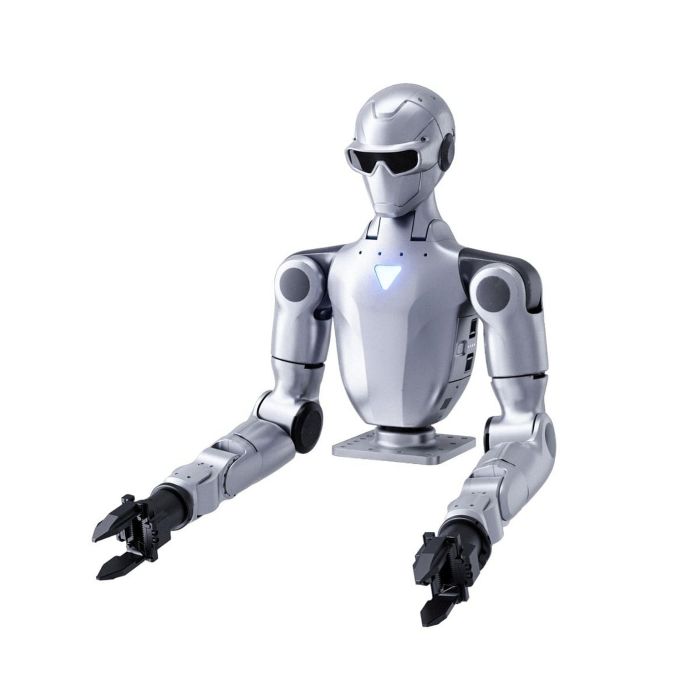
The Unitree R1-A7 Smart F is a fixed-base dual-arm manipulation platform from Unitree's R1 family: two 7-DOF arms, a rotating waist and a two-degree-of-freedom sensor head on a bench or pedestal mount, fitted with two LinkerBot O6 dexterous hands. It weighs about 13 kg, runs from an external power supply, and carries an NVIDIA Jetson Orin Nano at 40 TOPS. It is sold as a development platform with documented interfaces rather than as a closed product.
What "R1-A7 Smart" actually means
Four independent things are encoded in these names, and almost every buying mistake in this range comes from reading only some of them.
| Part of the name | What it decides |
|---|---|
| R1 | The Unitree R1 family — the compact, lightweight end of Unitree's humanoid range |
| A7 | Seven degrees of freedom in each arm. The A5 models have simpler arms; the extra axis gives the redundancy that complex manipulation needs |
| No D | A fixed base. The R1-A7-D models add a wheeled mobile chassis, a battery and navigation LiDAR |
| Smart | The compute trim: an NVIDIA Jetson Orin Nano at 40 TOPS. Ultimate trims carry an Orin NX at 100 TOPS |
| The final letter | Which hands it wears — eight options, from a simple gripper to tactile five-finger hands |
So the robot is identical across all eight letters; only the end effectors change.
Why a fixed base is often the better machine
It is natural to read "fixed" as the cut-down option. On this platform it is not.
A fixed R1-A7 weighs about 13 kg and runs from an external power supply. It carries the same 7-DOF arms as the wheeled models — 2 to 4 kg per arm depending on extension, at a quoted end-effector repeatability of ±0.1 mm — but with no battery to charge and no chassis to move. It never runs out of charge mid-experiment, one person can lift it onto a bench, and it avoids the lithium-battery restrictions that slow the wheeled models through customs.
So the question is not which is better, but whether your work needs the robot to travel. If your manipulation research happens at one bench, a fixed base gives you unlimited runtime, roughly a third of the mass to move and a materially lower price. If the robot must move between workstations, follow a person or navigate a building, you need the wheeled R1-A7-D and should expect to pay for it.
Thirteen kilos is a different kind of robot
At about 13 kg this is a dual-arm humanoid upper body one person can lift onto a bench. It stands 835 × 357 × 190 mm in a natural posture. You can move it between rooms, take it to a lecture or a customer meeting, and set it up without lifting equipment or a crate — which is not true of most research manipulators with this much freedom.
The platform also talks and listens: a four-array microphone and dual 3 W speakers are built in, which matters for human-robot interaction work and for demonstrations where the robot needs to be understood across a room.
The eight hand options
Listed cheapest first, which is also roughly the order of increasing capability. The same eight options are offered on the wheeled R1-A7-D.
| Letter | Hands | Tactile sensing |
|---|---|---|
| A | Dex1-1 two-finger gripper | No |
| H | Tendon-driven dexterous hands with wrist-mounted RGB cameras | No |
| F | LinkerBot O6 hands | No |
| G | LinkerBot O6 hands with tactile sensing | Yes |
| D | BrainCo Revo 2 Basic five-finger hands | No |
| B | Dex3-1 force-controlled three-finger hands | No |
| E | BrainCo Revo 2 five-finger hands with tactile sensing | Yes |
| C | Dex3-1 force-controlled three-finger hands with tactile sensing | Yes |
Decide the hands from what the robot needs to hold, the base from whether it needs to travel, and the trim from where your models run. All three choices price independently.
Where this configuration sits
The R1-A7 Smart F is the fixed base, the 40 TOPS trim and the F hand option. Two alternatives change exactly one thing each: the R1-A7-D Smart F is the same robot on a wheeled chassis with a battery, and an Ultimate F is the same robot with an Orin NX at 100 TOPS. On price it sits between the Smart H below it and the Smart G above. The Smart G is the same hands with tactile sensing. The wider range is listed under Unitree R1-A7, Unitree R1-A7-D and Unitree humanoid robots.
Unitree R1-A7 Smart F specifications
| Specification | Value |
|---|---|
| Degrees of freedom | 7 per arm × 2, plus 1 waist and 2 head — 17 excluding hands |
| Hands | LinkerBot O6 hands |
| Tactile sensing | None |
| Arm payload | 2 to 4 kg per arm, varying considerably with arm extension |
| Arm length | 555 mm (upper arm plus forearm) |
| End-effector repeatability | ±0.1 mm |
| Weight | About 13 kg |
| Dimensions | 835 × 357 × 190 mm in natural posture |
| Base | Fixed — bench or pedestal mount |
| Power | External power supply, no onboard battery |
| AI compute | NVIDIA Jetson Orin Nano, 40 TOPS |
| Onboard compute | 8-core CPU with a 10 TOPS module |
| Audio | Four-array microphone, dual 3 W speakers |
| Development | Documented interfaces for secondary development |
Counting the two gripper axes, Unitree quotes 19 degrees of freedom in total for the desk-mount A7. Totals in published material differ depending on how end effectors are counted, which is why the breakdown is given above. All specifications vary by production batch — confirm the exact build on your quotation before ordering.
Who buys it
- Teaching and research programmes on a constrained budget
- Multi-unit teaching laboratories where per-station cost compounds
- Manipulation work needing more than a gripper but not premium hands
- Groups prototyping before committing to an expensive hand
How to choose
Buy the R1-A7 Smart F if you need two LinkerBot O6 dexterous hands, the robot can stay on one bench, and your models run on a workstation rather than onboard. Change base with the R1-A7-D Smart F and nothing else changes; change compute with the Ultimate F. Add tactile sensing with the Smart G. For premium hands, compare the B, C, D and E options. If you need legs rather than a bench or a chassis, look at the bipedal platforms in our humanoid robots category.
Safety and standards
The R1-A7 is research and development equipment. The industrial robot safety standards — ISO 10218 and the ANSI/RIA R15.06 family — do not cover it, so the duty of care sits with the operator. Mount it securely, define and mark a working envelope, keep untrained people outside it, keep a trained operator with the emergency stop within reach, and complete a written risk assessment before any public demonstration. Two arms carrying up to 4 kg each deserve the same respect you would give any industrial manipulator, whatever the robot weighs.
Deployment and running costs
This is an undemanding platform to run. It needs a solid bench or pedestal to mount on, a mains outlet and a defined working envelope around the arms — no batteries to rotate, no floor to keep clear and no charging downtime. End-effector spares are the main running cost worth planning for, since hands are the most frequently damaged part of any manipulation platform; related parts are listed under robot accessories. International buyers should add duty and import charges. Current pricing is shown on the listing above; for quantities, grant purchases or bundles, request a written quotation.
Import and delivery
Units ship from the manufacturer and lead times follow production batches rather than a fixed schedule. With no onboard battery, this configuration avoids the lithium-battery shipping restrictions that slow the wheeled models down, which often makes it the quicker of the two to deliver. Tell us the destination country when you enquire and we will confirm delivered cost, a realistic lead time and the paperwork required before you commit.
Support before and after the sale
Before you buy, our team will be straight with you about where the LinkerBot O6 sits against the premium hands, so the saving is a decision rather than a surprise. We will also check the base and the compute trim with you, because those are the two easiest places to spend money you did not need to. After delivery, we help with training, set up and ongoing support. The specifics for your order are confirmed on your quotation.
Where to buy
This configuration is listed above with current price and availability, alongside the rest of the R1-A7 range and the wheeled R1-A7-D models so you can compare before committing. Order directly, or contact our team for a formal quotation including delivery to your country. Universities and institutions buying against a purchase order should request a written quotation first.
Frequently asked questions
How much does a Unitree R1-A7 Smart F cost?
Current pricing is shown on the listing above. Request a quotation for delivered pricing or quantities.
What is the difference between the R1-A7 Smart F and the R1-A7-D Smart F?
The base. This one is fixed and mains powered at about 13 kg; the D model adds a wheeled chassis, a battery and navigation LiDAR at about 30 kg. The arms are the same.
What is the difference between Smart F and Ultimate F?
Only the compute module. Smart carries an NVIDIA Jetson Orin Nano at 40 TOPS; Ultimate carries an Orin NX at 100 TOPS.
Is the fixed base a downgrade?
No. Same arms, same reach, same accuracy — with unlimited runtime on mains power, roughly a third of the mass and a lower price. The wheeled version buys mobility, not capability.
Does it have a battery?
No. It runs from an external power supply, which also means it avoids the lithium-battery shipping restrictions that slow the wheeled models.
What does the A7 in the name mean?
Seven degrees of freedom in each arm. The A5 models have simpler arms; the extra axis gives the redundancy that complex manipulation needs.
What hands does the Smart F have?
LinkerBot O6 hands, without tactile sensing.
How accurate is it?
End-effector repeatability is quoted at ±0.1 mm.
How much can each arm lift?
Between 2 and 4 kg per arm, with an arm length of 555 mm. Unitree notes the figure varies a great deal with how far the arm is extended, so plan against the lower end.
Does it walk?
No. The R1-A7 is a dual-arm upper body on a fixed mount. For a bipedal robot, see the Unitree R1 or the G1.
How heavy is it?
About 13 kg, so one person can lift it onto a bench.
Can I change the hands later?
Yes. End effectors are sold separately and can be changed, though specifying correctly at order saves cost and downtime.
Do you ship internationally?
Yes. Tell us the destination country when you enquire and we will confirm delivered cost and lead time.