Galbot ET1 Galaxy Star Bipedal Humanoid Robot
In stock
- ZĪMOLS:
- GALBOT
- MODELIS:
- ET1
- ORIGIN:
- Ķīna
- AVAILABILITY:
- SUBJECT TO AVAILABILITY
- SKU:
- Galbot-ET1
Galbot ET1 Galaxy Star Bipedal Humanoid Robot
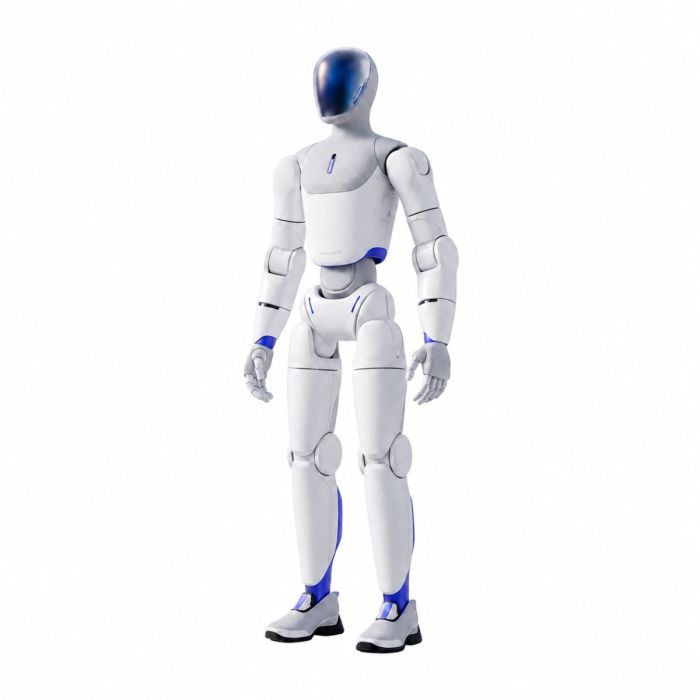
Most humanoid robots debut with a routine they have rehearsed for months; the Galbot ET1 debuted with a dance partner it had never met. At the 2026 World Robot Conference in Beijing, Galbot's first fully bipedal humanoid — nicknamed Galaxy Star — shared the stage with a human street dancer and mirrored floor moves, handstands, fluid transitions and fast choreography as they happened, learning the motion by watching rather than replaying anything pre-programmed. That single scene explains why the ET1 matters. Galbot built its reputation on wheels: the G1 mobile manipulator runs the world's first humanoid-operated convenience stores and around-the-clock unmanned pharmacies, machines famous for what they pick, not how they move. The ET1 takes that proven commercial brain and gives it legs — a full-size bipedal platform, reported at its debut at 173 centimetres and 65 kilograms with an aluminium alloy skeleton under lightweight polymer panels, 48 degrees of freedom in the body and another 24 across two five-finger hands, quasi-direct-drive brushless actuators and NVIDIA Jetson Thor computing — so the company that mastered shelves can now walk to them, up stairs and across the uneven floors where wheeled platforms stop.
The Galbot ET1 global version is available for purchase enquiry through this page, with delivery, customs clearance and after-sales support arranged for buyers across Europe, the Americas, the Middle East, Asia-Pacific and worldwide.
Background
From the shop counter to two legs
Galbot — Beijing Galaxy General Robot — earned its standing the unglamorous way: thousands of real transactions. Its wheeled G1 stocked and served actual convenience stores across dozens of Chinese cities and staffed unmanned pharmacies running twenty-four hours a day, achieving grasp reliability across thousands of everyday products that most laboratories only benchmark. The ET1, teased ahead of the World Robot Conference with a cinematic racket-sport sequence and unveiled live at the show in August 2026, is the company's declaration that this commercial intelligence is body-independent. It is not a replacement for the wheeled line but an extension of its reach — into staircases, thresholds, tight aisles and every workplace originally dimensioned for human legs.
One brain, many bodies
The ET1's most consequential feature is architectural. It runs Galaxy Star Brain, Galbot's shared embodied foundation model built on the company's WAM architecture, which unifies environment perception, task planning and motion control across bipedal, wheeled and heavy-duty robot bodies — meaning skills earned by the shopkeeper fleet inform the walker, and vice versa. On top sit two AstraBrain layers: AstraBrain-Agent, a physical-world native agent that observes its surroundings in real time, understands spoken human instructions and plans actions dynamically — down to eye contact, head micro-movements and body actions generated live from language — and AstraBrain-WBC, a whole-body-control foundation model trained on a large humanoid motion corpus with zero-shot generalisation to motions it has never seen. The practical result was on stage at the debut: new skills learned through direct human interaction, with no motion-capture suits and no action videos — the robot is currently learning tennis the same way.
Technical Specifications
| Feature | Galbot ET1 (as reported at debut) |
|---|---|
| Type | full-size bipedal humanoid robot — Galbot's first legged platform |
| Debut | World Robot Conference 2026, Beijing (August 2026) |
| Height / weight | 173 cm / 65 kg |
| Structure | aluminium alloy skeleton, lightweight polymer body panels |
| Degrees of freedom | 48 in the body; 24 across two five-finger hands |
| Actuation | quasi-direct-drive brushless servomotors with planetary and harmonic gearboxes |
| Computing | NVIDIA Jetson Thor |
| Core AI | Galaxy Star Brain shared embodied foundation model (WAM architecture) across bipedal, wheeled and heavy-duty bodies |
| Agent layer | AstraBrain-Agent: real-time observation, natural-language instruction understanding, dynamic action planning, live eye contact and gesture generation |
| Motion layer | AstraBrain-WBC whole-body control; large humanoid motion corpus; zero-shot generalisation of unseen motions |
| Learning | real-time skill acquisition from human demonstration — no motion capture, no action videos |
| Demonstrated | live choreography mirroring with a human dancer, handstands, floor transitions, teleoperation, real-time action generation at WRC 2026 |
| Status | newly unveiled platform; final manufacturer datasheet pending |
The ET1 is at the start of its commercial life: figures above reflect debut reporting, and final specifications for payload, battery runtime, sensors and configurations are confirmed against the official datasheet at quotation.
What makes the ET1 different from other new bipeds?
Its inheritance. Most first-generation bipeds arrive with athletic videos and an empty order book; the ET1 arrives with the operating history of its wheeled siblings behind its brain. Galbot's fleet has already solved the problems that kill humanoid deployments — grasping thousands of irregular products reliably, working unattended through the night, integrating with real commercial workflows — and Galaxy Star Brain carries that experience across bodies. The second difference is how it learns: where conventional humanoids are choreographed through motion capture or trained on curated video, the ET1 acquires motion by watching people directly and generalises to movements it has never seen, which is why an unrehearsed dance partner was a viable launch demonstration rather than a risk. For buyers, that combination — commercial pedigree plus watch-and-learn skill acquisition — points at the actual promise of the category: a machine taught new tasks by the workers beside it, not by an engineering team behind it.
Who is the ET1 for?
For research institutions, the ET1 global version is a frontier platform: a full-size biped carrying a deployed-at-scale foundation model, a zero-shot whole-body-control stack and Jetson Thor headroom — material for work on imitation learning, language-driven action and human-robot interaction at the current edge of the field. For industrial and commercial early adopters, it is the forward option on Galbot's roadmap: the company positions the ET1 toward manufacturing environments, commercial stores and industrial workspaces, learning complex manual tasks by observing human workers, with family service and retail scenarios expected as the platform matures. And for organisations already watching Galbot's wheeled systems, the ET1 completes the fleet logic — one brain across wheeled units for flat, fast floors and legged units for everywhere else.
What is the Galbot ET1 used for?
- Embodied AI research: imitation learning, zero-shot motion generalisation and language-to-action studies on a full-size bipedal platform.
- Human-robot interaction: real-time observation, eye contact, gesture generation and spoken-instruction response in live environments.
- Skill acquisition trials: teaching manual tasks by human demonstration — no motion capture rigs, no scripted routines.
- Manufacturing and industrial evaluation: early deployment programmes in the factory and workshop settings Galbot names as the platform's target.
- Commercial and retail pilots: extending the proven Galbot store playbook into legged access — stairs, thresholds and human-scale layouts.
- Demonstration and events: live motion-mirroring performances of the kind that made the WRC 2026 debut, from choreography to racket sports.
Pricing and Availability
The Galbot ET1 global version is available for purchase enquiry and international delivery through this page, from single research units to early-adopter programme quantities as the platform enters its commercial phase. As a newly unveiled system, price and cost are set by configuration, delivery timeline and programme scope, so buyers should request a current quotation and datasheet for their application; delivery, customs clearance and after-sales support are arranged worldwide. Purchase enquiries, specification updates and availability details for the Galbot ET1 are available on this page.
Frequently Asked Questions
What is the Galbot ET1?
The first fully bipedal humanoid robot from Beijing-based Galbot, nicknamed Galaxy Star, unveiled live at the 2026 World Robot Conference — a full-size platform reported at 173 centimetres and 65 kilograms, with 48 degrees of freedom in the body plus 24 across its two five-finger hands.
How is the ET1 different from the Galbot G1?
The G1 is Galbot's wheeled mobile manipulator, proven in real convenience stores and pharmacies; the ET1 is the company's first legged platform, built to carry the same shared intelligence into stairways, uneven floors and spaces designed for walking humans — one brain, two kinds of body.
What AI does the ET1 run?
Galbot's Galaxy Star Brain, a shared embodied foundation model on the WAM architecture spanning bipedal, wheeled and heavy-duty bodies, with AstraBrain-Agent providing real-time observation, language understanding and dynamic action planning, and AstraBrain-WBC providing whole-body control with zero-shot generalisation of unseen motions.
Does it really learn without programming?
That was the point of its debut: the ET1 mirrored a human street dancer's choreography, floor moves and handstands live, acquiring the motion by watching — no motion capture, no pre-recorded action videos — and is currently learning tennis the same way.
What hardware drives it?
Per debut reporting: an aluminium alloy skeleton under lightweight polymer panels, quasi-direct-drive brushless servomotors paired with planetary and harmonic gearboxes, and NVIDIA's Jetson Thor compute system — with the final datasheet to confirm payload, runtime and sensor details.
Is the ET1 ready for commercial deployment?
It is newly unveiled: Galbot positions it toward manufacturing, commercial stores and industrial workspaces, with the platform expected to move from research and early programmes toward service and logistics work as it matures — availability and configurations are confirmed at quotation.
Where can I buy the Galbot ET1 and what does it cost?
The ET1 global version is available through this page, with delivery, customs clearance and after-sales support arranged for buyers worldwide. Because the platform is newly launched and cost depends on configuration and programme scope, buyers should request an individual quotation. All purchasing details are available on this page.
Summary
The Galbot ET1 is what happens when the industry's most commercially proven humanoid brain gets legs: a full-size biped that debuted by improvising with a dancer, learns new skills by watching the humans around it, and inherits — through Galaxy Star Brain and the AstraBrain stack — the operating mileage of a wheeled fleet that already runs real stores and pharmacies. Reported at 173 centimetres, 65 kilograms and 72 total degrees of freedom on Jetson Thor computing, it aims squarely at the factories, stores and workspaces built for walking workers. The platform is young and its datasheet is still settling, which makes now the moment for research groups and early adopters to engage. For the global version of Galbot's first walker, this page is the starting point.