
Unitree H2-D Standard C Humanoid Robot
Ir noliktavā
- ZĪMOLS:
- UNITREE ROBOTICS
- MODELIS:
- H2-D-STANDARD-C
- DAĻA #:
- H2-D-Standard-C
- ORIGIN:
- Ķīna
- Warranty:
- 12 MONTHS
- AVAILABILITY:
- SUBJECT TO AVAILABILITY
- SKU:
- Unitree-H2-D-Standard-C
Buy now, pay later
Unitree H2-D Standard C Humanoid Robot
Tactile sensing earns its cost when something downstream reads it. On a fixed industrial station that is worth testing before you pay for it, and this page tells you how to decide rather than simply selling you the upgrade.
What it is
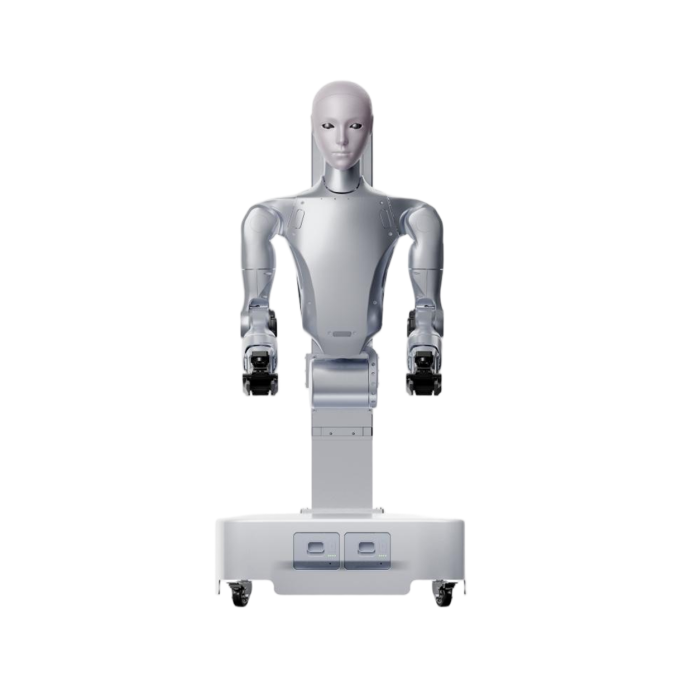
The Unitree H2-D Standard C is a fixed-base dual-arm humanoid platform for industrial mobile manipulation, commercial service, research and embodied-AI training: two 7-DOF arms rated at 7 kg each, a two-axis waist and two-axis head, and a half-metre lifting column giving a working envelope from floor level to about two metres. It weighs about 135 kg, runs continuously on a direct power supply, and carries the C hand package with open SDKs and APIs for development.
Fixed base, and why that is often the right answer
The H2-D comes in two forms, and the difference is the base rather than the brains. This is the fixed-base configuration: the dual-arm upper body, the two-axis waist, the two-axis head and the half-metre lifting column, installed in one position. The Ultimate configuration puts the same upper body on an omnidirectional mobile base.
Fixing it in place buys one thing that no battery-powered robot can match: it runs on a direct power supply, around the clock, with no charging cycle to design a shift around. For machine tending, a single assembly cell, a sorting station or a laboratory bench, that is a materially better proposition — and it costs appreciably less than the mobile version.
So the question is simply whether the work comes to the robot or the robot goes to the work. If a conveyor, a machine or a bench brings the work to one place, buy this. If the robot genuinely has to travel between locations, you want the H2-D Ultimate and should expect to pay for the base.
Floor to two metres, from one position
The detail that makes this more than a pair of arms on a stand is the lifting column. It travels half a metre at up to 200 mm/s, taking the whole upper body from 1,200 mm to 1,700 mm, and combined with a waist that pitches through 0 to 115 degrees the working envelope runs from floor level to about two metres.
That matters in practice. A conventional fixed arm is specified around a single working height and everything has to be presented to it at that height. This one reaches down to a pallet on the floor and up to a high shelf without anyone re-engineering the cell around it — and each arm is rated at 7 kg, with a single-arm reach of about 0.62 m using a two-finger gripper.
The hand packages, and what to confirm
We will be straight with you rather than pretend to more certainty than exists. The H2 family uses a letter scheme for its hand packages, published in detail for the H2 Plus range. Our price ordering across all thirteen H2-D letters matches that scheme exactly, which is strong evidence — but the per-letter package for this line is not comprehensively documented in public sources.
So treat the table below as the H2 family scheme, and ask us to confirm your specific package in writing on the quotation. We will get it from the manufacturer rather than infer it.
| Letter | Hand package in the H2 family scheme | DOF per hand | Tactile |
|---|---|---|---|
| A | Dex1-1 Advanced two-finger grippers | 1 | No |
| F | BrainCo Revo 2 Basic five-finger hands | 6 | No |
| B | Unitree Dex3-1 three-finger dexterous hands | 7 | No |
| C | Unitree Dex3-1 three-finger dexterous hands with tactile sensing | 7 | Yes |
| G | BrainCo Revo 2 Touch five-finger hands | 6 | Yes |
| H | Inspire DFQ five-finger hands | 6 | No |
| I | Inspire E2 five-finger hands with tactile sensing | 6 | Yes |
| D | Unitree Dex5-1 dexterous hands | 16 | No |
| E | Unitree Dex5-1 dexterous hands with tactile sensing | 16 | Yes |
| M | Wuji Dexterous Hand 2 | 20 | No |
| J | BrainCo Revo 3 Basic Senyun hands | 21 | No |
| K | BrainCo Revo 3 Touch Senyun hands with tactile sensing | 21 | Yes |
| L | BrainCo Revo 3 Vision Senyun hands with visuo-tactile sensing | 21 | Yes |
Hands are the largest cost variable here by a wide margin. On an industrial station, ask whether the task needs dexterity or simply a dependable grip — the manufacturer also lists two-finger, three-finger and five-finger end effectors as options, and a gripper does more real work than people expect.
Where this configuration sits
This is the fixed-base H2-D Standard with the C hand package. On price it sits between the Standard B below it and the Standard G above. The matching H2-D Ultimate carries the same arms, the same envelope and the same hand package on an omnidirectional mobile base, for a premium that varies by hand package. Ask us to quote both if you are unsure whether the robot needs to travel.
Unitree H2-D Standard C specifications
| Specification | Value |
|---|---|
| Configuration | Standard — fixed base |
| Arms | Two arms, 7 DOF each |
| Arm payload | 7 kg rated per arm, about 15 kg peak — the peak figure depends on posture and configuration |
| Single-arm reach | About 0.62 m with a two-finger gripper |
| Degrees of freedom | 19 excluding end effectors — 7 per arm, 2 waist, 2 head, 1 lifting column |
| Working envelope | Floor level to about 2 m |
| Lifting column | 0.5 m of travel at up to 200 mm/s |
| Dimensions | 1,200 × 576 × 620 mm at minimum column height, 1,700 × 576 × 620 mm at maximum |
| Waist pitch | 0 to 115 degrees |
| Weight | About 135 kg with battery |
| Hand package | C — confirm the exact hands in writing on your quotation |
| Tactile sensing | Expected on this package in the H2 family scheme — confirm on your quotation |
| Perception | Binocular vision, wrist cameras, force feedback and voice interaction |
| Battery | Quick-release base battery, 48 V / 18 Ah / 864 Wh |
| Runtime | Continuous — 24/7 operation on a direct power supply |
| Development | Open SDKs and APIs for application development and embodied-AI data collection |
| Mobile alternative | The H2-D Ultimate puts the same upper body on an omnidirectional mobile base |
Figures follow the manufacturer's published specifications for the H2-D Standard and vary by production batch. Confirm the exact build and hand package on your quotation before ordering.
Who buys it
- Machine tending and single-cell industrial automation
- High-speed sorting and kitting stations
- Assembly, inspection and laboratory validation work
- Robot manipulation research and embodied-AI data collection
- Operations that want continuous running rather than battery shifts
How to choose
Buy this configuration if the work comes to the robot and the a three-finger tactile hand package suits the task. Drop to a non-tactile package if nothing in your stack reads touch data. If the robot has to travel between locations, the H2-D Ultimate on its mobile base is the right product and the premium is unavoidable. If it has to handle stairs or rough ground, you want the legged H2 instead. Compare the whole field in our humanoid robots category.
Safety and standards
Treat this as industrial equipment, because that is what it is. The H2-D Standard weighs about 135 kg and moves two arms carrying 7 kg each through an envelope reaching two metres. It is not covered by the industrial robot safety standards — ISO 10218 and the ANSI/RIA R15.06 family — so the duty of care sits entirely with the operator.
Being fixed in place makes the safety case simpler than for a mobile robot, not lighter. Guard or clearly mark the full reach envelope, including the floor-level and overhead extremes, because the column makes that envelope larger than people expect from looking at the robot at rest. Keep untrained people outside it, keep a trained operator with the emergency stop within reach whenever the robot is powered, and complete a written risk assessment before it runs anywhere staff can reach. If it is going onto a working industrial floor, agree the arrangement with whoever runs that floor before delivery.
Deployment and running costs
This is the simpler of the two H2-D configurations to run. On a direct power supply it operates continuously, so there is no charging cycle to plan a shift around and no battery rotation to manage — a genuine operational advantage over any mobile platform. What it does need is a properly chosen position: a floor that takes about 135 kg, a marked reach envelope including the floor-level and overhead extremes, and power. At that weight, delivery needs a route in, so check door widths, lift capacity and floor loading before the crate arrives rather than on the day. End-effector spares are worth planning for, since hands take the punishment on any manipulation platform. Related parts are listed under robot accessories. International buyers should add duty and import charges.
Import and delivery
Units ship from the manufacturer and lead times follow production batches rather than a fixed schedule. At roughly 135 kg this is a heavy, bulky crate, and the lithium battery restricts some routes and adds documentation. Tell us the destination country when you enquire and we will confirm delivered cost, a realistic lead time and the paperwork required before you commit. If the robot is needed for a specific production date, tell us that date first — it changes what we can honestly promise.
Support before and after the sale
Before you buy, our team will settle three things in writing: which hands your package includes, whether the work genuinely comes to the robot or the robot needs to travel, and whether the chosen position suits the full reach envelope. That last one catches people out — the lifting column and waist pitch make the envelope considerably larger than the robot looks at rest. After delivery, we help with training, set up and ongoing support. The specifics for your order are confirmed on your quotation.
Where to buy
This configuration is listed above with current price and availability, alongside the rest of the H2-D Standard range and the mobile-base H2-D Ultimate configurations so you can compare before committing. Order directly, or contact our team for a formal quotation including delivery to your country. Organisations buying against a purchase order should request a written quotation first, and we will put the hand package in writing on it.
Frequently asked questions
How much does a Unitree H2-D Standard C cost?
Current pricing is shown on the listing above. Request a quotation for delivered pricing or quantities.
What hands does the Standard C have?
The C package. In the H2 family letter scheme that is unitree dex3-1 three-finger dexterous hands with tactile sensing, and our price ordering across all thirteen letters matches that scheme — but the per-letter package for this line is not comprehensively documented publicly, so ask us to confirm yours in writing before ordering.
Is the H2-D Standard fixed or mobile?
Fixed. It installs in one position. The H2-D Ultimate puts the same upper body on an omnidirectional mobile base.
What is the difference between H2-D Standard and Ultimate?
The base. The Standard is fixed and runs continuously on a direct power supply; the Ultimate adds an omnidirectional mobile base, a larger battery and travel at up to 1.5 m/s. Same twin 7 kg arms and the same floor-to-2 m envelope on both.
How long can it run?
Continuously. On a direct power supply it operates 24/7, with no charging cycle to plan around. The quick-release base battery is 48 V / 18 Ah / 864 Wh.
How much can it lift?
7 kg rated per arm and about 15 kg at peak, though the peak figure depends on posture and configuration. Plan against the rated value.
How high and how low can it reach?
The working envelope runs from floor level to about 2 m. The lifting column travels half a metre at up to 200 mm/s, taking the body from 1,200 mm to 1,700 mm, and the waist pitches through 0 to 115 degrees.
What is the single-arm reach?
About 0.62 m using a two-finger gripper.
How many degrees of freedom does it have?
19 excluding end effectors — 7 in each arm, 2 at the waist, 2 in the head and 1 in the lifting column. Hands add to that.
How heavy is it?
About 135 kg with battery. Check door widths, lift capacity and floor loading before delivery.
What sensing does it have?
Binocular vision, wrist cameras, force feedback and voice interaction.
Is it open for development?
Yes. The platform ships with open SDKs and APIs for application development and embodied-AI data collection.
Is it safe on a working floor?
Only with the full reach envelope guarded or clearly marked, untrained people kept outside it, a trained operator on the emergency stop and a written risk assessment. The column makes the envelope larger than it looks at rest.
Do you ship internationally?
Yes. The crate is heavy and the lithium battery affects routing, so confirm the destination country and any fixed production date when you enquire.