
Richtech Robotics Matradee Plus
In stock
- STÄMPLA:
- Richtech Robotics
- MODELL:
- Matradee Plus
- Warranty:
- 12 MONTHS
- AVAILABILITY:
- SUBJECT TO AVAILABILITY
- SKU:
- Richtech-Matradee-Plus
Richtech Robotics Matradee Plus
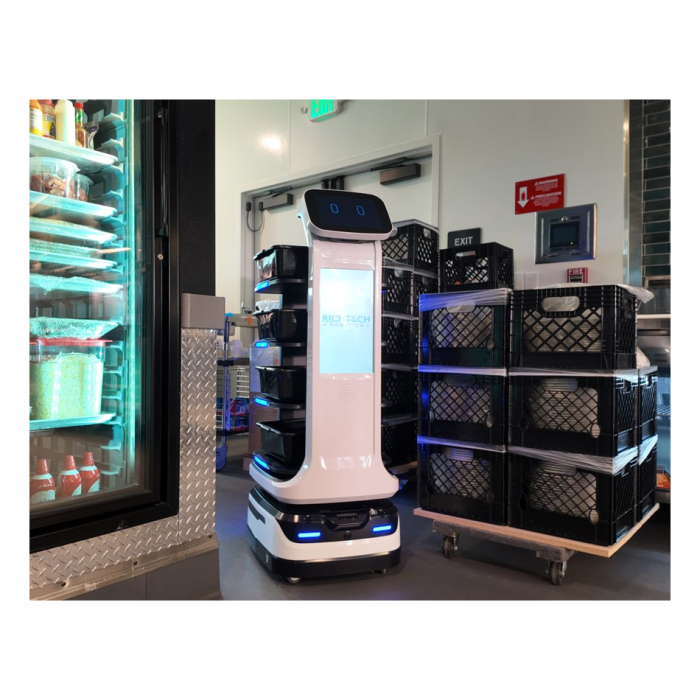
Richtech Robotics Matradee Plus is an autonomous restaurant delivery robot with four trays and an 88 lb combined carrying capacity. Richtech Robotics describes serving, bussing, hosting, and greeting functions alongside an advertising display. Published battery life is 10 hours, with a four-hour charging time.
Background
Company and lineage
Richtech Robotics presents Matradee Plus within its commercial service robot range. The manufacturer describes front-of-house assistance and provides customer testimonials. Such accounts illustrate intended use but do not establish a guaranteed result for every dining room.
Positioning in the market
Matradee Plus addresses transport and guest-facing service rather than beverage preparation. Its operating and advertising screens serve different purposes, while mapped destinations support delivery and bussing. The robot is positioned as assistance for staff, not a substitute for hospitality judgment.
Technical Specifications
| Specification | Value |
|---|---|
| Battery life | 10 hours |
| Charging time | 4 hours |
| Running speed | Up to 3.9 ft/s |
| Number of trays | 4 |
| Total payload capacity | 88 lbs |
| Tray dimensions | 16.9" x 15.7" |
| Dimensions (W x L x H) | 22.8" x 19.2" x 50.7" |
| Robot weight | 145 lbs |
| Screens | 10.1" operation touchscreen, 15.6" advertising display |
| Navigation and mapping | SLAM with LiDAR and 3D cameras |
| Operating system | Android 9 |
Specifications are drawn from manufacturer-published materials and may change between production batches or software revisions; confirm the current datasheet for your region before making a final decision.
How does the Matradee Plus navigate a busy dining room?
The robot builds and stores a virtual map of its operating environment, which it uses to plan routes and stop precisely at programmed destinations such as tables, server stations, or bussing points. While moving, it relies on LiDAR and 3D cameras, combined with onboard obstacle-avoidance algorithms, to detect people, chairs, and other objects and steer around them. Staff interact with the unit through its 10.1" touchscreen, selecting destinations or modes without needing specialized training. As general deployment advice, venues with narrow aisles, steps, or frequent layout changes should plan a mapping and trial phase before committing the robot to full service, since real-world floor conditions strongly influence how well any AMR performs.
Can the Matradee Plus do more than deliver food?
Yes, within the scope the manufacturer describes. Beyond running dishes from the kitchen, the four operation modes allow the unit to take on greeting, hosting, and bussing-style duties, meeting guests or collecting used items as it circulates. The 15.6" advertising screen turns each trip across the floor into a promotional opportunity, displaying branded graphics, event announcements, or featured dishes. It is worth noting that these are operating modes of a single mobile platform, not separate machines; as practical advice, operators should decide which role matters most during each daypart rather than expecting one robot to cover every duty simultaneously.
Who is Richtech Robotics Matradee Plus for?
Matradee Plus is intended for restaurant and food-service teams with repeated kitchen-to-dining-room transport. Buyers should review aisle widths, landing stations, tray handling, traffic patterns, and charging opportunities. A restaurant-specific demonstration is preferable to projecting service improvements from headline specifications alone.
What is Richtech Robotics Matradee Plus used for?
The following are evaluation scenarios operators commonly propose for a tray-delivery AMR of this type, not guaranteed outcomes:
- Running plated meals from the kitchen pass to tables or landing stations during peak service.
- Bussing support, carrying cleared dishes and used items back toward the dish area.
- Greeting and escorting guests toward their seating area in a hosting-style role.
- Continuous beverage, condiment, or side-item runs across large dining floors.
- In-venue promotion, using the advertising screen to highlight specials and events while it travels.
- Meal distribution trials in senior-living or institutional dining rooms with fixed delivery routes.
Pricing and Availability
Pricing for the Matradee Plus is provided on a quotation basis, since final cost depends on configuration, deployment scope, mapping and setup requirements, and after-sales arrangements for your region. To receive a formal quote, submit a request through the quotation option and the sales team will respond with current terms, lead times, and purchase details on this page. No stock or delivery promises are implied until a quotation is confirmed; availability is verified at the time each request is processed.
Frequently Asked Questions
How many trays does the Matradee Plus carry and how much weight can it hold?
The robot is fitted with four trays, each measuring 16.9" by 15.7", and the platform supports a total payload of 88 lbs across all levels. That geometry is sized for plated meals, drinks, and bussing tubs, giving staff flexibility to load several orders per trip while keeping items stable during travel.
How long does the Matradee Plus run on a single charge?
Manufacturer figures list a 10-hour battery life with a 4-hour recharge time. In practice, runtime depends on load, floor surface, and how continuously the unit is dispatched, so operators planning double shifts should map charging windows into the daily schedule rather than assuming uninterrupted all-day operation.
How fast does the Matradee Plus move?
The stated maximum speed is 3.9 ft/s, a brisk walking pace that balances delivery time against stability of carried items. Speed in a live venue is also shaped by obstacle density; the navigation stack slows or reroutes the robot when guests or furniture block its planned path.
What technology does the Matradee Plus use to avoid people and obstacles?
Navigation combines SLAM mapping with LiDAR sensing and 3D cameras, processed by onboard obstacle-avoidance algorithms. The robot references a stored map of the venue for route planning and stop points, while its sensors handle dynamic obstacles such as moving guests, allowing it to operate in crowded rooms without constant supervision.
Is the Matradee Plus difficult for staff to operate?
Day-to-day control happens through the 10.1" operation touchscreen, where staff pick destinations and switch between the four operation modes. The manufacturer describes the interface as intuitive, and the Android 9-based system is menu-driven rather than code-driven. As general advice, a short orientation session for each shift team is still worthwhile so everyone loads trays and dispatches the unit consistently.
Will the Matradee Plus replace my serving staff?
Richtech Robotics frames the robot as an assistant, not a replacement: it absorbs repetitive carrying trips so human servers can remain on the floor engaging with guests. Whether that balance holds in a given venue depends on how the operator redesigns workflows around the machine, which is an operational decision rather than a property of the robot itself.
Where can I buy Richtech Robotics Matradee Plus and what does it cost?
The Matradee Plus is sold through a quotation process rather than at a posted price, because configuration, setup, and regional support all influence the final figure. Use the quote request option to describe your venue and intended use; the sales team will reply with current pricing, lead times, and purchase details on this page, with availability confirmed per request.
Summary
The Richtech Robotics Matradee Plus is a four-tray autonomous delivery robot for food-service environments, combining an 88 lb payload, 10-hour battery, SLAM and LiDAR navigation, and dual screens for operation and in-venue promotion. Its four operation modes let it rotate between delivery, bussing, greeting, and hosting-style duties, which makes it a candidate for restaurants and institutional dining rooms facing persistent staffing pressure. Specifications here reflect manufacturer-published data, and a structured on-site pilot remains the prudent way to validate fit before scaling. For quotation requests and current availability, this page is the starting point