
Sanbot Max Standard
In stock
- STÄMPLA:
- Sanbot
- MODELL:
- Max Standard
- DEL #:
- Max Standard
- Warranty:
- 12 MONTHS
- AVAILABILITY:
- SUBJECT TO AVAILABILITY
- SKU:
- Sanbot-Max-Standard
Sanbot Max Standard
Sanbot Max Standard
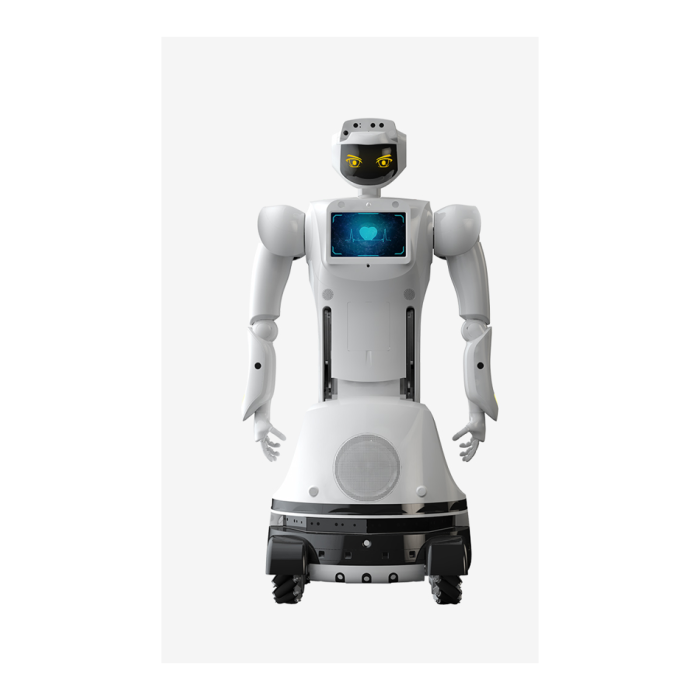
Sanbot Max Standard is a motor-driven service robot configuration with a 10.1-inch 1080P touchscreen, articulated arms and hands, and a Mecanum-wheel base. Its edition-specific specification lists a nominal 1.0 kWh lithium battery operating at 36 V, normally about 10 hours of working time, and a mass of about 90 kg. Standard should be evaluated as its own configuration rather than as Professional with an assumed identical equipment package.
Position within the Max family
The defining selection point is the combination of powered movement and interactive hardware without importing Professional-only freight and auxiliary equipment claims. The Standard table provides no freight payload rating. A buyer should therefore not use the larger edition's load figure when specifying a Standard installation, nor assume that the robot's own mass describes a carrying capacity.
Standard may be considered for a supervised visitor-facing demonstration or an application-development assessment where a powered base and articulated presentation hardware are relevant. These are project possibilities, not statements that a ready-made reception, delivery, or guest-management application is included. The required workflow, content, and operational responsibilities should be agreed before the configuration is selected.
Wheel system and chassis sensing
The edition table lists four Mecanum wheels with external wheel motors. Its chassis inventory includes 18 infrared distance sensors, six ultrasonic scanners, four 3D cameras, and a vision camera. A charging port, charging indicator, power switch, and turn signals are also described. The presence of these components should be separated from a claim about validated autonomous operation at a particular site.
For Standard, the manufacturer publishes a speed range of 0–5 m/s and ground clearance of 4.5 cm. The speed is a vendor-rated figure, not a safe operating recommendation for shared spaces. An installation assessment should establish appropriate limits, routes, stopping procedures, and supervision. The clearance figure alone does not establish the ability to cross steps, gaps, ramps, or other floor transitions.
Screen, cameras, and audio hardware
The central touchscreen combines a 10.1-inch diagonal with the manufacturer's 1080P display designation. It offers a defined visual interface around which a project can specify menus, explanatory material, or presentation content, provided compatible software is supplied. Screen size and resolution do not establish the availability of any particular app, language package, or accessible user-interface design.
The detailed head inventory lists seven microphones, two OLED eye displays, two RGB background lights, two speakers, a 720P camera, a visual camera, a 3D camera, an LED light, and a touch sensor. In the torso, Standard has a camera, two PIR sensors, two scanners, two treble speakers, and two touch sensors. These are hardware distinctions to check against the proposed application rather than promises of recognition accuracy or conversation quality.
Arms and interaction planning
The manufacturer supplies arm and hand movement entries for Standard and describes touch sensors, infrared distance sensors, and background lighting in its arm assemblies. This differentiates the edition from a simple screen-only terminal. Any planned movement routine should nevertheless be checked against the supplied controller, installed software, nearby people, and the physical space available.
Articulation does not by itself establish lifting performance, gripping strength, precision assembly capability, or safe physical assistance. If an application requires manipulation or contact with people, request explicit confirmation of that function instead of inferring it from the humanoid appearance. Exact head movement counts and ranges are not specified here because the manufacturer's table contains inconsistent entries.
Power, charging, and connections
- Battery: nominal 1.0 kWh lithium, 36 V.
- Working time: normally about 10 hours according to the manufacturer.
- Robot mass: about 90 kg.
- Charging methods listed: charging pile and power adapter.
- Torso connections include USB, HDMI, RJ45 Ethernet, audio input, and I²C.
Working time is approximate and should be checked against the intended duty cycle. Confirm charging equipment and charging procedures rather than assuming a particular accessory is supplied. The Standard column does not provide a standby duration, so this description does not assign the Professional standby figure to it.
USB and the other documented ports can support an initial compatibility discussion. They do not guarantee that a printer, payment terminal, network service, or specialist peripheral can be connected without additional work. Check drivers, electrical requirements, application access, mounting, and the scope of technical integration during quotation.
Software scope and availability
The shared operating-system row names Android, Linux, ROS, and RTOS. These are vendor platform labels, not verified current support commitments. Before commissioning a project, establish which software is actually supplied, what development access is available, and who maintains it. Cloud connectivity, facial recognition, conversational services, and external system integration must be confirmed separately rather than assumed from general Sanbot Max marketing.
Frequently asked questions
What is Sanbot Max Standard?
It is the powered Standard edition of the Max service robot family, with a touchscreen, articulated arms and hands, and the sensor equipment listed in its own specification column.
Does Standard have powered wheels?
Yes. The manufacturer describes external wheel motors and four Mecanum wheels. This differs from the manually pushed Economic edition.
What battery runtime is published?
The source gives normally about 10 working hours from a nominal 1.0 kWh, 36 V battery. This is approximate, not a guaranteed operating shift.
Does Standard have a rated freight payload?
No freight rating is provided for Standard in the edition table. A load-bearing requirement needs separate written confirmation.
Where can I obtain a quotation?
Request a Sanbot Max Standard quotation with the intended application, software needs, and charging requirements. This product is quote-only and subject to availability.
Summary
Sanbot Max Standard combines documented powered mobility, interactive hardware, and a mid-family battery configuration. Selection should follow an edition-specific review of the hardware and proposed software, without borrowing freight, runtime, or equipment claims from Professional.