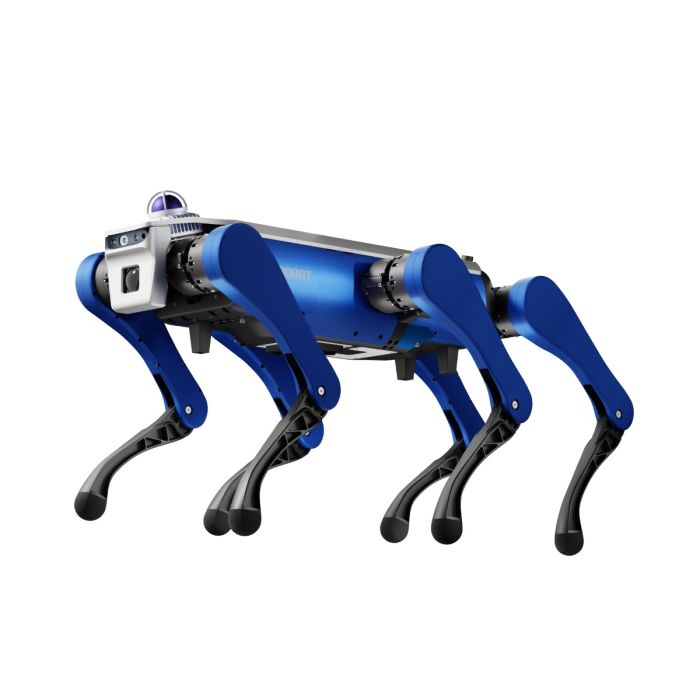
Dobot Hexplorer Six-Legged Bionic Robot
In stock
- ZNAMKA:
- DOBOT
- MODEL:
- HEXPLORER SIX-LEGGED BIONIC ROBOT
- ORIGIN:
- Kitajska
- AVAILABILITY:
- SUBJECT TO AVAILABILITY
- SKU:
- Dobot-Hexplorer
Dobot Hexplorer
Four-legged robots spend their lives solving a problem six-legged ones never have: staying upright. A quadruped balances dynamically — clever, but every step is a controlled fall — while a hexapod in tripod gait keeps three feet planted at every instant, statically stable the way a tripod itself is. The Dobot Hexplorer is that mathematical advantage built into a product: a six-legged bionic robot from Shenzhen Dobot Corp — among the first hexapods of its class ever offered as a tangible commercial platform rather than a laboratory build — engineered for the terrain that unsettles everything else. Its 18 joint-driven degrees of freedom, dynamic centre-of-gravity control and anti-disturbance algorithms carry it across grass, sand, gravel, wet floors, stairs and confined passages at up to 1.8 metres per second, over obstacles to 20 centimetres and up slopes to 40 degrees, with autonomous self-recovery if the terrain wins a round anyway. The stability pays out as work: a rated 10-kilogram payload, towing capability several times the machine's own weight from 33-newton-metre peak-torque joints, and an operating hush of 50 to 55 decibels — library-quiet field robotics. And it arrives developer-ready: Ubuntu 22.04 and ROS2 Humble preconfigured, a full Python and C++ SDK from high-level motion commands to low-level joint control, simulation environments included, and a modular expansion rail prepared for robotic arms, remote video transmission and wireless auto-charging.
The Dobot Hexplorer is available for purchase internationally through this page, with delivery, customs clearance and after-sales support arranged for buyers across Europe, the Americas, the Middle East, Asia-Pacific and worldwide.
Background
From Kickstarter arm to legged flagship
Dobot's story runs from a crowdfunded desktop arm to one of the world's most complete robotics manufacturers — collaborative arms across payload classes, industrial automation, humanoid development, and now legged mobility. That pedigree matters for a hexapod in two ways. First, actuation: Dobot builds precision joint drives for a living, and the Hexplorer's smooth, quiet, high-torque legs are cobot engineering walking. Second, ecosystem: the expansion rail's provision for mounting collaborative arms points at a manufacturer able to supply both halves of a mobile-manipulation platform from its own catalogue — a legged base and the arm it carries, one vendor, one support channel.
Why six legs
Hexapods dominated early legged-robotics research for the same reason insects dominate rough terrain: redundancy. With six legs, a tripod gait keeps a stable support triangle on the ground through every phase of motion — no dynamic balancing act, no vulnerable moment mid-stride — and losing traction on one foot leaves five. The cost was always complexity, which is why the form stayed in laboratories and military programmes for decades while quadrupeds commercialised. The Hexplorer closes that gap: its bionic architecture, terrain-aware gait adaptation from proprioceptive and exteroceptive sensing, and self-recovery behaviours package hexapod stability with product-grade software and support. The result reads like a quadruped with the failure modes deleted — steadier on slopes, calmer under disturbance, harder to tip, and strong enough to tow like a machine twice its class.
Technical Specifications
| Parameter | Dobot Hexplorer |
|---|---|
| Type | six-legged bionic hexapod locomotion platform |
| Degrees of freedom | 18 (three joints per leg) |
| Gait | bionic tripod gait — three legs grounded at all times; dynamic centre-of-gravity control; anti-disturbance and autonomous self-recovery |
| Maximum speed | 1.8 m/s |
| Slope capability | up to 40° |
| Obstacle clearance | up to 20 cm |
| Terrain | grassland, sand, gravel, wet and slippery surfaces, stairs, confined passages |
| Rated payload | 10 kg (higher maximum per configuration) |
| Towing | loads several times the machine's own weight (per manufacturer demonstration) |
| Peak joint torque | 33 N·m |
| Noise | ~50–55 dB in operation |
| Compute | x86_64 architecture; Intel Core i5/i7 options |
| Sensing | IMU and joint encoders; LiDAR (e.g. Livox Mid-360) and RGB-D camera (e.g. RealSense D435) per configuration |
| Software | Ubuntu 22.04 + ROS2 Humble preconfigured; Python and C++ SDK (high-level motion to low-level joint control); simulation environments, debugging tools, examples |
| Expansion | modular rail supporting robotic-arm integration, remote video transmission, wireless auto-charging |
Configuration-dependent figures — sensor fit-out, maximum payload and endurance — are confirmed against the datasheet at quotation.
What makes a hexapod better than a robot dog?
Certainty. A quadruped's stability is an achievement renewed every millisecond by its control loop; a hexapod's is a property of geometry. In tripod gait the Hexplorer is statically stable at every instant — on a 40-degree slope, on wet tile, under a shove, while towing — because three planted feet define a support polygon that doesn't depend on speed or software heroics. That translates directly into field value: sensors ride steadier (sharper inspection imagery), payloads sit safer, disturbances that would stagger a dynamic walker barely register, and the redundancy of six limbs degrades gracefully where four would not. Add the towing strength of its high-torque joints and its near-silent gait — an asset indoors, at night patrols and around wildlife — and the Hexplorer occupies ground the quadruped category genuinely cannot: the missions where falling over is not an acceptable failure mode.
Who is the Hexplorer for?
For research institutions and universities, it is close to purpose-built: a statically stable, 18-DOF legged platform with ROS2 Humble, a two-language SDK, simulation environments and honest documentation is a gait-research, terrain-perception and multi-legged-control curriculum in one crate. For industrial operators — utilities, energy sites, plants, tunnels — it is the inspection carrier for the terrain that defeats wheels and unnerves quadrupeds: slopes, grating, wet passages, rubble margins. For security and facility teams it offers quiet, tireless patrol across large mixed-surface estates. For emergency-response programmes it brings stability and towing strength to reconnaissance and equipment-hauling concepts in hazardous zones. And for education and visitor engagement, a six-legged machine walking with insect calm remains one of robotics' most arresting demonstrations.
What is the Dobot Hexplorer used for?
- Research and education: gait learning, motion control, perception and multi-legged locomotion on a ROS2 platform with full SDK access.
- Industrial inspection: infrastructure, utility tunnels and energy facilities with slopes, steps and unstable footing.
- Security and patrol: quiet autonomous monitoring of industrial areas, campuses and large venues.
- Emergency response and exploration: reconnaissance, search support and heavy towing in hazardous or damaged terrain.
- Field data collection: steady sensor carriage across grass, sand, gravel and wet ground for mapping and monitoring.
- Mobile manipulation development: arm integration via the expansion rail for pick, inspect and intervention research.
Pricing and Availability
The Dobot Hexplorer is available for purchase and international delivery through this page, from single research units to multi-robot programmes for inspection fleets and institutional laboratories. Price and cost depend on configuration — compute option, sensor fit-out, expansion modules and accessories — as well as training, support scope and quantity, so buyers should request a current quotation for their application; delivery, customs clearance and after-sales support are arranged worldwide. Purchase enquiries, datasheets and availability details for the Dobot Hexplorer are available on this page.
Frequently Asked Questions
What is the Dobot Hexplorer?
A six-legged bionic hexapod robot from Shenzhen Dobot Corp — an 18-degree-of-freedom legged platform for research, education, industrial inspection, security patrol and field deployment, and among the first commercial hexapod products of its class.
Why six legs instead of four?
Static stability: the tripod gait keeps three feet planted at every moment, so the robot is stable by geometry rather than by continuous dynamic balancing — steadier on slopes and slippery ground, more resistant to tipping and disturbance, and gracefully redundant if a foot slips.
How capable is it on rough terrain?
It walks at up to 1.8 metres per second, climbs slopes to 40 degrees and obstacles to 20 centimetres, and handles grass, sand, gravel, wet surfaces, stairs and confined passages — with terrain-aware gait adaptation and autonomous self-recovery built in.
How strong is it?
Rated for a 10-kilogram payload with a higher configuration-dependent maximum, driven by joints peaking at 33 newton-metres — and demonstrated towing loads several times its own weight, all at a 50-to-55-decibel operating noise.
Is it suitable for development work?
Thoroughly: it ships with Ubuntu 22.04 and ROS2 Humble preconfigured, a Python and C++ SDK spanning high-level motion commands to low-level joint control, simulation environments, debugging tools and interface examples.
Can it carry sensors or an arm?
Yes — configurations support LiDAR and RGB-D cameras, and the modular expansion rail is designed for robotic-arm integration, remote video transmission and wireless auto-charging, opening a path to mobile manipulation on one platform.
Where can I buy the Dobot Hexplorer and what does it cost?
The Hexplorer is available through this page, with delivery, customs clearance and after-sales support arranged for buyers worldwide. Because cost varies with compute, sensors, expansion modules and quantity, buyers should request an individual quotation. All purchasing details are available on this page.
Summary
The Dobot Hexplorer settles an old argument in legged robotics by shipping it as a product: when the mission cannot tolerate a fall, geometry beats acrobatics. Six legs and a tripod gait give it stability that quadrupeds must continuously earn, and Dobot's actuation pedigree turns that stability into working numbers — 10 kilograms carried, multiples of its weight towed, 40-degree slopes climbed, all at a whisper. With ROS2, a full SDK and an expansion rail waiting for arms and modules, it serves the laboratory as readily as the utility tunnel. For buyers whose terrain, payloads or uptime demands have outgrown the four-legged compromise, the six-legged answer is finally on the market — and this page is the starting point.
Specifications
General
Mobility
Performance
Sensors
Software
Battery + Power
What's included
Dobot Hexplorer
Remote Controller
Charger