
Richtech Robotics Dex Stationary
In stock
- ZNAMKA:
- Richtech Robotics
- MODEL:
- Dex Stationary
- Warranty:
- 12 MONTHS
- AVAILABILITY:
- SUBJECT TO AVAILABILITY
- SKU:
- Richtech-Dex-Stationary
Richtech Robotics Dex Stationary
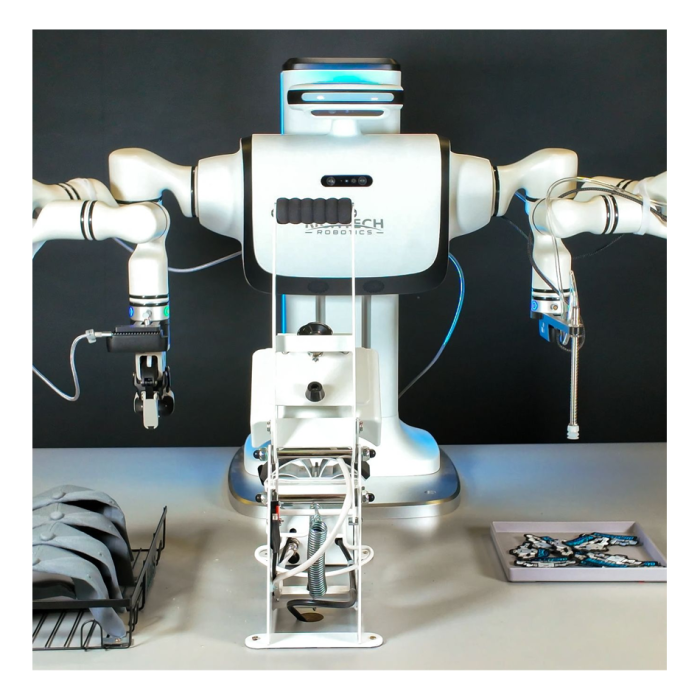
Richtech Robotics Dex Stationary is the fixed upper-body configuration of Richtech Robotics’ industrial humanoid platform, described by the manufacturer as approaching launch. It stands 3 ft 7 in, or 109.2 cm, and uses continuous power. Published shared platform specifications include 11 lb payload per arm, four task cameras, and an NVIDIA Jetson Thor computer.
Background
Richtech Robotics and the Dex program
Richtech Robotics introduces Dex as an industrial humanoid platform for manufacturing, logistics, and warehouse applications. The official page describes simulation-to-real training and modular end effectors. Its launch-oriented wording means project readiness and availability require direct confirmation.
Positioning of the stationary platform
The stationary configuration emphasizes repetitive work at a fixed location and continuous power. This listing is separate from Dex Mobile: mobile battery runtime, charging time, autonomous travel sensors, and floor-traversal limits are not stationary specifications. End-effector selection and workcell integration remain project-specific.
Technical Specifications
The table below lists only the attributes the manufacturer attributes to the stationary configuration or to Dex as a whole.
| Attribute | Detail |
|---|---|
| Configuration | Stationary platform (fixed base) |
| Height | 3 ft 7 in (109.2 cm) |
| Payload capacity | 11 lb per arm |
| Task vision system | 4 cameras (2 depth, 2 arm-mounted) |
| Onboard computer | NVIDIA Jetson Thor |
| Power | Continuous power (no battery dependency) |
| End effectors | Modular, swappable for different jobs |
| Training method | Sim2Real (simulation training refined in real-world testing) |
| Software updates | Over-the-air updates with scalable AI capabilities |
All figures above are manufacturer-published specifications for a product that has not yet launched; they may be revised before general availability, so confirm current values during the quotation process.
How does the Dex Stationary learn and adapt to new tasks?
Richtech Robotics describes a hybrid training pipeline the company calls Sim2Real. Skills are first developed in simulation, where the robot can rehearse task variations at scale, and are then fine-tuned through real-world testing. The manufacturer's stated aim is a faster and safer rollout than training exclusively on physical hardware would allow. On the perception side, the four-camera task vision system — two depth cameras plus two arm-mounted cameras — feeds multimodal sensing that the company says supports obstacle detection, object recognition, and real-time decision-making in complex industrial environments. Over-the-air updates are intended to deliver new capabilities after deployment. How quickly a specific task can be trained for a specific facility is not quantified in the source material, so buyers should treat task-adaptation timelines as a question for the manufacturer.
How is the stationary platform different from the mobile version?
The fundamental distinction is mobility and power. The stationary platform operates from a fixed base on continuous power, which removes battery runtime and recharge cycles from the operating equation and suits workcells where the task comes to the robot. The mobile platform, by contrast, is built to navigate changing spaces and carries its own navigation sensing and battery system. Both configurations share the elements the manufacturer applies across the Dex line: 11 lb payload per arm, the four-camera task vision system, the NVIDIA Jetson Thor computer, modular end effectors, and Sim2Real training. Navigation-related specifications belong to the mobile variant only and should not be assumed for the stationary unit described on this page.
Who is Richtech Robotics Dex Stationary for?
Dex Stationary is intended for industrial engineering teams evaluating fixed-position manipulation. Potential pilot tasks should be selected around actual parts, tooling, fixtures, and supervision requirements. Continuous power removes the mobile charging schedule, but does not establish uninterrupted production, autonomous recovery, or guaranteed throughput.
What is Richtech Robotics Dex Stationary used for?
The following are proposed evaluation scenarios consistent with the manufacturer's description of repetitive, high-precision fixed-station work; they are suggestions for pilot planning, not certified capabilities.
- Machine-tending trials at a fixed cell, loading and unloading parts within the 11 lb per-arm payload envelope.
- Kitting and order-consolidation stations in warehouses, assembling sets of components or goods at a bench.
- Repetitive pick-and-place or sorting of parts presented at a fixed workstation, guided by the camera-based vision system.
- Packing and carton-preparation tasks on logistics lines where items arrive by conveyor to a stationary post.
- Bench-level assembly assistance, performing repeatable sub-steps alongside human workers who handle exceptions.
- Vision-assisted inspection-support trials, using the depth and arm-mounted cameras to present or reposition items for checking.
Pricing and Availability
Dex Stationary is explicitly a prelaunch product: Richtech Robotics is collecting interest and offering detailed specifications, roadmap updates, and demo opportunities as launch approaches, and no shipping or stock promises can be made at this stage. Pricing is handled on a quotation basis rather than published list pricing, which is typical for industrial humanoid platforms where end effectors, integration, and support shape the final figure. To move forward, submit a quote request with your application details — task type, payload, cycle expectations, and site conditions — and you will receive purchase details on this page through the quotation process, including configuration options and projected availability as the manufacturer confirms them.
Frequently Asked Questions
Is the Dex Stationary available to order right now?
No firm delivery commitment exists yet. The manufacturer describes Dex as approaching launch and is sharing specs, roadmap updates, and demo opportunities with interested parties in the meantime. A quote request is the practical way to register interest and be informed when ordering opens.
How much weight can the Dex Stationary handle?
The published payload capacity is 11 lb per arm. The source does not state a combined two-arm lifting figure or reach dimensions, so plan trials around the per-arm rating and confirm anything beyond it with the manufacturer.
What vision hardware does the robot use?
The task vision system comprises four cameras: two depth cameras and two arm-mounted cameras. The manufacturer states this multimodal sensing supports obstacle detection, object recognition, and real-time decision-making during manipulation.
Can the hands or tooling be changed for different jobs?
Yes. Dex uses modular end effectors that, according to the manufacturer, allow it to take on varied jobs across manufacturing, logistics, and warehouse settings without costly reconfiguration. Which specific effector options ship at launch is not detailed in the source material.
Does the Dex Stationary need charging or battery swaps?
No. The stationary platform runs on continuous power, so there is no battery runtime or recharge cycle to manage. As general deployment advice, confirm your facility's electrical provisioning and workcell layout requirements with the manufacturer during the quotation stage.
Will the robot improve after it is installed?
The manufacturer states that Dex receives over-the-air updates and scalable AI capabilities, meaning software-delivered improvements are part of the product concept. The cadence, content, and any subscription terms of those updates are not specified in the source and should be clarified before purchase.
Where can I buy Richtech Robotics Dex Stationary and what does it cost?
Because the product is prelaunch, there is no published price, and all pricing is provided by individual quotation. Submit a quote request from this page with your application requirements; you will receive a tailored quotation along with availability and configuration information as the launch timeline firms up. No stock or delivery-date promises are made at this stage.
Summary
The Richtech Robotics Dex Stationary is a 3 ft 7 in fixed-base industrial humanoid built for repetitive, high-precision work on continuous power, pairing 11 lb-per-arm manipulation with a four-camera vision system, an NVIDIA Jetson Thor computer, modular end effectors, and Sim2Real training backed by over-the-air updates. It is a prelaunch platform, so current engagement means quotation requests, demo opportunities, and roadmap updates rather than immediate delivery. For organizations weighing a fixed-station humanoid pilot, this page is the starting point