
Unitree Go2 Ent Quadruped Robot (GO2-ENT)
In stock
- ZNAMKA:
- UNITREE ROBOTICS
- MODEL:
- GO2-ENT
- DEL #:
- GO2-ENT
- ORIGIN:
- Kitajska
- AVAILABILITY:
- SUBJECT TO AVAILABILITY
- SKU:
- Unitree-GO2-ENT
Unitree Go2 Ent Quadruped Robot (GO2-ENT)
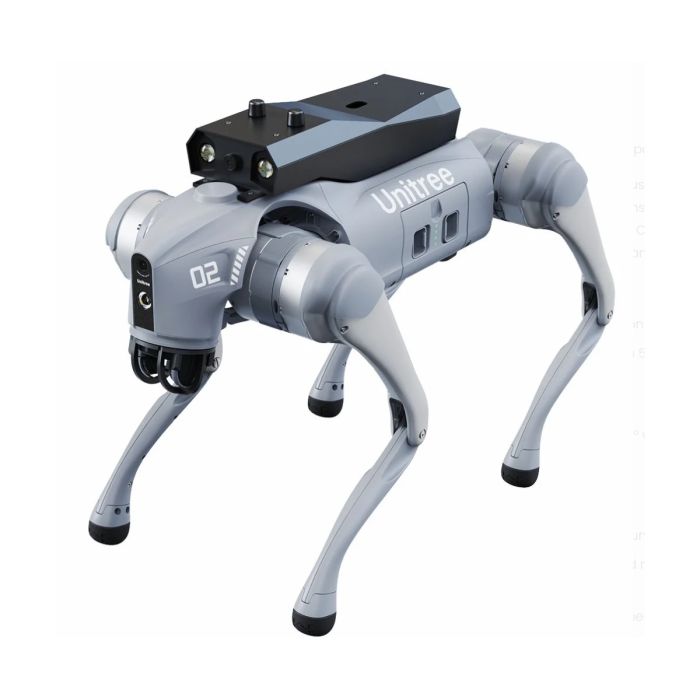
Most quadruped robots are judged on how they move. The Unitree Go2 Ent is judged on what it sends back. Unitree's enterprise version of the Go2 keeps the agile, 15 kg legged body of the series. It adds a professional communications package: a 5.8 GHz main link that carries both control and high-definition video, a full-network 4G backup channel and a handheld controller with its own screen. The Go2 Ent was built for security patrol, site inspection, search and rescue and surveillance. It puts a camera on the ground where a person would rather not be, and it keeps that picture flowing to the operator in real time.
Background and Position in the Go2 Family
Unitree Robotics, based in Hangzhou, launched the Go2 series as the successor to the Go1. It moved the whole line to a self-developed 4D LiDAR, stronger joint motors and AI-trained gaits. The family is tiered by user. Air and Pro serve consumers and enthusiasts, Edu serves researchers and developers, and Ent, short for Enterprise, serves industry, public safety and commercial operators.
Edu and Ent are built for different jobs. Edu is an open development platform. Ent is a field tool. Unitree ships Ent as a ready-to-deploy package with an operator controller and long-range video transmission, aimed at teams that need a working inspection or patrol asset rather than a research base. Three mission variants extend it further: Ent Plus for public safety, Ent MTPTZ for thermal inspection and Ent GAS for atmospheric monitoring.
Design and Engineering
The Go2 Ent shares the series chassis. It is made of aluminum alloy and high-strength engineering plastic, measures about 70 × 31 × 40 cm standing and weighs about 15 kg with its battery. Twelve aluminum joint motors give it three degrees of freedom per leg, with peak joint torque of about 45 N·m. Internal joint wiring and heat-pipe cooling keep the motors running steadily under sustained load. The robot climbs steps of about 16 cm and slopes of up to 40°. It carries a working payload of about 8 kg.
The robot's perception comes from Unitree's 4D LiDAR, which scans a 360° × 90° hemisphere. Its blind spot is very small and it can detect objects as close as 0.05 m. That lets the Go2 Ent avoid obstacles autonomously and build point cloud maps for route planning. Foot-end force sensing and Unitree's simulation-trained locomotion keep the robot stable on uneven ground.
The Ent communications system is what sets it apart from the rest of the family. Its main 5.8 GHz link carries telemetry and digital video together as one signal. If that link drops, an all-network 4G channel takes over as a backup. Video arrives at 1080P with latency as low as about 180 ms. The system can carry two 1080P channels at once and accepts a standard Ethernet video stream input. The standard imaging system uses dual 1080P cameras with a 120° wide-angle view and four high-brightness fill lights for low-light work. Operators fly the robot from a handheld controller with a ruggedized built-in screen, so no separate tablet is needed.
Technical Specifications
| Parameter | Unitree Go2 Ent |
|---|---|
| Dimensions (crouching) | approx. 76 × 31 × 20 cm |
| Working payload | approx. 8 kg |
| Battery | Quick-release smart battery, long-endurance pack available |
| Not supported | Depth camera, servo arm, add-on LiDAR |
Configurations
Go2 Ent: This is the base enterprise package with the screen controller, dual-link communications and dual-camera imaging. It suits routine inspection and surveillance.
Go2 Ent Plus: This version adds public-safety hardware: a 30 W, 3,000-lumen searchlight, a 10 W red and blue warning light with several flash modes, and a digital loudspeaker that carries roughly 500 to 800 m. Operators can shout in real time, play recordings, use text-to-speech and control the lighting from the controller.
Go2 Ent MTPTZ: This version fits a three-axis stabilized dual-light head with a 640 × 512 thermal sensor in the 8 to 14 µm band. It measures temperatures from −20 °C to +550 °C across two gain ranges. Pan, tilt and roll are all controllable. It is built for equipment inspection and for finding people in smoke or darkness.
Go2 Ent GAS: This version is built on the Go2 Edu base. It carries sensors for oxygen, carbon monoxide, carbon dioxide, methane, hydrogen sulfide and benzene, plus temperature and humidity. Readings appear in the official Go2 app.
Who It Is For
The Go2 Ent serves organizations that need remote eyes on a site more than they need a programmable research robot. Typical buyers include security firms and facility managers running patrols, industrial plants inspecting equipment, utilities and transport operators checking infrastructure, and emergency and public-safety teams that need reconnaissance before sending people in. Teams that plan to write their own code, mount robotic arms or add sensors should look at the Go2 Edu instead.
Applications
Security patrol: Night and perimeter rounds with live 1080P video. The 4G backup link keeps the feed going beyond the 5.8 GHz range.
Industrial inspection: Walk-throughs of plants, substations, tunnels and pipe galleries. Gauges, leaks and anomalies are recorded without exposing staff to the area.
Search and rescue: Low-profile reconnaissance of collapsed or smoke-filled spaces. The Plus and MTPTZ variants add lighting, audio contact and thermal detection.
Hazardous atmospheres: The GAS configuration samples air quality in confined or contaminated areas before a person enters.
Public events and incident response: A mobile camera and loudspeaker platform for crowd guidance and on-scene awareness.
Pricing and Availability
The Unitree Go2 Ent is supplied by quotation. The final cost depends on the configuration you choose (Ent, Ent Plus, Ent MTPTZ or Ent GAS), any extra batteries or charging equipment, the delivery destination and import duties. Every unit is sourced through the manufacturer's official channels and comes with full manufacturer warranty, documentation and technical support, plus guidance on choosing the right variant for your mission. Quotations for the Unitree Go2 Ent, including volume and fleet orders, are available on this page.
Frequently Asked Questions
What is the difference between the Go2 Ent and the Go2 Edu?
The Go2 Ent is a ready-to-deploy field package with a screen controller, a 5.8 GHz video link and a 4G backup. The Go2 Edu is an open development platform that supports custom code, robotic arms and extra sensors.
How does the Go2 Ent transmit video?
Its main 5.8 GHz link carries control and 1080P video together with latency as low as about 180 ms. An all-network 4G channel takes over as a backup if the main link drops.
Can the Go2 Ent work at night?
Yes. The standard dual-camera system has four high-brightness fill lights. The Ent Plus adds a 3,000-lumen searchlight, and the MTPTZ adds thermal imaging.
Does the Go2 Ent avoid obstacles on its own?
Yes. Its 4D LiDAR scans a 360° × 90° field and detects objects as close as 0.05 m, so the robot avoids obstacles autonomously and supports point cloud mapping.
Can I add a robotic arm or extra LiDAR to the Go2 Ent?
No. The Ent, Ent Plus and Ent MTPTZ do not support a servo arm, add-on LiDAR or a depth camera. Projects that need those should use the Go2 Edu.
Which Go2 Ent variant is best for inspection?
The base Go2 Ent covers visual inspection. The Ent MTPTZ adds thermal measurement up to 550 °C for electrical and mechanical equipment. The Ent GAS adds air-quality monitoring for confined spaces.
Where can I buy the Unitree Go2 Ent and what does it cost?
You can buy the Unitree Go2 Ent right here. The price depends on the configuration, accessories and delivery destination, and you can request a quotation for your exact setup on this page.
Summary
The Go2 Ent turns Unitree's most agile compact quadruped into a field communications asset. It carries a live picture and a backup link into places where sending a person would be slow, costly or unsafe. Its 4D LiDAR handles the terrain and its dual-link video handles the reporting. Three mission variants add searchlights, thermal vision or gas sensing for the job. For security teams, plant operators and first responders choosing their first enterprise robot dog, this page is the starting point.