
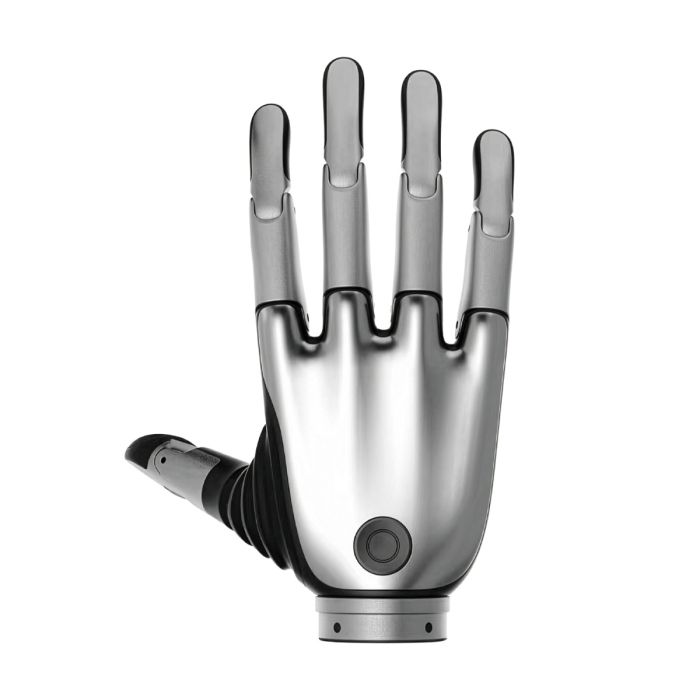
BrainCo Revo 2 Pro Dexterous Right Hand (XER)
In stock
- BRANDA:
- BRAINCO
- MÚNLA:
- REVO 2 PRO
- CUID #:
- XER
- ORIGIN:
- China
- Warranty:
- 12 MONTHS
- AVAILABILITY:
- SUBJECT TO AVAILABILITY
- SKU:
- BrainCo-Revo-2-Pro
BrainCo Revo 2 Pro Dexterous Right Hand (XER)
Before a robot hand can grasp anything, someone has to decide where its cable leaves the wrist. That small question shapes a whole integration, and it is where the BrainCo Revo 2 Pro Dexterous Right Hand (XER) starts to make sense: a bionic dexterous hand for robot integration and research whose communication interface sits below the wrist and speaks three different protocols.
Robots Europa, based in Dublin, sells this hand to research groups and robot builders across the EU and the DACH region. Robots Europa prepares the quotation, arranges delivery and provides support for the supply. Send us your robot platform, your intended control bus and your research goals, and the quotation will address your application rather than simply name a part.
Background
BRAINCO and the Revo 2 family
BRAINCO is the brand behind the Revo 2 series of bionic hands. The series is offered in three versions: Basic (XRL/XRR), Pro (XEL/XER) and Touch (XTL/XTR). In each pair the first code is the left hand and the second the right. This page concerns the Pro version in its right-hand form, code XER. Its left-hand counterpart, the BrainCo Revo 2 Pro Dexterous Left Hand (XEL), shares the Pro designation.
Our material describes the product rather than the company, so we offer no history of BRAINCO and no account of how the Revo 2 grew out of earlier designs. What it does establish is the purpose: the Revo 2 is a bionic dexterous hand for robot integration and research. The whole family is organised around that purpose, and the wider range can be browsed in the BrainCo Revo 2 category.
Positioning and key technology of the Pro version
Across the series the hand provides 6 active joints and 11 degrees of freedom. The thumb has two active degrees of freedom for abduction and adduction, as well as one passive degree of freedom for flexion and extension. Each of the remaining four fingers has one active and one passive degree of freedom for flexion and extension. The result is a hand in which a modest number of actuators drives a larger number of articulations, a common approach in robotic hands where the passive joints follow the active ones.
The control side is equally specific. The hand includes closed-loop servo control, custom gesture definitions, and protections for current, stall, high temperature and collision conditions. For software, the series offers SDK support for Linux, Windows and ROS workflows. What distinguishes the Pro version is its communication: it supports three interfaces, 485, CAN FD and EtherCAT, for communication and control, with the interface located below the wrist.
Technical Specifications
| Specification | Value |
|---|---|
| Product type | Bionic dexterous hand for robot integration and research |
| Version and code | Pro, XEL/XER (this page: XER, right hand) |
| Active joints | 6 |
| Degrees of freedom | 11 |
| Thumb | Two active degrees of freedom (abduction and adduction); one passive degree of freedom (flexion and extension) |
| Four remaining fingers | Each one active and one passive degree of freedom (flexion and extension) |
| Communication interfaces | 485, CAN FD, EtherCAT |
| Interface location | Below the wrist |
| SDK support | Linux, Windows, ROS |
| Control | Closed-loop servo control; custom gesture definitions |
| Protections | Current, stall, high temperature, collision |
Specifications as published by the manufacturer; confirmed against the datasheet at quotation.
The manufacturer has not published the dimensions, the wrist mounting dimensions, the material, the IP rating or the service life; they are confirmed at quotation.
What makes the Pro version different from the Basic and Touch versions?
The family is separated by version code and by communication. The advanced version and the tactile version are the ones that support three interfaces: 485, CAN FD and EtherCAT. The Pro (XEL/XER) is the advanced version, and the Touch (XTL/XTR) is the tactile one. For a team whose robot already runs an EtherCAT or CAN FD network, that matters more than any difference in finger count, because the joint layout, the SDK support and the protections apply to the whole series.
In practice this means a buyer is choosing between versions on the basis of how the hand will be wired and what it should sense, not on how many fingers it has. If your controller speaks one protocol only, a hand that offers three gives you room to change the architecture later without changing the hand. If you are still weighing the entry version, the BrainCo Revo 2 Basic Right Dexterous Bionic Hand (XRR) is the sibling to compare; ask us about its interfaces when you request a quotation.
How does the hand's joint layout shape grasping?
With 6 active joints driving 11 degrees of freedom, the hand is built around the idea that not every articulation needs its own actuator. The thumb is the most capable digit, with two active degrees of freedom for abduction and adduction, which is the motion that lets it move across the palm towards the fingers. Flexion and extension of the thumb are passive.
The four other fingers each combine one active and one passive degree of freedom for flexion and extension. For a research team, this layout defines the control problem: six active joints are what the software commands, and custom gesture definitions let you store the postures your experiments need. Closed-loop servo control means those commands are tracked against feedback rather than issued blindly, and the protections for current, stall, high temperature and collision conditions are there for the moments when a trial does not go as planned.
Who is the BrainCo Revo 2 Pro Dexterous Right Hand (XER) for?
The first group is robotics research laboratories that study manipulation and need a hand they can command through a standard bus. SDK support for Linux, Windows and ROS means the hand fits the software environments in which such laboratories already work.
The second group is companies building humanoid or other manipulation platforms who need an end effector for the right side of the robot. This is the right-hand version; a robot that needs both hands will also want the left-hand Pro (XEL). The third group is integrators whose control cabinet is built around EtherCAT or CAN FD, for whom the three-interface Pro version is a sensible match.
Teams whose research depends on tactile sensing should look at the Brainco Revo 2 Touch Biomimetic Dexterous Right Hand (XTR), the tactile version of the same series. Buyers who want the simplest entry into the family can start from the Basic version. Other hands from the wider catalogue are listed under Lámha.
What is the BrainCo Revo 2 Pro Dexterous Right Hand (XER) used for?
- Robot integration. Fitting a bionic hand to an arm or humanoid platform as its right-hand end effector.
- Manipulation research. Studying how a multi-jointed hand grasps objects under different control strategies.
- Gesture programming. Defining custom gestures and calling them from the control software.
- Fieldbus testing. Connecting the hand through 485, CAN FD or EtherCAT to evaluate which bus suits a given robot.
- Software development. Writing and testing control code with the SDK under Linux, Windows or ROS.
- Teaching and demonstration. Showing students and visitors how a robotic hand with active and passive joints behaves.
Pricing and Availability
Robots Europa supplies this hand on a quotation basis. Tell us your robot platform, your control interface and your application, and we will prepare a quotation tailored to it. Delivery, customs and support are arranged together with the quotation, so that the supply to your site in the EU or the DACH region is settled in one step. Everything we can state about this hand today is available on this page.
Frequently Asked Questions
Is this the left or the right hand?
This page is for the right hand, code XER. The left-hand Pro version carries the code XEL and has its own page.
Which communication interfaces does it support?
The Pro version supports 485, CAN FD and EtherCAT for communication and control. The interface is located below the wrist.
How many joints and degrees of freedom does it have?
The hand has 6 active joints and 11 degrees of freedom. The thumb has three of those degrees of freedom and each of the other four fingers has two.
Which software environments does the SDK cover?
The SDK supports Linux, Windows and ROS workflows.
What protections does the hand include?
It includes protections for current, stall, high temperature and collision conditions, together with closed-loop servo control and custom gesture definitions.
Can I get the dimensions, material and IP rating?
Ask Robots Europa for them when you request your quotation, so that you can check the fit against your robot before you order.
Where can I buy the BrainCo Revo 2 Pro Dexterous Right Hand (XER) and what does it cost?
You can buy it from Robots Europa by requesting a quotation through this page. The cost is set in the quotation, which reflects your project and the delivery arrangements.
Summary
The question of where the cable leaves the wrist is really a question about whether a hand will fit into a working robot. The BrainCo Revo 2 Pro Dexterous Right Hand (XER) answers it with an interface below the wrist, three communication options, 6 active joints driving 11 degrees of freedom, SDK support for Linux, Windows and ROS, and protections that cover current, stall, temperature and collision. If your project needs a right-hand bionic end effector for integration or research, this page is the starting point.
Specifications
General
Physical
Mobility
Performance
Connectivity
Software
Hand
Feature
1. High quality and stability – five years of product iteration and professional production lines.
2. Lightweight (383 grams), with 5 kg active grip force, 20 kg single-hand load capacity, and a grip-to-weight ratio of 53.
3. Ergonomic Bionic Design – supports curved surface grasping with anti- collision finger design.
4. Multi-dimensional tactile perception – pressure, friction, direction, proximity, and surface texture.
5. High Sensitivity Tactile Perception – max resolution of 0.01N.
6. Wide voltage support – 64V.
7. Universal Interfaces – RS485 & CAN-FD, and EtherCAT.
8. Standard Protocols and SDKs – Modbus & Protobuf protocols, SDKs for Python / C / ROS.


