
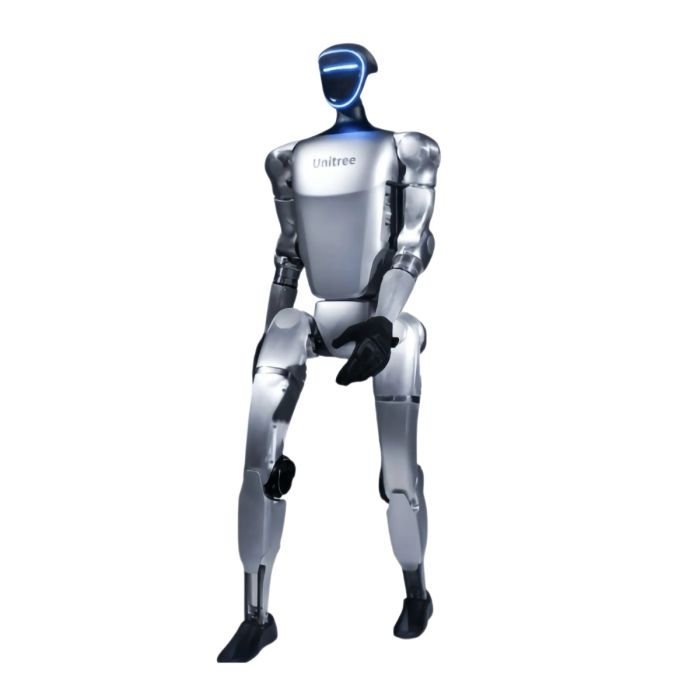
Unitree G1 Ultimate B Humanoid Robot with 3 Finger Hands with Tactile Sensor (G1EDU-U4)
In stock
- ZNAMKA:
- UNITREE ROBOTICS
- MODEL:
- G1 EDU ULTIMATE B
- DEL #:
- G1EDU-U4
- ORIGIN:
- Kitajska
- Warranty:
- 18 MONTHS
- AVAILABILITY:
- SUBJECT TO AVAILABILITY
- SKU:
- Unitree-G1-Edu-U4
Unitree G1 Ultimate B Humanoid Robot with 3 Finger Hands with Tactile Sensor (G1EDU-U4)
Picking up an egg, a screwdriver and a paper cup takes three very different grips, and a robot only learns the difference if it can feel what it is holding. The Unitree G1 EDU U4 is built for exactly that research. It takes the full-specification G1 humanoid body and adds two dexterous hands lined with tactile sensors, giving labs a walking, programmable platform that registers contact as well as position.
Among the G1 EDU configurations, the U4 is the touch-sensing flagship. It shares the 43-degree-of-freedom body, 3-axis waist and 7-axis arms of the U3. The difference is that its Dex3-1 hands report pressure across the fingertips and palm, so researchers can build closed-loop grasping, train visuotactile policies and collect richer demonstration data than vision alone provides.
Background
Unitree Robotics introduced the G1 in 2024 as a compact, affordable humanoid. It quickly became one of the most widely used research humanoids in universities and AI labs. The range is split in two: the base G1, which is driven by remote control and doesn't support custom code, and the G1 EDU, which opens up full high-level and low-level secondary development.
Within the EDU family, the U-numbers describe hardware configurations of the same platform:
- U1 is the entry development version with 23 degrees of freedom.
- U2 adds the 3-axis waist and 7-axis arms.
- U3 adds Dex3-1 three-finger hands.
- U4 upgrades those hands with tactile sensing.
- U5 and U6 use five-finger hands instead.
The U4 therefore suits teams whose work depends on contact-rich manipulation.
Design and Features
Tactile Dex3-1 Hands
Each of the two Dex3-1 hands has three fingers and 7 degrees of freedom, with 33 tactile sensors spread over the fingertips and palm. Hybrid force-position control lets the hand switch between a gentle, compliant hold for fragile objects and a firm, positioned grip for tools, and the tactile data closes the loop by confirming when contact is made and how secure the grasp is.
Full 43-Degree-of-Freedom Body
The joints break down as six per leg, a 3-axis waist, seven per arm and seven per hand. The extra waist and arm freedom lets the G1 lean, twist and reach in ways the entry configurations can't, so it can work at a bench, pick from the floor and manipulate objects at different heights.
Onboard AI Compute
A dedicated NVIDIA Jetson Orin NX development computer with 16 GB of memory delivers 100 TOPS of AI performance for perception, learned policies and on-robot inference. It runs alongside an 8-core CPU that handles real-time motion control.
Perception
A Livox MID-360 3D LiDAR provides all-round spatial mapping, and an Intel RealSense D435i depth camera adds close-range 3D vision for manipulation. A four-microphone array and a 5 W speaker support voice interaction.
Robust, Compact Hardware
Knee joints deliver up to 120 N·m of torque. Every joint has dual encoders and industrial-grade crossed roller bearings, and wiring runs through hollow joints so no cables are exposed. The robot stands 1.32 metres tall, weighs about 35 kilograms and folds to 69 centimetres for transport.
Quick-Swap Power
A 9,000 mAh smart battery gives about two hours of operation and releases in seconds, so labs can keep the robot running across a session by rotating charged packs.
Technical Specifications
| Item | Specification |
|---|---|
| Model | Unitree G1 EDU U4 (Ultimate B) |
| Height / folded | 1,320 mm / 690 mm |
| Weight | Approx. 35 kg |
| Total degrees of freedom | 43 |
| Leg / waist / arm | 6 per leg / 3 / 7 per arm |
| Hands | 2 × Dex3-1 three-finger, 7 DOF each |
| Tactile sensing | 33 sensors per hand |
| Max knee torque | 120 N·m |
| Arm payload | Approx. 3 kg |
| Development computer | NVIDIA Jetson Orin NX 16 GB, 100 TOPS |
| Motion computer | 8-core high-performance CPU |
| Sensors | Livox MID-360 3D LiDAR, Intel RealSense D435i depth camera |
| Audio | 4-microphone array, 5 W speaker |
| Battery | 9,000 mAh quick-release, approx. 2 hours |
| Connectivity | Wi-Fi 6, Bluetooth 5.2 |
| Development | High- and low-level secondary development, SDK, ROS 2 support |
| In the box | Robot, two Dex3-1 tactile hands, remote controller, battery, charger, debugging and protection gantry |
Who Should Buy the G1 EDU U4
- University robotics and AI labs working on manipulation, grasping and humanoid control.
- Embodied AI teams training vision-language-action models and imitation-learning policies that benefit from touch data.
- Industrial R&D groups testing whether humanoids can handle assembly, kitting and parts handling.
- Robotics teaching programmes that want students to work with a complete, current-generation platform.
Teams focused only on locomotion or reinforcement-learning gait research may find the U1 or U2 sufficient. The U4's value lies in its hands.
Applications
- Tactile grasping research: slip detection, grip-force regulation and handling of deformable or fragile objects.
- Teleoperation and data collection: recording rich demonstrations, including contact data, to train manipulation policies.
- Sim-to-real transfer: validating policies trained in NVIDIA Isaac Sim or MuJoCo on real hardware.
- Mobile manipulation: combining walking, LiDAR navigation and hand work in one task sequence.
- Human-robot interaction: voice, gesture and handover experiments.
- Demonstrations and outreach: showcasing advanced humanoid capability at events and open days.
Pre-Sale, Setup, Deployment and Ongoing Support
Pre-Sale Consultation
Choosing between the six G1 EDU configurations is the most important decision in the purchase. Before quoting, specialists review your research goals, the manipulation tasks involved, your software stack and your budget, then confirm whether the U4's tactile hands are the right fit or whether another configuration would serve better. Datasheets, configuration comparisons and answers on spare batteries, accessories and lead times are provided at this stage.
Setup
Each robot ships with a debugging and protection gantry for safe first use. Setup covers unpacking and inspection, gantry assembly, battery and charger checks, first power-on, firmware updates, network and remote-controller pairing, and a joint and hand calibration check. Safe operating procedures, including fall protection and emergency stops, are covered before the robot leaves the gantry.
Deployment
Deployment gets your team productive with the robot. That includes configuring the Jetson development computer, installing the SDK and ROS 2 environment, connecting simulation tools, and walking through sample programs for locomotion, arm control and tactile hand feedback. Training can be arranged for researchers, technicians and students, so the platform is in active use from the first week.
Ongoing Support
After delivery, support continues through the manufacturer warranty, with technical troubleshooting, guidance on firmware and software updates, diagnosis of hardware faults, and supply of spare parts, batteries and replacement components. Help is also available as projects grow, whether that means adding robots, upgrading hands or expanding into new research areas.
Pricing and Availability
The Unitree G1 EDU U4 is available for purchase and international delivery through this page, for single research units and multi-robot lab installations alike. Price and cost depend on quantity, spare batteries, accessories, training scope and delivery destination, so buyers should request a current quotation. Delivery, customs clearance, setup, deployment and after-sales support are arranged worldwide. Purchase enquiries, datasheets and availability details for the G1 EDU U4 are available on this page.
Frequently Asked Questions
What is the Unitree G1 EDU U4?
The G1 EDU U4, also called the Ultimate B, is the research version of Unitree's G1 humanoid with 43 degrees of freedom, a Jetson Orin computer and two Dex3-1 three-finger hands with tactile sensing.
What is the difference between the G1 EDU U3 and U4?
Both have the same 43-degree-of-freedom body and Dex3-1 hands. The U4's hands add 33 tactile sensors each, so the robot can feel contact and grip force.
Can I program the G1 EDU U4?
Yes. The EDU versions support full high-level and low-level secondary development through Unitree's SDK, with ROS 2 support and compatibility with common simulation tools.
How long does the battery last?
About two hours per 9,000 mAh pack. The battery releases quickly, so spare packs keep the robot running through longer sessions.
How much can the G1 EDU U4 lift?
Each arm handles approximately 3 kilograms, which suits tools, components and everyday objects.
What support is included with the G1 EDU U4?
Pre-sale configuration advice, setup and calibration, deployment of the development environment with training, and ongoing technical support, spare parts and warranty service after delivery.
Where can I buy the Unitree G1 EDU U4 and what does it cost?
The G1 EDU U4 is available for purchase through this page. Quotations, specifications, delivery arrangements and support options are provided on request.
Summary
The Unitree G1 EDU U4 gives research teams a complete humanoid that can walk, reach and feel. Its tactile Dex3-1 hands, 43-degree-of-freedom body and onboard Jetson Orin computer make it one of the most capable platforms for contact-rich manipulation and embodied AI, and full support from pre-sale advice through setup, deployment and beyond helps labs put it to work quickly. For any team investing in touch-enabled humanoid research, this page is the starting point.
Specifications
General
Physical
Mobility
Performance
Computing
Sensors
Connectivity
Software
Battery + Power
Shipping
Feature
| Equipped with all the functions of G1-Edu standard version |
| Upgraded from 1 to 3 degrees of freedom in the waist. |
| Single arm freedom upgraded from 5 to 7, both arms upgraded. |
| Up to 29 DOF for whole robot |