
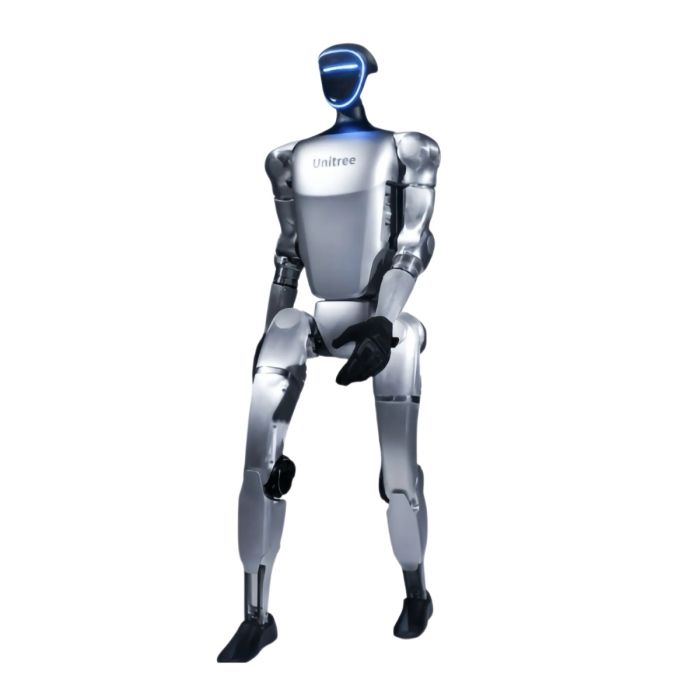
Unitree G1 Edu Standard Humanoid Robot with Fake Hands (G1EDU-U1)
In stock
- BRAND:
- UNITREE ROBOTICS
- MODEL:
- G1 EDU STANDARD
- PART #:
- G1EDU-U1
- ORIGIN:
- China
- Warranty:
- 18 MONTHS
- AVAILABILITY:
- SUBJECT TO AVAILABILITY
- SKU:
- Unitree-G1-Edu-Standard
Unitree G1 Edu Standard Humanoid Robot with Fake Hands (G1EDU-U1)
A humanoid that stands 1320mm tall yet folds to 690mm for the journey between laboratory and lecture hall poses a simple question to whoever unpacks it: what will you teach it to do? The Unitree G1 Edu Standard Humanoid Robot with Fake Hands (G1EDU-U1) is built around that question. It is less a finished appliance than a capable body, with legs, a waist, depth sensing, 3D LiDAR and an 8-core onboard computer, offered with the secondary development access that turns a demonstration robot into a working research platform.
Robots Europa, based in Dublin, supplies the G1EDU-U1 to universities, research institutes and companies across the European Union and the DACH region. Robots Europa prepares each quotation for the specific configuration requested, arranges delivery to the customer's site and remains the point of contact for support once the robot is in service.
Background
Unitree Robotics and the G1 family
Unitree Robotics became widely known through its quadruped robots before moving into full-size humanoids. The G1 is the company's compact humanoid line, billed as a "humanoid agent AI avatar": a bipedal platform intended to carry the rapid progress in AI-driven robot control into a body that people can actually work with day to day. The line receives continuous over-the-air software updates and is linked to Unitree's UnifoLM robot model work, which signals that the platform is expected to keep evolving after delivery.
Within the family, Unitree's own parameter table distinguishes two columns, the G1 and the G1 EDU. The EDU column is the one that applies to this product, and it is the column that opens the robot to secondary development.
The EDU platform and its Standard configuration
The G1 EDU is the developer-facing version of the G1. It shares the mechanical envelope of the base model but raises the maximum knee joint torque, raises the arm load, widens the possible joint count and adds secondary development, documented by Unitree in a dedicated manual. It also supports an optional high computing power module, with Orin among the available options.
The Standard configuration with fake hands sits at the entry point of the EDU range. It keeps the EDU's development access, sensors and drive train while leaving dexterous hands to the higher configurations, which makes it a natural choice for teams whose work centres on locomotion, balance, perception and human-robot interaction rather than fine manipulation.
Technical Specifications
| Specification | Value |
|---|---|
| Dimensions standing (H x W x T) | 1320x450x200mm |
| Dimensions folded (H x W x T) | 690x450x300mm |
| Weight (with battery) | About 35kg+ |
| Total degrees of freedom (EDU range) | 23 - 43 |
| Single leg degrees of freedom | 6 |
| Single arm degrees of freedom | 5 |
| Waist degrees of freedom | 1+(Optional 2 additional waist degrees of freedom) |
| Maximum knee joint torque | 120N.m |
| Arm maximum load | About 3Kg |
| Calf + thigh length | 0.6M |
| Arm span | About 0.45M |
| Joint motor | Low inertia high-speed internal rotor PMSM (permanent magnet synchronous motor) |
| Joint output bearing | Industrial grade crossed roller bearings |
| Joint encoder | Dual encoder |
| Cooling system | Local air cooling |
| Power supply | 13 string lithium battery |
| Smart battery (quick release) | 9000mAh |
| Charger | 54V 5A |
| Battery life | About 2h |
| Basic computing power | 8-core high-performance CPU |
| High computing power module | Multiple brands and models available such as Orin, etc. |
| Sensing sensors | Depth Camera+3D LiDAR |
| Audio | 4 Microphone Array, 5W Speaker |
| Wireless connectivity | WiFi 6, Bluetooth 5.2 |
| Manual controller | Yes |
| Upgraded intelligent OTA | Yes |
| Secondary development | Yes |
Specifications are as published by the manufacturer and are confirmed against the datasheet at quotation.
Unitree has not published the fake-hand configuration, the payload of this Standard configuration, an IP rating, the walking speed, the operating temperature range or a package contents list, so Robots Europa confirms each of these at quotation.
What does the G1 EDU add over the base G1?
Unitree's parameter table sets the two columns side by side, and the differences are concentrated where a developer feels them. The knee joint, whose motor is the most powerful in the machine, reaches a maximum torque of 120N.m on the EDU against 90N.m on the base G1. That margin matters for squatting, recovering from a push and carrying the body through dynamic gaits, all of which load the knee more than any other joint.
The arm maximum load rises from about 2Kg on the base G1 to about 3Kg on the EDU. This figure varies considerably with how far the arm is extended, so it describes a capability envelope rather than a working load at every posture.
The most consequential difference is not mechanical at all. Secondary development is listed for the EDU and not for the base G1, and the EDU column adds the option of a high computing power module alongside the onboard 8-core CPU. In practical terms, the base G1 is a robot to operate, while the EDU is a robot to program: researchers can run their own controllers, perception pipelines and interaction software on the platform. The EDU's joint count also extends from 23 to as many as 43 depending on configuration, with optional extra waist degrees of freedom available, so the family can grow towards more articulated builds.
Shared between both columns are the sensing suite, the PMSM joint motors with dual encoders and crossed roller bearings, hollow internal electrical routing through the joints, the quick-release battery and continuous OTA updates.
Who is the Unitree G1 Edu Standard for?
The G1EDU-U1 suits university robotics groups that teach and research bipedal locomotion, whole-body control and reinforcement learning, and that need a full-size humanoid their students can program directly. It also suits corporate innovation teams evaluating humanoids for future service or logistics roles, where the first questions concern walking, perception and interaction in real spaces rather than grasping.
AI and software laboratories working on embodied intelligence, speech and vision will find the microphone array, speaker, depth camera and 3D LiDAR a sound base for experiments, with the optional high computing power module available when onboard models outgrow the standard CPU. Museums, science centres and technology showrooms that want a programmable humanoid for demonstrations and guided interaction are a further audience.
Buyers whose research is built on manipulation should look beyond fake hands. Configurations such as the Unitree G1 Ultimate A Humanoid Robot with 3 Finger Hands (G1EDU-U3) or the Unitree G1 Ultimate C Humanoid Robot with 5 Finger Hands (G1EDU-U5) are the better match for grasping work. The Unitree G1 Edu Plus Humanoid Robot with Fake Hands (G1EDU-U2) is the neighbouring EDU option, and organisations that do not need secondary development may compare the Unitree G1 Basic Humanoid Robot. The whole line is gathered in the Unitree G1 category.
What is the Unitree G1 Edu Standard used for?
- Locomotion research – developing and testing walking, balance and fall-recovery controllers on a full-size biped.
- Reinforcement learning – transferring policies trained in simulation onto real hardware through secondary development.
- Robotics teaching – giving students hands-on work with a humanoid in courses on control, perception and embedded systems.
- Perception and mapping – combining the depth camera and 3D LiDAR for navigation and scene understanding.
- Human-robot interaction – building voice and dialogue applications on the microphone array and speaker.
- Technology demonstration – presenting embodied AI to visitors, partners and students in showrooms and exhibitions.
Pricing and Availability
Robots Europa supplies the G1EDU-U1 by quotation, so that the configuration, any optional computing module and the documentation required by the customer are settled before an order is placed. Delivery, customs and support are arranged together with the quotation. Humanoids are powerful machines that call for a safe distance from people, and Robots Europa is glad to discuss site preparation and safe operation as part of the enquiry. To receive an offer tailored to your project, use the quotation request available on this page.
Frequently Asked Questions
Can I develop my own software for the G1EDU-U1?
Yes. Secondary development is listed for the G1 EDU, and Unitree provides a secondary development manual describing the options.
How long does the battery last?
The battery life is about 2h from the 9000mAh quick-release smart battery. A quick-release design allows a charged spare to be fitted between sessions.
Which sensors does the robot carry?
The G1 EDU uses a depth camera together with a 3D LiDAR, complemented by a 4 microphone array and a 5W speaker for voice interaction.
Can the computing power be increased?
The G1 EDU supports an optional high computing power module, with multiple brands and models available such as Orin. Robots Europa advises on the right module for your workload.
How easy is the robot to transport?
The robot folds from 1320x450x200mm standing to 690x450x300mm, and it weighs about 35kg+ with the battery fitted.
Does the robot receive software updates?
Yes. The G1 EDU supports upgraded intelligent OTA, and the G1 line receives continuous software upgrades.
Where can I buy the Unitree G1 Edu Standard Humanoid Robot with Fake Hands (G1EDU-U1) and what does it cost?
Robots Europa supplies the G1EDU-U1 across the EU and the DACH region. The cost depends on the configuration and options chosen, so a binding figure is given in a personal quotation requested through this page.
Summary
The Unitree G1 Edu Standard with fake hands answers the question its owner faces on unpacking with an open platform rather than a fixed routine. It brings the EDU's stronger knee joint, higher arm load, depth camera and 3D LiDAR, an 8-core CPU with optional additional computing and, above all, secondary development, in a body that folds small enough to move between sites. For teams whose work starts with walking, sensing and interaction, and who intend to write what the robot does next, this page is the starting point.
Specifications
General
Physical
Mobility
Performance
Computing
Sensors
Connectivity
Software
Battery + Power
Shipping
Feature
| All features of the specific G1 basic version |
| Built-in 100Tops computing unit for secondary development with AI algorithm and technical support. |
| Maximum arm payload upgrade to 3kg |
| Provide excellent technical support services, complete development manuals and ecological support |


