
Wonik Robotics WR1000CV
In stock
- MARKË:
- Wonik Robotics
- MODEL:
- WR1000CV
- PJESA #:
- WR1000CV
- Warranty:
- 12 MONTHS
- AVAILABILITY:
- SUBJECT TO AVAILABILITY
- SKU:
- Wonik-WR1000CV
Wonik Robotics WR1000CV
Overview
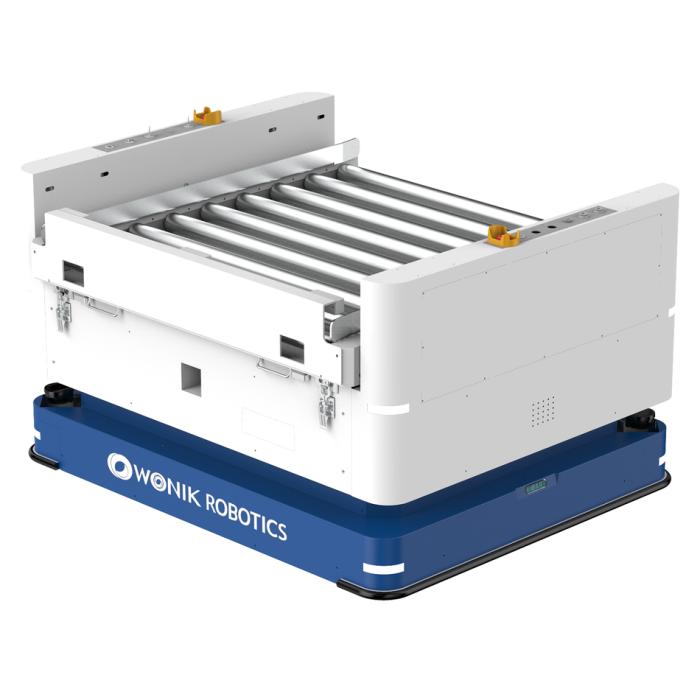
The Wonik Robotics WR1000CV is an autonomous mobile robot built in a pallet conveyor configuration and propelled by a differential drive system. It is rated for payloads of up to 1,000 kg, reaches a maximum speed of 1 m/sec, and is listed with an operating time of 12 hours. This approach generally makes route changes a matter of software configuration instead of physical modification of the facility floor.
The defining feature of the WR1000CV is its onboard pallet conveyor, dimensioned at 1,100 x 1,100 x 100 mm. Loads are transferred on and off the vehicle across this conveyor surface, meaning the robot exchanges pallets with stationary transfer equipment at pick-up and drop-off points instead of lifting or towing them. Combined with the one-tonne payload rating, this orients the WR1000CV toward moving palletized goods between fixed transfer stations.
Design
The chassis measures 1,250 x 1,500 x 854 mm (W x L x H), giving the robot a footprint slightly larger than the 1,100 x 1,100 mm conveyor deck it carries and a relatively low overall height. The drive layout is differential: two urethane driving wheels, each 8 inches (20 cm) in diameter, are controlled by varying their relative speeds, and four additional sub wheels support the platform.
The conveyor deck defines the loading method. Because pallets move across the conveyor rather than being lifted, accurate alignment with the mating station matters; the WR1000CV lists QR-code-assisted docking at ±10 mm, specified separately from its general stop accuracy.
Specifications
The table below summarizes the manufacturer-listed specifications for the WR1000CV.
| Item | Specification |
|---|---|
| Configuration | Pallet Conveyor |
| Navigation Type | SLAM |
| Dimensions (W x L x H) | 1,250 x 1,500 x 854 mm |
| Payload | 1,000 kg |
| Driving System | Differential Drive |
| Wheels | Urethane; two 8-inch (20 cm) driving wheels and four sub wheels |
| Loading Method | Pallet Conveyor (1,100 x 1,100 x 100 mm) |
| Stop Accuracy | ±20 mm |
| Docking Accuracy (with QR code) | ±10 mm |
| Maximum Speed | 1 m/sec |
| Average Speed | About 0.7 m/sec |
| Operating Time | 12 hours |
| Battery | Li-ion, DC50V / 50Ah |
| Charging Time | About 2 to 2.5 hours |
| Charging Method | Auto / Manual; automatic sliding-type charging |
| Communication | Wi-Fi 2.4 GHz and 5 GHz; LTE/5G support (optional) |
Operational Considerations
The WR1000CV lists two distinct positioning figures. Stop accuracy of ±20 mm describes how precisely the robot halts at a commanded position during general operation. Docking accuracy of ±10 mm applies specifically when the robot docks using a QR code reference, the tighter tolerance relevant to conveyor-to-conveyor pallet transfer, where the robot deck and the stationary station must line up for the load to pass across reliably. Facility planners should treat these as separate values rather than a single accuracy rating.
Power comes from a Li-ion battery pack rated at DC50V / 50Ah, with a listed charging time of about 2 to 2.5 hours. The 12-hour operating time, read alongside the charging window, gives an indication of how the vehicle might fit into shift patterns, though actual runtime in any deployment depends on load, speed, and duty cycle.
For connectivity, the robot supports Wi-Fi on both 2.4 GHz and 5 GHz bands, while LTE/5G support is listed as optional and therefore should not be assumed present in a base configuration. Cellular connectivity, where selected, is relevant to sites where wireless LAN coverage is uneven across the operating area.
The speed figures are also worth reading together: the 1 m/sec maximum represents the top rated travel speed, while the average speed of about 0.7 m/sec is an approximate figure that reflects more typical movement. Real-world averages depend on route layout, traffic, and the frequency of stops and docking events.
Applications
As a pallet conveyor AMR with a 1,000 kg rating, the WR1000CV is suited to intralogistics tasks where standardized pallet loads move repeatedly between fixed points equipped with compatible transfer stations. Typical contexts for this class of vehicle include:
- Transfer of palletized goods between production lines and buffer or storage areas
- End-of-line transport from palletizing equipment toward dispatch zones
- Linking conveyor segments in facilities where fixed conveyors are impractical to extend
- Repetitive pallet moves in warehouses and distribution operations
- Material supply loops feeding manufacturing cells on a scheduled basis
Because loading is conveyor-based, deployments are structured around matching transfer points at each end of a route, with SLAM navigation handling the travel between them.
Frequently Asked Questions
How much can the WR1000CV carry?
The robot is rated for a payload of 1,000 kg, carried on its onboard pallet conveyor deck, which measures 1,100 x 1,100 x 100 mm.
How does the robot load and unload pallets?
The loading method is a pallet conveyor. Pallets travel across the robot's conveyor surface onto or off a mating station at each transfer point, so loads are exchanged by conveyance rather than by lifting or towing.
What is the difference between stop accuracy and docking accuracy?
Stop accuracy, listed at ±20 mm, describes positioning during general stops. Docking accuracy, listed at ±10 mm, applies when the robot docks with the aid of a QR code reference, the tighter figure used for alignment at transfer stations.
What battery does it use and how is it charged?
The WR1000CV uses a Li-ion battery rated DC50V / 50Ah, with a charging time of about 2 to 2.5 hours. Charging can be automatic or manual, and the automatic method is a sliding-type charging connection.
What connectivity options are available?
The robot supports Wi-Fi on 2.4 GHz and 5 GHz bands. LTE/5G support is available as an option and is not part of the standard listing.
How does the robot navigate?
The manufacturer lists SLAM as the navigation type for the WR1000CV. This identifies the navigation approach separately from the published stopping and docking accuracy specifications.
Summary
It travels at up to 1 m/sec with an average speed of about 0.7 m/sec, operates for a listed 12 hours, and recharges its DC50V / 50Ah Li-ion battery in roughly 2 to 2.5 hours via automatic sliding-type or manual charging. With ±20 mm stop accuracy, ±10 mm QR-assisted docking accuracy, dual-band Wi-Fi, and optional LTE/5G, it is positioned for repetitive pallet transfer between fixed conveyor stations in industrial facilities.
Request a quotation to confirm configuration, pricing and availability. Catalog stock status is not confirmation of physical inventory or immediate shipment.