
Wonik Robotics WR300CV
In stock
- MARKË:
- Wonik Robotics
- MODEL:
- WR300CV
- PJESA #:
- WR300CV
- Warranty:
- 12 MONTHS
- AVAILABILITY:
- SUBJECT TO AVAILABILITY
- SKU:
- Wonik-WR300CV
Wonik Robotics WR300CV
Overview
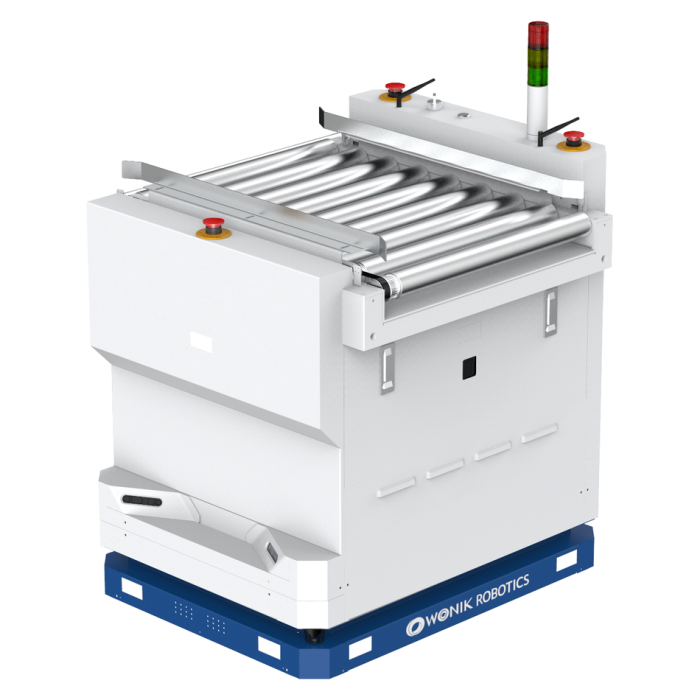
The Wonik Robotics WR300CV is an autonomous mobile robot (AMR) configured with an onboard conveyor for automated material transfer. The conveyor configuration allows the robot to load and unload payloads automatically when it docks with compatible conveyor equipment, with docking available from the front or the side of the platform.
With a stated maximum speed of 1.2 m/sec, an average speed of about 0.7 m/sec, and an operating time of 12 hours per charge, the WR300CV is positioned for repetitive transport tasks in indoor logistics and production environments. Its lithium-ion battery recharges in approximately 1 to 1.5 hours and supports both automatic and manual charging methods.
Design
The WR300CV has a compact footprint of 630 x 825 mm and an overall height of 890 mm, which places the conveyor deck at a level intended to interface with stationary conveyor equipment. The relatively narrow body helps the robot operate in aisles and transfer areas where floor space is limited, while still carrying a 300 kg payload.
Locomotion is provided by a differential drive arrangement with two urethane driving wheels measuring 6 inches (15 cm), supported by four sub-wheels.
The loading method is listed as an auto conveyor, meaning the deck itself actively transfers totes, boxes, or other conveyable loads on and off the robot rather than relying on manual lifting. The docking method supports front or side docking, giving layout planners two orientation options when positioning transfer stations along a route.
Specifications
| Item | Specification |
|---|---|
| Configuration | Conveyor |
| Navigation Type | SLAM |
| Dimensions (W x L x H) | 630 x 825 x 890 mm |
| Payload | 300 kg |
| Driving System | Differential Drive |
| Driving Wheels | Urethane, 6 in (15 cm) x 2 |
| Sub-Wheels | x 4 |
| Loading Method | Auto Conveyor Equipment |
| Docking Method | Front or Side Docking |
| Stop Accuracy | ± 30 mm |
| Docking Accuracy (V Marker) | ± 10 mm |
| Maximum Speed | 1.2 m/sec |
| Average Speed | About 0.7 m/sec |
| Operating Time | 12 h |
| Battery Type, Capacity | Li-ion, DC24V / 50Ah |
| Charging Time | About 1 to 1.5 h |
| Charging Method | Auto / Manual |
| Communication | Wi-Fi 2.4 GHz, 5 GHz; Optional LTE/5G support |
Operational Considerations
Two distinct accuracy figures are published for the WR300CV, and they serve different purposes. Stop accuracy of ±30 mm describes how precisely the robot halts at a general destination along its route. Docking accuracy of ±10 mm, achieved using a V marker reference, applies specifically when the robot aligns with a docking station. The tighter docking tolerance matters for the conveyor configuration, because automated load transfer requires the robot deck and the stationary equipment to line up closely enough for items to pass between them reliably.
SLAM navigation means the robot builds and uses a map of its environment, so routes can be defined and adjusted in software rather than by modifying the floor. Facilities evaluating the WR300CV should still plan traffic flow, aisle widths, and station placement around the robot's 630 x 825 mm footprint and its differential drive turning behavior.
Energy planning is straightforward given the published figures: a 12-hour operating time per charge combined with an approximate 1 to 1.5 hour charging time allows scheduling of charging windows between shifts or during low-demand periods.
For connectivity, the robot communicates over Wi-Fi at 2.4 GHz and 5 GHz. LTE/5G support is listed as optional, so cellular connectivity should be treated as an add-on choice rather than a standard feature. Sites with large areas or challenging wireless coverage should assess their network environment as part of deployment planning.
Applications
The WR300CV's conveyor top and 300 kg payload suit automated transfer of conveyable goods between fixed process points. Typical scenarios include moving totes or cartons between production lines and buffer areas, linking workcells that each have their own conveyor stations, and shuttling materials between warehouse zones and packing or inspection areas.
Because loading and unloading are automated through the conveyor and docking system, the robot can serve routes where no operator is present at either end of the journey. The choice of front or side docking supports both in-line station layouts, where the robot approaches head-on, and lateral layouts, where stations sit alongside the travel path. The 12-hour operating time aligns with extended shift patterns common in manufacturing and distribution operations.
FAQ
What payload can the WR300CV carry?
The WR300CV is rated for a payload of 300 kg, carried on its conveyor deck and transferred automatically when the robot docks with compatible conveyor equipment.
How does the WR300CV navigate?
The manufacturer lists SLAM as the navigation type for the WR300CV. This identifies the navigation approach separately from the published stopping and docking accuracy specifications.
What is the difference between stop accuracy and docking accuracy?
Stop accuracy of ±30 mm describes positioning when the robot halts at a general route destination, while docking accuracy of ±10 mm applies to alignment with docking stations using a V marker. Docking accuracy is the relevant figure for automated conveyor transfer.
How long does the WR300CV operate and charge?
The published operating time is 12 hours, and charging takes approximately 1 to 1.5 hours. Both automatic and manual charging methods are supported, allowing either autonomous recharging routines or operator-initiated charging.
What connectivity options does the robot offer?
The WR300CV communicates over Wi-Fi at 2.4 GHz and 5 GHz. LTE/5G support is listed as optional, so cellular communication is available as an optional capability rather than standard equipment.
Can the robot dock from different directions?
Yes. The WR300CV supports both front and side docking, which gives facility planners flexibility in how conveyor transfer stations are oriented relative to the robot's travel paths.
Summary
The Wonik Robotics WR300CV is a conveyor-equipped autonomous mobile robot combining a 300 kg payload, SLAM navigation, and differential drive in a 630 x 825 x 890 mm platform. Its automated conveyor loading, front or side docking with ±10 mm V-marker accuracy, 12-hour operating time, fast 1 to 1.5 hour charging, and dual-band Wi-Fi with optional LTE/5G make it a candidate for hands-free material transfer between conveyor stations in indoor logistics and production environments.
Request a quotation to confirm configuration, pricing and availability. Catalog stock status is not confirmation of physical inventory or immediate shipment.