
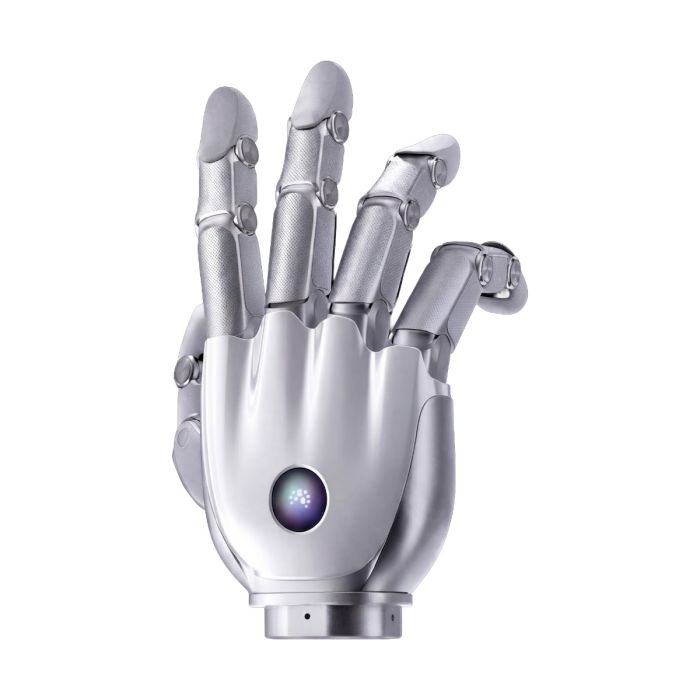
BrainCo Revo 3-21 V-Touch Robot Hand
In stock
- BRANDA:
- BRAINCO
- MÚNLA:
- REVO 3-21 V-TOUCH
- ORIGIN:
- China
- Warranty:
- 12 MONTHS
- AVAILABILITY:
- SUBJECT TO AVAILABILITY
- SKU:
- BrainCo-Revo-3-V-Touch
BrainCo Revo 3-21 V-Touch Robot Hand
Dexterity is decided in the moments after a grasp: when a connector has to be turned, a cable fed through, or a part let go without a jolt. The BrainCo Revo 3-21 V-Touch Robot Hand is built for those moments. It pairs a finger-and-thumb architecture that follows the human hand with two layers of touch sensing, so that a controller learns what the hand is touching rather than guessing at it.
Robots Europa, based in Dublin, sells the BrainCo Revo 3-21 V-Touch Robot Hand and supplies it to customers across the EU and the DACH region. Robots Europa prepares the quotation, arranges delivery and supports the hand after purchase, so that one point of contact covers the project from enquiry to commissioning.
Background
BRAINCO and the Revo 3 range
BRAINCO is the brand behind the Revo series of biomimetic dexterous hands. The Revo 3 generation is offered in four named versions: Revo 3 U21, Revo 3 U21F, Revo 3 U21T and Revo 3 U21VT. The figures on this page belong to the Revo 3 U21VT, the version sold here as the V-Touch hand, and they are kept with that designation throughout. Where a figure is not stated for a version, it is not carried over from another.
The Revo 3 is designed for industrial automation, scientific research and advanced robotics manipulation. These are three different working environments, but they share a need: a hand that can be driven precisely by software, that tolerates repeated use, and that returns information a control loop can use.
Direct drive and two kinds of touch
The hand has 21 degrees of freedom, and its joints are direct-driven and backdrivable. In practical terms, backdrivable joints can be moved by an external force instead of resisting it, which matters when a hand meets an unexpected obstacle or is guided by hand during teaching. The 21 degrees of freedom are distributed as four fingers with 4 DoF each and a thumb with 5 DoF.
The V-Touch designation refers to its sensing. The palm carries a piezoresistive array of 336 points, and the fingertips use vision-tactile sensing with 2000 markers. Together they cover broad contact across the palm and fine detail at the fingertip, which is the area where most manipulation tasks are won or lost.
Technical Specifications
| Specification | Value (Revo 3 U21VT) |
|---|---|
| Total degrees of freedom | 21 (direct-driven and backdrivable) |
| DoF distribution | Four fingers × 4 DoF, thumb × 5 DoF |
| Hand dimensions | 216 × 108 × 50 mm |
| Supply voltage | 16–85 V |
| Max current | 10 A (24 V) |
| Max active grip force | ≥100 N |
| Max fingertip pinch force | ≥25 N |
| Total hand payload | 20 kg |
| Four-finger payload | 5 kg |
| Repeatability | 0.1° |
| Joint open/close time | 0.33 s |
| Communication interfaces | EtherCAT / CAN FD / RS-485 |
| Communication frequency | 500 Hz |
| Onboard sensors | IMU (mainboard), temperature (mainboard) |
| Tactile type | Palm piezoresistive array + fingertip vision-tactile |
| Tactile points | 336 points (piezoresistive) + 2000 markers (vision-tactile) |
| Tactile force range | 0–20 N |
| Tactile resolution | 0.01 N |
| Durability rating | Over 1,000,000 joint flex cycles |
| Motion ability | Full score on the Kapandji opposition test; covers 33 grasp types (Feix GRASP taxonomy) |
| Software | Cross-platform C/C++ and Python SDKs for Linux and Windows |
| Recommended power supply | Stable 24V DC, at least 100W |
Specifications as published by the manufacturer; confirmed against the datasheet at quotation. The manufacturer has not published the weight, the IP rating, the operating temperature range, the package contents or the hand-only mass without the wrist; these are confirmed at quotation.
What makes the V-Touch different from a plain gripper?
A conventional gripper is specified by stroke and force, and it has two useful states. The Revo 3 U21VT is specified differently. It offers 21 degrees of freedom, a thumb with five of them, and a full score on the Kapandji opposition test, which assesses how well the thumb can reach the other fingers. It covers 33 grasp types in the Feix GRASP taxonomy, a standard reference list of human grasps. For a researcher or an integrator, that range means the same hand can be used for a power grasp, a precision pinch or an in-hand adjustment without a change of tooling.
The strength figures show that this is not a delicate instrument only. The maximum active grip force is at least 100 N, the fingertip pinch force at least 25 N, and the total hand payload is 20 kg, of which the four fingers account for 5 kg. Those figures stay with the U21VT and should be read together: the payload of the whole hand and that of the four fingers describe different load cases.
What does the tactile system add?
Force alone does not tell a controller whether an object is slipping, rotating or sitting off-centre. The V-Touch sensing is designed to close that gap. The palm array registers contact over a broad surface through 336 piezoresistive points, while the fingertips use vision-tactile sensing with 2000 markers to follow fine deformation at the contact. The tactile force range is 0–20 N with a resolution of 0.01 N.
Two further points are worth weighing. First, the hand communicates over EtherCAT, CAN FD or RS-485 at 500 Hz, so sensor data can reach a controller at a rate suited to closed-loop work. Second, the SDKs for C/C++ and Python run on Linux and Windows, which lets a team use the language and operating system it already works in. Teams that do not need fingertip vision-tactile sensing may find the BrainCo Revo 3-21 Basic Robot Hand or the BrainCo Revo 3-21 Touch Robot Hand closer to their needs.
Who is the BrainCo Revo 3-21 V-Touch Robot Hand for?
The first group is university and corporate research laboratories working on manipulation, imitation learning or tactile perception. For them, the combination of backdrivable joints, a broad range of grasp types and dense contact data is the reason to choose this version over a simpler one. The second group is industrial automation teams that need to handle varied or fragile parts, where contact feedback can reduce the number of failed picks and the fixture work behind them.
The third group is robotics developers building humanoid or arm-mounted platforms who want a hand that connects through industrial fieldbus interfaces and a documented SDK. Buyers who need strong dexterity but do not need the fingertip vision-tactile layer should compare this version with the Basic and Touch versions before deciding. Robots Europa can explain the differences when preparing a quotation.
What is the BrainCo Revo 3-21 V-Touch Robot Hand used for?
- Dexterous manipulation research: studying grasping, re-grasping and in-hand movement with a hand whose thumb and fingers follow human anatomy.
- Tactile perception work: developing algorithms that use palm and fingertip contact data to judge slip, shape and pressure.
- Industrial automation: handling parts of varied form where a two-state gripper would need several tools.
- Teleoperation and teaching: guiding the hand by an operator, with backdrivable joints that yield to external forces.
- Humanoid and arm-mounted platforms: adding a capable end-effector to a robot that has to work among human-designed tools and objects.
- Teaching and training: giving students a working platform for control, sensing and software integration on Linux or Windows.
Pricing and Availability
Robots Europa does not show prices on this page. Quotation is the next step: send the intended application, the controller or arm it will be mounted on and the interface you plan to use, and Robots Europa will prepare a quotation for the Revo 3 U21VT. Delivery, customs and support are arranged with the quotation. The hand is powered best from a stable 24V DC supply of at least 100W, and that requirement is worth planning for early. Request a quotation through the enquiry options available on this page.
Frequently Asked Questions
How many degrees of freedom does the hand have?
The Revo 3 U21VT has 21 degrees of freedom, all direct-driven and backdrivable. Each of the four fingers has 4 DoF and the thumb has 5 DoF.
What touch sensing does the V-Touch version carry?
It has a piezoresistive array of 336 points in the palm and vision-tactile sensing with 2000 markers at the fingertips. The tactile force range is 0–20 N with a resolution of 0.01 N.
Which communication interfaces are supported?
The hand supports EtherCAT, CAN FD and RS-485, with a communication frequency of 500 Hz. This allows connection to a range of controllers and robot arms.
What software is available?
Cross-platform C/C++ and Python SDKs are available for Linux and Windows. They are intended to streamline development and integration.
What power supply does the hand need?
The supply voltage range is 16–85 V, and the maximum current is 10 A at 24 V. A stable 24V DC supply of at least 100W is recommended to reduce the risk of voltage drop.
Is the weight or IP rating available?
Neither figure is among the data supplied for this hand. Ask Robots Europa about them when you request a quotation.
Where can I buy the BrainCo Revo 3-21 V-Touch Robot Hand and what does it cost?
Robots Europa, based in Dublin, supplies the hand across the EU and the DACH region. The cost is given in a personal quotation, as no price is shown on this page.
Summary
The test of a robot hand is what it does after the grasp, and the BrainCo Revo 3-21 V-Touch Robot Hand is designed around that test. It offers 21 direct-driven, backdrivable degrees of freedom, a thumb with five of them, strong grip and payload figures, and tactile sensing at both palm and fingertip. For research and automation teams that want contact feedback in the control loop, it is a serious option, and Robots Europa can compare it with the Basic and Touch versions for your task. To request a quotation, this page is the starting point.


