
BrainCo Revo 3-21 Basic Robot Hand
In stock
- BRANDA:
- BRAINCO
- MÚNLA:
- REVO 3-21 BASIC
- ORIGIN:
- China
- Warranty:
- 12 MONTHS
- AVAILABILITY:
- SUBJECT TO AVAILABILITY
- SKU:
- BrainCo-Revo-3
BrainCo Revo 3-21 Basic Robot Hand
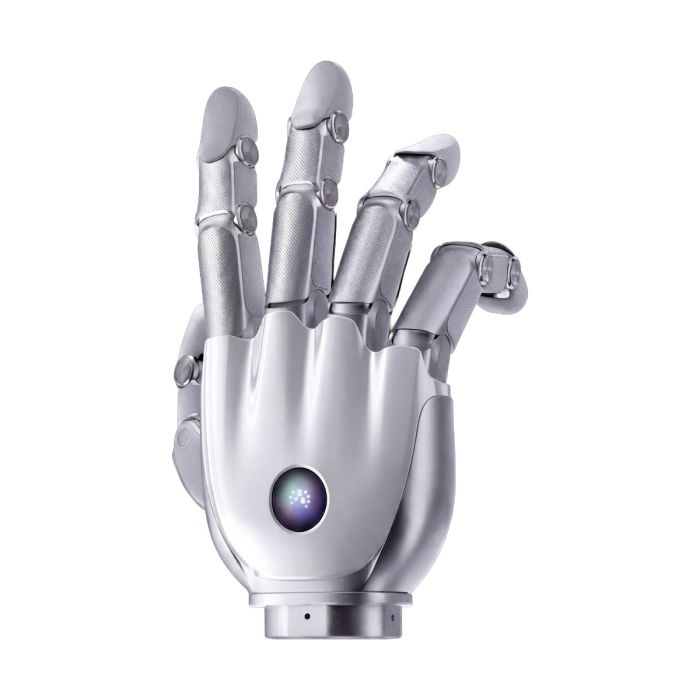
Engineers have long measured robot hands against the one benchmark nature provides, and most fall short at the first joint. The BrainCo Revo 3-21 Basic Robot Hand takes that comparison seriously: it gives the thumb five active degrees of freedom and each of the four fingers four more, every one of them driven by its own motor. The result is a hand meant for work that asks for adjustment, not just closure.
Robots Europa, based in Dublin, sells the BrainCo Revo 3-21 Basic Robot Hand and supplies it to customers across the EU and the DACH region. Robots Europa prepares your quotation and arranges delivery and support around the configuration you agree.
Background
BrainCo and the Revo lineage
BrainCo was founded in 2015 and has built its reputation on bionic and brain-interface technology. Its Revo hands form a numbered family. The earlier generations are still available from Robots Europa, among them the BrainCo Revo 1 Intelligent Dexterous Bionic Hand, and the third generation is collected in the BrainCo Revo 3 category.
Within Revo 3, the sources name several versions: Revo 3 U21, U21F, U21T and U21VT in the manufacturer's naming, and Revo 3 Basic, Touch and Vision in the retail naming. This page describes the Basic version. Figures from the Revo 3 U21 table stay with the U21, and they are not carried over to the Basic version.
Positioning and key technology
The Revo 3 is a biomimetic dexterous hand designed for industrial automation, scientific research and advanced robotics manipulation. Its joints are direct-driven and backdrivable, which gives rapid response and high control density across all finger segments. In practice this means the controller can address each finger segment individually, and the mechanism can be moved by an external force instead of fighting it.
The hand is rated for over 1,000,000 joint flex cycles. For development, BrainCo supplies cross-platform C/C++ and Python SDKs compatible with Linux and Windows, so that integration work can start in the languages most robotics teams already use.
Technical Specifications
The table keeps each figure with the version it belongs to. A dash means that no figure is stated for that version.
| Specification | Revo 3 U21 | Revo 3 Basic |
|---|---|---|
| Degrees of freedom | 21 | 21 |
| Hand dimensions | 216 × 108 × 50 mm | 215 × 105 × 50 mm |
| Supply voltage | 16–85 V | 12–80V |
| Max current | 10 A (24 V) | — |
| Active grip force | ≥100 N | Above 70N |
| Max fingertip pinch force | ≥25 N | — |
| Total hand payload | 20 kg | — |
| Four-finger payload | 5 kg | — |
| Repeatability | 0.1° | — |
| Joint open/close time | 0.33 s | — |
| Max grasping diameter | 150 mm | — |
| Communication interface | EtherCAT / CAN FD / RS-485 | — |
| Communication frequency | 500 Hz | — |
| Onboard sensors | IMU (Mainboard), Temperature (Mainboard) | — |
| Tactile sensors | — | Not included |
| Control modes | — | Position / MIT Force-Position / Admittance / Zero-Torque |
Specifications as published by the manufacturer; confirmed against the datasheet at quotation.
The manufacturer has not published the weight, the box contents, the IP rating, the operating temperature range or the power consumption; they are confirmed at quotation.
What separates the Basic version from the other Revo 3 hands?
The most visible difference is what the Basic version leaves out: tactile sensors are not included. The hand therefore reports through its joints and its mainboard, and a project that needs contact information at the fingertips should look at a sibling. The BrainCo Revo 3-21 Touch Robot Hand is the natural step for tasks where the hand must register contact, and the BrainCo Revo 3-21 V-Touch Robot Hand is the one to examine when vision is part of the brief.
The second difference is documentary. The U21 table describes the electrical and mechanical limits in some detail. The Basic version is described with its own, slightly different figures: smaller overall dimensions, a supply range of 12–80V and an active grasping force above 70N. Treat these as two separate sets of numbers.
What the two share is the architecture: 21 independently driven degrees of freedom, direct-driven backdrivable joints and the same SDK support. For the Basic version, four control modes are listed: position, MIT force-position, admittance and zero-torque. Together they cover simple commanded motion, compliant interaction and hand-guided teaching.
Why do backdrivable joints matter for a dexterous hand?
A joint that cannot be pushed back is a joint that must be controlled perfectly. A backdrivable joint tolerates imperfection: when a finger meets an obstacle or an object shifts, the mechanism can give way instead of loading the motor and the part. For researchers this makes compliant behaviour and learning from demonstration far more practical, and for integrators it reduces the risk of damage during commissioning.
Direct drive also shortens the path between command and motion, which is why the response is described as rapid. Combined with admittance and zero-torque modes, the hand can be guided by a person, moved into a pose and then asked to reproduce it. That is a very different working style from a two-jaw gripper, and it is the main reason to choose a hand with this many active joints.
Who is the BrainCo Revo 3-21 Basic Robot Hand for?
Research laboratories are the clearest audience. A hand with 21 active degrees of freedom is a platform for studying grasping, in-hand manipulation and imitation learning, and the C/C++ and Python SDKs on Linux and Windows fit the software stacks those groups already run.
Integrators and automation engineers form the second group. They can use the hand on a robot arm for tasks that a gripper cannot do, such as handling varied small parts or operating tools, and they can plan around the supply range and control modes listed for the Basic version.
Teams in teleoperation and robotics education will also find the hand useful, because the finger-by-finger control makes human motion easy to map. If your application depends on touch feedback, however, choose the Revo 3-21 Touch instead, since the Basic version does not include tactile sensors.
What is the BrainCo Revo 3-21 Basic Robot Hand used for?
- In-hand manipulation research. Independent control of every finger segment lets researchers study how objects are repositioned within the grasp.
- Imitation learning. Zero-torque and admittance modes allow a person to guide the fingers and record the motion.
- Industrial part handling. A multi-finger hand can adapt to varied components that a fixed gripper would need to be retooled for.
- Teleoperation. Operators can map their own finger movements onto the hand for remote or hazardous tasks.
- Tool use. Wrapping, pinching and releasing in sequence makes it possible to pick up and operate handheld tools.
- Teaching and demonstration. Universities and training centres can show students what dexterous manipulation involves on real hardware.
Pricing and Availability
Robots Europa does not publish prices for this hand; the call to action is a quotation, which we prepare for the exact version and quantity you need. Delivery, customs and support are arranged with the quotation, so that the whole process is settled in one place. You can request a quotation from the enquiry options available on this page.
Frequently Asked Questions
How many degrees of freedom does the hand have?
It has 21 fully active, independently driven degrees of freedom: five in the thumb and four in each of the index, middle, ring and pinky fingers.
Which communication interfaces are listed?
The Revo 3 U21 table lists EtherCAT, CAN FD and RS-485, with a communication frequency of 500 Hz. No interface figures are stated for the Basic version.
Does the Basic version include tactile sensors?
No. Tactile sensors are not included in the Basic version. The Touch and V-Touch versions are the ones to consider when fingertip sensing is required.
Which control modes are available?
The Basic version lists position, MIT force-position, admittance and zero-torque modes.
Which software tools are supplied for integration?
BrainCo provides cross-platform C/C++ and Python SDKs compatible with Linux and Windows.
Are the Basic and U21 figures interchangeable?
No. The Basic version has its own dimensions, supply range and grasping force, which differ from the U21 table. Quote the version you order.
Where can I buy the BrainCo Revo 3-21 Basic Robot Hand and what does it cost?
You can buy it from Robots Europa, which supplies customers in the EU and the DACH region. The cost is given in a quotation prepared for your version and quantity.
Summary
The BrainCo Revo 3-21 Basic Robot Hand is a hand measured against the human original: 21 active degrees of freedom, direct-driven backdrivable joints and SDKs for Linux and Windows. It omits tactile sensors, and its figures differ from the U21 table, so the version matters. For teams that want dexterity without the sensing extras, this page is the starting point.


