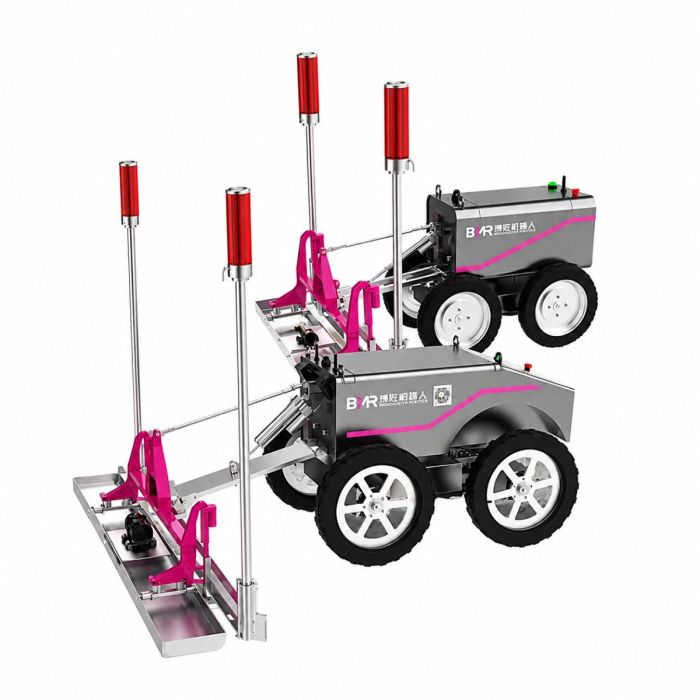
BMR 2.5 Meter Concrete Leveling Robot
In stock
- BRAND:
- BMR
- ORIGIN:
- China
- Warranty:
- 12 MONTHS
- AVAILABILITY:
- SUBJECT TO AVAILABILITY
- SKU:
- BMR-Concrete-Leveling-Robot
Concrete Leveling Robot
Every concrete pour is a race, and the finish line is the initial set. Between the moment the mix hits the deck and the moment it stops being workable, a slab crew must strike it to level, lift the slurry, close the surface and hold the elevation — across hundreds or thousands of square metres, on their knees or behind a vibrating screed, with the concrete stiffening under them by the minute. The Concrete Leveling Robot from BrightMaster Robotics (BMR) runs that race on wheels and lasers. Widely recognised in the industry as a robotic floor leveller or self-levelling robot, it replaces traditional manual screeding on large-scale flooring projects: guided by a high-precision laser reference — Topcon or MOBA systems by variant — it automatically adjusts screed height, vibration frequency and travel speed in real time, performing slurry lifting, surface finishing and elevation control before the concrete's initial set, to millimetre-level flatness that manual methods cannot hold across a full pour. The family spans two working widths and four models: the 1.5-metre 15SY and 15MY, 175-kilogram machines levelling 30 to 150 millimetres at 160 square metres per hour or more, and the 2.5-metre 25SY and 25MY, 350-kilogram machines levelling 30 to 250 millimetres at 300 square metres per hour or more — all remote-controlled, battery-electric and quiet enough for night pours in occupied districts.
The Concrete Leveling Robot is available for purchase internationally through this page, with delivery, customs clearance and after-sales support arranged for buyers across Europe, the Americas, the Middle East, Asia-Pacific and worldwide.
Why the flattest floors are no longer struck by hand
Flatness is money. Warehouse racking, forklift speeds, machine foundations, crack behaviour and floor-covering budgets all trace back to how the slab was levelled in its first workable hour — and manual screeding, however skilled, varies with fatigue, sightlines and the crew's position on the pour. Laser-guided robotic levelling changes the reference: instead of following screed rails and eyesight, the machine follows a laser plane projected across the whole slab, correcting its screed head continuously against it. BMR's implementation adds an independently developed dual-degree-of-freedom adaptive system with intelligent motion-control algorithms, so the head stays true even as the chassis rides the uneven, reinforcement-strewn surface of a live pour. The result is repeatable, industrial-grade flatness with reduced surface cracking and a dense, uniform finish — on the ten-thousandth square metre as on the first.
A four-model family with a simple code
The range resolves into two decisions. Width: the 1.5-metre machines fit residential floors, basements and cut-up commercial layouts, while the 2.5-metre machines are built for the open slabs of factories, airports, malls and logistics halls. Laser ecosystem: SY variants carry Topcon systems, MY variants carry MOBA — matching the robot to whichever laser infrastructure a contractor already runs. All four share the control philosophy, remote operation and battery-electric drivetrain, and all four are proven in the field: reference deployments span the Abu Dhabi Data Centre and RAK Central commercial project in the UAE, the Centrepole Samsung Raemian residential development in Songdo, South Korea, the Shenzhen Semiconductor and Advanced Manufacturing Industrial Park, Tianjin Binhai West Station infrastructure and further industrial and emerging-architecture projects.
Technical Specifications
| Parameter | 15SY / 15MY | 25SY / 25MY |
|---|---|---|
| Leveling head size | 1,500 mm | 2,500 mm |
| Dimensions (L×W×H) | 1,650 × 1,600 × 1,650 mm | 2,500 × 2,200 × 2,100 mm |
| Weight | 175 kg | 350 kg |
| Laser system | Topcon (15SY) / MOBA (15MY) | Topcon (25SY) / MOBA (25MY) |
| Leveling thickness | 30–150 mm | 30–250 mm |
| Operational efficiency | ≥160 m²/h | ≥300 m²/h |
| Power supply | 48 V / 40 Ah | 48 V / 90 Ah |
| Operating endurance | ≥5 h | ≥10 h |
| Battery charging time | 2.5 h | 4 h |
| Tyres | 3.00-10 all-terrain tubeless | 26×4-18 tubeless; optional AT26×9-14 all-terrain |
| Maximum travel speed | 800 mm/s | 800 mm/s |
| Operation mode | remote control | remote control |
| Operating temperature | 0–45 °C | 0–45 °C |
| Core functions | slurry lifting, surface finishing, elevation control before initial set; real-time automatic adjustment of screed height, vibration frequency and travel speed | same |
Configurations are confirmed at quotation.
What makes robotic leveling better than manual screeding?
Consistency under time pressure. The robot's advantage is not that it works faster than a crew — though at up to 300 square metres per hour it does — but that its two-hundredth minute is identical to its first. The laser reference does not tire, the adaptive head does not drift, and the vibration energy is metered to the mix rather than to the operator's arm, which is what produces the dense, crack-resistant surface industrial specifications demand. The operating economics follow: one remote operator replaces a screeding crew at the most labour-intensive moment of slab construction, battery-electric drive removes engine fumes from enclosed pours — basements, data halls, night work — and low-noise operation keeps urban and occupied-site schedules open. For contractors, that converts the most schedule-critical trade in concrete flooring from a staffing problem into a machine slot.
Who is the Concrete Leveling Robot for?
For concrete contractors and flooring specialists pouring at scale: logistics and industrial developers whose racking specifications demand documented flatness, data-centre and semiconductor builders working in enclosed, ventilation-sensitive halls, airport and infrastructure contractors striking vast aprons and platforms, residential builders levelling tower slabs floor after identical floor, and commercial fit-out programmes for malls and public buildings. The 1.5-metre models suit confined and residential geometries; the 2.5-metre models earn their keep on open industrial slabs; and the SY/MY split lets a contractor standardise on the Topcon or MOBA laser ecosystem already in the fleet. It also pairs naturally with the rest of BMR's concrete set — the floor screeding robot, concrete finishing robot and intelligent follow-up placing pump — in multi-robot pour schemes.
What is the Concrete Leveling Robot used for?
- Industrial slabs: high-tolerance floor leveling for factories, warehouses and logistics halls with heavy load and racking requirements.
- Residential floors: apartment and housing slab leveling, repeated identically across tower storeys.
- Basements and enclosed pours: emission-free, low-noise leveling for underground structures and ventilation-limited halls.
- Airports and infrastructure: large-area, high-precision concrete flooring for aprons, terminals and station platforms.
- Commercial and public spaces: smooth, uniform slab surfaces for shopping malls, offices and public buildings.
- Data centres and clean industrial builds: flatness-critical floors proven on data-centre and semiconductor-park references.
Pricing and Availability
The Concrete Leveling Robot is available for purchase and international delivery through this page, across all four models — 15SY, 15MY, 25SY and 25MY — from a single machine for a flooring contractor to multi-unit packages for large pours and multi-robot concrete schemes. Price and cost depend on model, laser system, tyre and battery options, spare and wear-part provisioning, training and commissioning scope, and quantity, so buyers should request a current quotation for their project profile; delivery, customs clearance and after-sales support are arranged worldwide. Purchase enquiries, datasheets and availability details for the Concrete Leveling Robot are available on this page.
Frequently Asked Questions
What is the Concrete Leveling Robot?
A laser-guided robotic floor leveller from BrightMaster Robotics (BMR) that replaces manual screeding on large concrete pours — automatically adjusting screed height, vibration frequency and travel speed in real time to deliver millimetre-level flatness before the concrete's initial set.
Which models are available?
Four: the 1.5-metre 15SY and 15MY (175 kilograms, at least 160 square metres per hour, 30–150 millimetre thickness) and the 2.5-metre 25SY and 25MY (350 kilograms, at least 300 square metres per hour, 30–250 millimetres) — SY variants running Topcon laser systems, MY variants running MOBA.
How accurate is it?
The system holds millimetre-level flatness against its laser reference, with the dual-degree-of-freedom adaptive head correcting continuously as the chassis moves — reducing surface cracking and producing the dense, uniform finish industrial flooring standards require.
How long can it work per charge?
The 1.5-metre models run at least five hours on their 48-volt 40-amp-hour packs and recharge in 2.5 hours; the 2.5-metre models run at least ten hours on 90-amp-hour packs and recharge in four — enough for full pour shifts, with quiet, emission-free operation suited to night and enclosed work.
Is it difficult to operate?
No — operation is by remote control, with the intelligence onboard: the operator directs the machine while the control system manages screed height, vibration and speed against the laser plane. Traveling at up to 800 millimetres per second on all-terrain tyres, it covers live pour surfaces confidently between 0 and 45 degrees Celsius.
Has it been used on major projects?
Yes — references include the Abu Dhabi Data Centre and RAK Central commercial building in the UAE, the Centrepole Samsung Raemian residential project in Songdo, South Korea, the Shenzhen Semiconductor and Advanced Manufacturing Industrial Park, and Tianjin Binhai West Station infrastructure works.
Where can I buy the Concrete Leveling Robot and what does it cost?
The Concrete Leveling Robot is available through this page, with delivery, customs clearance and after-sales support arranged for buyers worldwide. Because cost varies with model, laser system, configuration and quantity, buyers should request an individual quotation. All purchasing details are available on this page.
Summary
The Concrete Leveling Robot wins the one race every slab crew runs: the race against the initial set. A laser plane replaces the string line, an adaptive screed head replaces the tiring arm, and a remote operator replaces the crew on its knees — at up to 300 square metres per hour, to millimetre flatness, for up to ten quiet, emission-free hours per charge. With two working widths, a choice of Topcon or MOBA laser ecosystems and references running from Gulf data centres to Korean residential towers, it turns the most schedule-critical trade in concrete flooring into a repeatable machine process. For contractors who are measured by their floors, this page is the starting point.
v2, August 14, 2026