DexForce
DexForce is the Shenzhen embodied intelligence company, founded in 2021, whose 3D vision systems and DexSense spatial sensors guide robots across more than fifty sub industries and a thousand deployments, and whose DexVerse Sim2Real engine powers the W1 Pro, an AI defined wheeled humanoid of 163 centimetres and 110 kilogrammes with up to 40 degrees of freedom, dual 7 degree of freedom arms carrying 10 kilogrammes each at sub millimetre precision, 1000 hertz full body control, 300 TOPS of computing and 8 hour runtime.
DexForce
Most humanoid companies built a body first and went hunting for a brain; DexForce did it the other way round. The Shenzhen company, founded in 2021 and known in Chinese as 跨维智能, Interdimensional, spent its first years as the vision specialist of industrial automation, supplying the 3D cameras, recognition algorithms and guidance software, the eyes and the visual brain, that let ordinary robot arms master detection, positioning, bin picking and palletising in the messy light of real factories. That business compounded across more than fifty sub industries and over a thousand real world deployments, and it produced the asset that now defines the company: DexVerse™, a Sim2Real embodied intelligence engine that generates massive synthetic training worlds, physics simulated down to the refraction of light, and transfers what robots learn there onto real hardware with minimal domain gap, at claimed success rates beyond 99.9 per cent on grasping and operating tasks at millimetre accuracy.
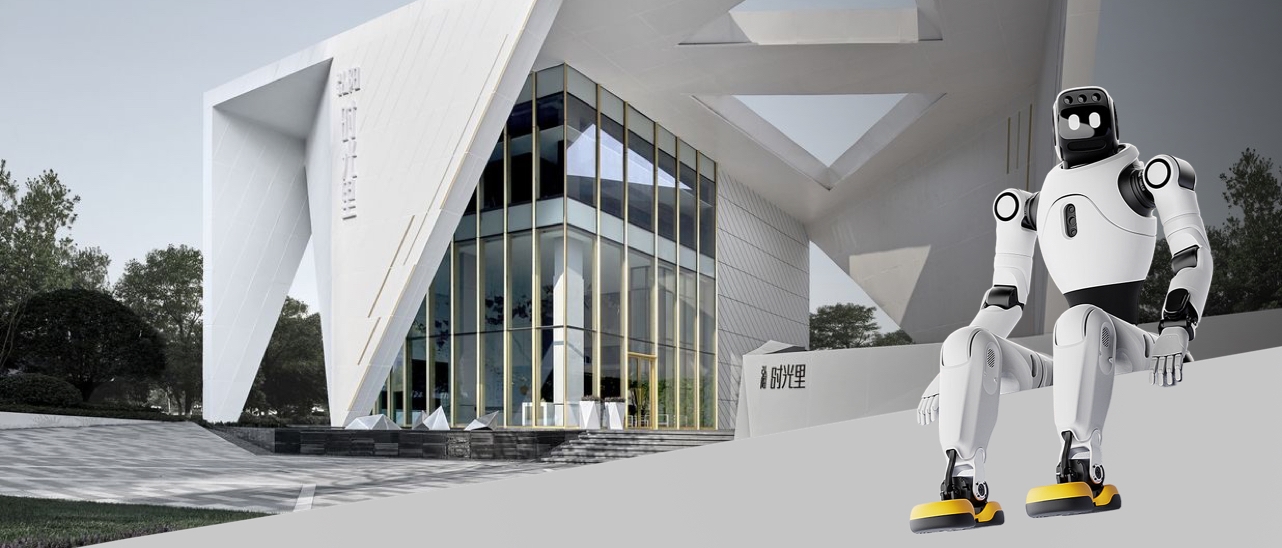
Then the eyes grew a body. The W1, released in January 2025, and today's second generation W1 Pro carry DexForce's stack into humanoid form as what the company bills the industry's first AI defined humanoid robot: a 163 centimetre, 110 kilogramme wheeled machine offering up to 40 degrees of freedom, dual 7 degree of freedom arms lifting 10 kilogrammes each at sub millimetre precision, 1000 hertz full body control and at least 300 TOPS of computing, engineered around the conviction that a humanoid is not a mechanism to be programmed but an output of the intelligence engine behind it. Fresh Series B capital closed in June 2026, part of roughly $161 million raised, funds the scaling.
Within the wider humanoid and wheeled humanoid categories, the full DexForce range for sale can be explored through this page.
Background
Vision as the foundation business
DexForce entered robotics at its genuine bottleneck: machines could move precisely long before they could see reliably, and complex automation stalled on perception. By specialising in high fidelity 3D vision with the AI to interpret it, and integrating into existing arms and manufacturing execution systems rather than competing with them, the company built its deployment base where competitors built demonstrations, vision guided cells running random bin picking, palletising, loading and unloading, and single target precision positioning across factory floors that tolerate no excuses about lighting.
From datasets to bodies
DexVerse converted that experience into a manufacturing process for intelligence itself: procedural generation and generative 3D modelling produce annotated synthetic datasets at scales real world collection cannot approach, physics based simulation makes them honest, and Sim2Real transfer deploys the trained models onto hardware directly, so teaching a robot a new part or task becomes data generation rather than custom programming. The humanoid programme is the doctrine's proof: an AI defined machine whose capabilities arrive from the engine, switch between applications rapidly, and improve as the simulation worlds do.
The DexForce Range
3D Vision Systems and DexSense Sensors
The founding product line remains the range's backbone: industrial 3D vision cameras and the DexSense family of pure visual spatial intelligence sensors, built on modular multi image sensor designs and self developed algorithms that hold accuracy through direct glare, shadow and low light, recognising targets through deep learning and reconstructing the spatial structure around them, supplied both as components for integrators and inside DexForce's own vision guided cell solutions for picking, palletising and precision placement.
The DexVerse Embodied Intelligence Engine
DexVerse is the company's centre of gravity: the Sim2Real engine whose generated worlds, modelled to the detail of light behaviour, train vision language action models for manipulation, delivering the claimed 99.9 per cent plus task success and millimetre accuracy in semi structured scenes, and giving every DexForce machine, and partner programmes building on the stack, a training pipeline where new capabilities are generated rather than hand engineered.
DexForce W1 Pro
The W1 Pro is the flagship embodiment: a wheeled humanoid of 163 centimetres and 110 kilogrammes whose 34 power units extend to 40 degrees of freedom with options, pairing dual 7 degree of freedom arms, 10 kilogrammes of payload each, with optional 6 degree of freedom dexterous hands whose force control resolves to the 20 milliamp level. Its chassis configures as differential drive for simplicity or omnidirectional for manoeuvrability, in full body and half body versions; its control runs the whole body at 1000 hertz over EtherCAT ring networking on a dual PC architecture with at least 300 TOPS; its perception fuses binocular stereo vision, wrist cameras and LiDAR enhanced SLAM with hybrid VSLAM mapping; and its endurance reaches eight hours of continuous duty. Trained through DexVerse VLA models, it executes assembly, inspection, machine tending and service tasks, coffee machine operation among its demonstrations, at sub millimetre repeatability, with ROS ecosystem integration, modular end effectors and cloud teleoperation completing the platform.
Range Overview
| Product | What it is | Key figures |
|---|---|---|
| 3D Vision & DexSense | Industrial cameras and spatial sensors | Glare, shadow and low light tolerant; deep learning recognition |
| Vision guided cells | Turnkey picking and palletising solutions | Random bin picking, precision positioning; 50+ sub industries |
| DexVerse engine | Sim2Real training and deployment stack | >99.9% claimed task success; millimetre accuracy |
| W1 Pro humanoid | AI defined wheeled humanoid | 163 cm, 110 kg, up to 40 DOF, 10 kg/arm, sub-mm, 1000 Hz, ≥300 TOPS, 8 h |
Figures follow published specifications; versions and configurations are confirmed at quotation.
Which buyers does DexForce suit?
DexForce sells along its own history. Manufacturers automating inspection, assembly and machine tending take the W1 Pro's precision and endurance across industrial and factory robotics. Logistics and fulfilment operators take the wheeled chassis, eight hour duty and picking pedigree across logistics and warehouse robotics. Quality programmes take vision guided inspection, integrators take the camera and sensor lines with the wider laser and camera catalogue, and research groups take the DexVerse pipeline and the W1 Pro as an embodied AI platform whose training bottlenecks, data, annotation, transfer, arrive pre solved across research robotics, with mission software from the robot software catalogue completing deployments.
Technology
AI defined, literally
The W1 Pro's designation is an architecture claim: capabilities originate in DexVerse's simulated worlds, arrive on the robot as trained vision language action models, and switch between applications at the pace of data generation rather than reprogramming, the humanoid as the deployment surface of an intelligence engine, which is why new tasks cost datasets instead of engineering projects.
Precision as a control property
Sub millimetre manipulation from a mobile platform rests on the control stack: 1000 hertz full body coordination over EtherCAT ring networking, dual PC computing at 300 TOPS and better, and force control in the optional dexterous hands resolving to the 20 milliamp level, the loop speed and sensitivity that let a wheeled humanoid hold tolerances fixed automation is bought for.
Vision that survives real light
DexForce's sensing pedigree shows where humanoids usually fail, in glare, shadow and gloom: DexSense's modular multi sensor design and algorithms were hardened in factories before the humanoid existed, and the W1 Pro's binocular stereo, wrist cameras and LiDAR enhanced hybrid SLAM inherit that tolerance, perception built by a company whose first customers measured it in scrap rates.
Endurance for the whole shift
Eight hours of runtime, chassis options trading simplicity against omnidirectional agility, full and half body versions, and cloud teleoperation for oversight and intervention make the W1 Pro's working day an operations design rather than a demonstration window, long duration repetitive work being precisely the brief the platform was stated for.
What are DexForce products used for?
- Precision assembly and machine tending: sub millimetre manipulation on production lines across industrial and factory robotics.
- Quality inspection: vision led checking and long duration inspection rounds across inspection robotics.
- Picking, palletising and fulfilment: vision guided cells and humanoid handling across logistics and warehouse robotics.
- Service and machine operation: trained appliance and equipment operation, the coffee machine class of task, in commercial settings.
- Vision system integration: 3D cameras and DexSense sensors as components across the sensor catalogue.
- Embodied AI research: Sim2Real pipelines and VLA deployment on a pre solved training stack across research robotics.
Pricing and Availability
DexForce products are available for purchase across Europe and worldwide, from vision systems and sensor sets to W1 Pro humanoid deployments in full and half body versions, alongside the wider humanoid catalogue on Robots Europa. DexForce price and cost vary by product line, configuration and deployment scope, so buyers seeking the W1 Pro or DexForce vision systems for sale should request a current quotation for their requirements, with European delivery, customs clearance and support arranged through Robots Europa. Purchasing enquiries, specification sheets and availability details for those looking to buy DexForce products can be found on this page.
Frequently Asked Questions
What is DexForce?
DexForce is a Shenzhen embodied intelligence company founded in 2021, known in Chinese as Interdimensional: the 3D vision specialist behind deployments across more than fifty sub industries, the maker of the DexVerse Sim2Real engine and DexSense spatial sensors, and the builder of the W1 Pro wheeled humanoid.
How does the DexForce W1 Pro work?
It manipulates through dual 7 degree of freedom arms, 10 kilogrammes each at sub millimetre precision, within up to 40 degrees of freedom under 1000 hertz full body control, perceives through binocular vision, wrist cameras and LiDAR enhanced hybrid SLAM, computes at 300 TOPS and beyond on a dual PC EtherCAT architecture, and learns its tasks as vision language action models trained in DexVerse simulation.
What is DexVerse?
DexVerse is DexForce's embodied intelligence engine: a Sim2Real system generating massive synthetic training datasets through procedural and generative 3D modelling with physics simulation faithful to light itself, transferring trained models to real robots with minimal domain gap at claimed success rates above 99.9 per cent on grasping and operation tasks.
What makes the W1 Pro "AI defined"?
Its capabilities are outputs of the engine rather than programmes: tasks from assembly to appliance operation are trained in simulation and deployed as models, so the robot switches applications at the pace of data generation, the architecture DexForce presents as the industry's first AI defined humanoid.
What are the benefits of DexForce products?
Key benefits include manipulation precision at sub millimetre level rare among mobile humanoids, perception hardened by years of factory vision deployments, task acquisition through data rather than programming, eight hour working endurance with configurable chassis and body versions and a stack proven across a thousand real world installations.
Does DexForce only make humanoids?
No, the range spans the stack: industrial 3D vision cameras and DexSense spatial sensors, vision guided robotic cells for picking and palletising, the DexVerse training engine and the W1 Pro humanoid, so buyers can adopt DexForce as components, as solutions or as a complete embodied platform.
Where can I buy DexForce products and what do they cost?
DexForce products are for sale through Robots Europa, serving the United Kingdom, the European Union and markets worldwide with delivery, customs clearance and support. Because cost varies by product line and configuration, buyers should request a tailored quotation. Full purchasing details are available on this page.
Summary
DexForce is the humanoid argument run in the correct order: perception first, proven across a thousand factory deployments; then DexVerse, the engine that turns simulation into skill at claimed four nines success; and only then the body, a W1 Pro whose sub millimetre hands, kilohertz control and eight hour shifts exist to give the intelligence somewhere to work. The range lets buyers enter at any layer, cameras and DexSense sensors, vision guided cells, or the full AI defined humanoid, and every layer improves as the engine does. As the vision bred precision house of wheeled humanoids, DexForce stands where seeing, learning and doing meet on the factory floor, and this page as the European starting point for putting it to work.
v3, August 9, 2026