Noetix E1
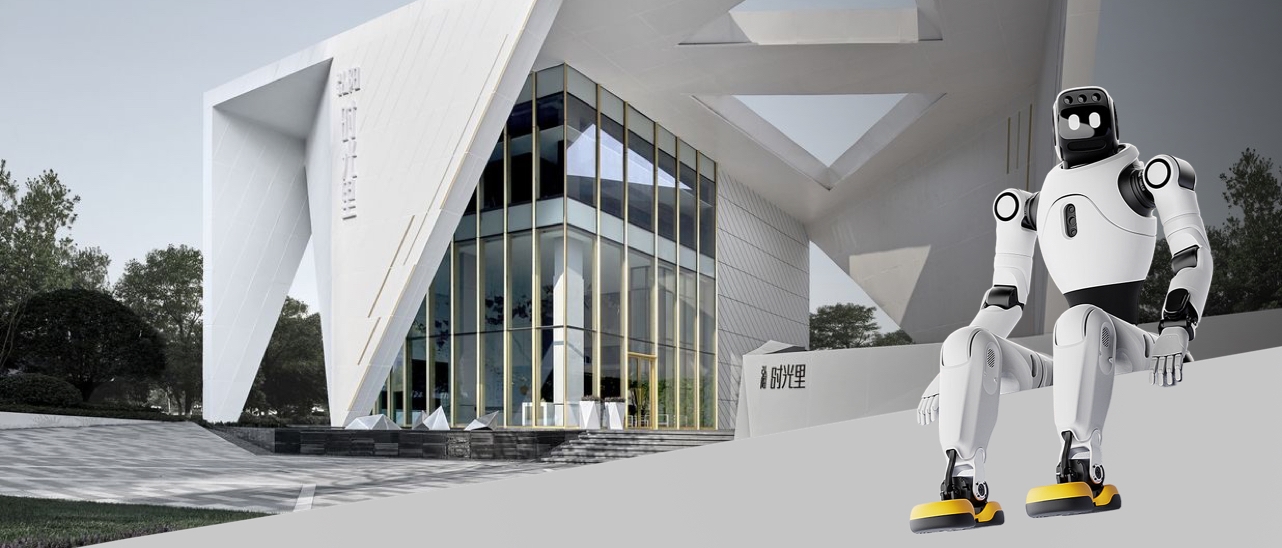
The Noetix E1 (marketed as the "Geek Pioneer E1") is a bipedal embodied intelligence humanoid robot developed by Beijing Noetix Robotics Technology Co., Ltd. and available to European buyers through direct enterprise inquiry at en.noetixrobotics.com and through authorized international distributors. Standing 1.36 meters tall with a baseline of 21 degrees of freedom, the E1 is Noetix's platform for embodied AI interaction, manipulation research, cultural venue guidance, elder care piloting, and corporate service deployment.
Noetix E1 Europe: The Geek Pioneer Embodied Intelligence Humanoid for European Research and Deployment
The E1 in Europe's Embodied Intelligence Research Context
Why Embodied AI Research Matters in European Institutions
The concept of "embodied intelligence," the principle that certain cognitive capabilities can only be fully developed and tested in a physical body that perceives and acts in the physical world, has become a central organizing idea in AI research at European institutions. Research programs at ETH Zürich, the German Research Center for Artificial Intelligence (DFKI), Inria in France, and leading UK universities have invested substantially in embodied robotics as a research domain, recognizing that the next generation of AI systems must be physically grounded in ways that purely digital models are not.
.webp)
The E1 in Europe's Embodied Intelligence Research Context
Why Embodied AI Research Matters in European Institutions
The concept of "embodied intelligence," the principle that certain cognitive capabilities can only be fully developed and tested in a physical body that perceives and acts in the physical world, has become a central organizing idea in AI research at European institutions. Research programs at ETH Zürich, the German Research Center for Artificial Intelligence (DFKI), Inria in France, and leading UK universities have invested substantially in embodied robotics as a research domain, recognizing that the next generation of AI systems must be physically grounded in ways that purely digital models are not.
For European research groups working on this problem, the E1 provides a humanoid platform with a functional embodied AI stack, including large language model-based multilingual speech interaction, memory retention across sessions, and emotionally responsive conversational adaptation, that allows researchers to study how AI systems behave when they inhabit a human-proportioned physical body and must interact with people in real social contexts. This research is fundamentally different from training language models on text data: it requires a physical robot that can be present with a human user, perceive the full multimodal context of the interaction, and respond through coordinated speech, facial expression, and body gesture simultaneously.
The Modular Hardware Approach for European Research Staged Adoption
European university research programs and institutional technology centers are often constrained to make capital equipment purchases that justify their cost over a multi-year horizon, which creates tension with the rapidly evolving technology landscape of embodied AI. The E1's modular hardware design addresses this tension directly.
The baseline E1 at 21 degrees of freedom provides sufficient capability for human-robot interaction research, social robotics studies, embodied language grounding research, and cultural venue deployment without requiring the full hardware configuration. As research programs mature and specific hardware needs emerge, the platform can be expanded with optional seven-degree-of-freedom arms (increasing arm dexterity for manipulation research), five-finger dexterous hands (adding finger-level grasp research capability), LiDAR-based autonomous navigation (enabling studies of autonomous guidance and spatial mapping), and higher-compute developer configuration with NVIDIA Jetson Orin Nano Super (enabling demanding onboard AI model execution).
This staged investment model allows European institutions to enter at the platform's baseline cost and expand hardware capability as their research programs justify it, protecting the initial investment rather than requiring a full-specification purchase from day one.
Physical Design and Characteristics
Height and Interaction Proportions
The E1's 1.36-meter height is the most practically significant physical specification for European deployment contexts. Unlike the N2's 118 centimeters, which positions the robot at children's eye level, or full-size humanoids at 170 centimeters, which can feel imposing in small spaces, 1.36 meters places the E1's head and face at roughly the eye level of a seated European adult or a standing person viewed from a comfortable conversational distance. This proportioning is not accidental: it is the result of deliberate design to facilitate the kind of comfortable, natural-feeling human-robot conversation that sustains long-form interaction in hospitality, elder care, and museum guidance contexts.
For European museum guide applications in particular, this height means the E1 can maintain eye contact with visitors standing in front of exhibit cases, address seated visitors in rest areas, and navigate through exhibition spaces without towering over exhibits or creating an imposing physical presence that would conflict with the contemplative atmosphere European cultural institutions typically cultivate.
For elder care applications, 1.36 meters places the robot's face at the approximate eye level of a person seated in a standard chair or wheelchair, enabling natural conversational eye contact during companion and assistance interactions without requiring the older adult to look up at an uncomfortable angle.
Waist Degree of Freedom
A specific physical feature of the E1 that the smaller N2 does not share is a dedicated waist degree of freedom enabling the torso to rotate and tilt independently of the hip assembly. In interaction contexts, this joint produces the natural upper-body orienting behavior that humans use constantly during conversation: turning toward a speaker, leaning slightly forward to indicate attentiveness, and pivoting to address different members of a group without repositioning the entire body.
European human-robot interaction researchers studying social presence and perceived engagement will find the waist joint particularly relevant: studies in social robotics consistently show that robots capable of natural upper-body orienting and postural adjustment are perceived as more socially intelligent and engaging than robots with rigid torsos, and this perception translates directly into the quality and sustainability of extended human-robot interactions.
Available Color Configurations
The E1 is offered in the same three color options as the N2: Flowing Purple, Moonlight White, and Space Gray. For European institutional deployments where the robot's visual identity should align with the organization's brand or the environment's aesthetic, the ability to select from these three finishes provides meaningful flexibility.
Technology and Specifications
Multimodal AI Interaction
The E1's interaction system is built on what Noetix describes as a 48V low-power computing platform running large language model-based voice interaction. The LLM integration enables genuinely generative conversation: the E1 can answer open-ended questions, maintain context across multiple conversational turns, adjust its vocabulary and complexity level to match the apparent expertise of the person it is speaking with, and provide contextually appropriate responses to queries it has not been explicitly trained on.
The multilingual capability is particularly relevant for European deployment. A single E1 unit can engage visitors in German, French, English, Italian, Spanish, and other languages without hardware modification or reconfiguration, switching between languages based on the visitor's spoken input. This capability is commercially significant for European cultural venues, hotels, and corporate reception environments that regularly serve visitors from multiple European and international language backgrounds.
Three simultaneous output channels are coordinated by the interaction system: speech synthesis from the LLM voice module, facial expression animation, and whole-body gesture. The low-latency synchronization of these three channels produces coherent, human-like communication where words, face, and body respond as a unified whole rather than as separate sequential outputs.
Memory and personality development features allow the E1 to recognize returning visitors, build conversational continuity across separate sessions, and develop a consistent interactive persona over time. For European museums and hospitality venues operating membership programs, or elder care facilities seeking to build meaningful companionship relationships between residents and the robot, this session memory capability is directly operationally valuable.
Modular Hardware Expansion Options
The E1's baseline 21 degrees of freedom expand to approximately 29 DOF with both arm and hand upgrades installed. The expansion options are:
Seven-degree-of-freedom arm upgrade: Replaces the standard arm configuration with a higher-articulation arm that increases the range of approach angles for manipulation tasks and enables more naturalistically varied arm movements during interaction.
Five-finger dexterous hand: Adds independent finger-level control, enabling precision grasp configurations including key-grip, power grasp, and pinch, for manipulation research and light physical task execution such as handing objects to visitors.
LiDAR module: Adds 360-degree spatial mapping for SLAM-based autonomous navigation, enabling the E1 to navigate independently through facilities, avoid obstacles, and perform guided escort duties without operator control.
NVIDIA Jetson Orin Nano Super (developer configuration): Increases onboard AI compute to approximately 67 TOPS, enabling researchers to run demanding perception, language, and planning models entirely on the device without cloud dependency.
Sensing and Perception
The baseline E1 carries a depth camera for three-dimensional visual perception and an IMU (inertial measurement unit) for balance sensing and motion state estimation. These provide the spatial awareness needed for obstacle detection, person tracking during interaction, and stable bipedal locomotion in real-world indoor environments. The optional LiDAR module extends this to full-facility-scale mapping and autonomous navigation capability.
Locomotion
The E1 walks at approximately 1.2 meters per second, a pace well-matched to the guided tour, elder care, and corporate reception contexts where it is primarily deployed. At this walking speed, the robot covers about 72 meters per minute, sufficient to escort visitors between exhibits, accompany a resident through a care facility corridor, or navigate from one lobby area to another at a pace that walking humans can comfortably follow.
Applications and Use Cases in European Markets
European Museum and Heritage Sites
European museums face a consistent challenge: delivering personalized, high-quality interpretation to visitors who come from diverse language backgrounds and arrive with widely varying levels of prior knowledge. Guide staff and audio guide systems address this partially, but neither provides the adaptive, conversational experience that the E1 can offer. A robot that can answer follow-up questions in the visitor's language, adjust the depth of its explanation to match apparent expertise, and escort visitors between exhibits creates a qualitatively different visitor experience than any static guide format.
European heritage organizations managing UNESCO World Heritage Sites have additional motivation: many physically significant sites cannot accommodate large guide groups, creating dispersed visitor flows that are difficult to manage with limited human guide staff. The E1's autonomous navigation capability, with optional LiDAR, allows it to accompany individual visitors or small groups independently through designated routes.
European University Research Programs
The E1's combination of interaction AI, modular hardware expandability, and ROS-compatible programming environment makes it a comprehensive research platform for European university groups studying multiple dimensions of embodied AI. Social robotics groups at institutes including the Bristol Robotics Laboratory, the German DFKI, Inria Bordeaux, and TU Delft can use the E1's LLM interaction system and session memory for studies of long-term human-robot relationship development. Manipulation research groups can expand the E1 to dexterous hand and seven-DOF arm configurations for grasp and manipulation policy research. Navigation research groups can use the LiDAR-equipped E1 for autonomous indoor navigation studies in university buildings.
European Elder Care and Healthcare
Germany, France, the Netherlands, and Scandinavia are among the European countries with the highest old-age dependency ratios, where demographic pressure is most acute and where the case for social companion robot assistance is strongest. The E1's emotional awareness, session memory, and natural conversational AI create a more meaningful companion interaction quality than screen-based or simpler robots can achieve. Its 1.36-meter height and autonomous navigation capability allow it to move through care facility spaces to accompany residents and provide engagement in common rooms, dining areas, and corridors.
European healthcare organizations evaluating companion robots for elder care should note that the E1 is currently most appropriate for companion, reminder, and conversational support roles rather than physical care tasks, which require manipulation dexterity and safety certifications beyond what a research and development platform typically carries.
European Corporate Hospitality and Luxury Hotels
European luxury hotels and corporate headquarters that host international guests and senior executives represent a high-value deployment environment for the E1's multilingual, memory-enabled interaction. A robot that recognizes a returning hotel guest, addresses them in their preferred language, and provides personally relevant information based on previous interactions creates a distinctly premium service experience. The E1's physical height and expressiveness make it a more natural fit for upscale lobby environments than smaller educational robots.
European Luxury Retail and Exhibition
European luxury retail flagships on streets including Via Montenapoleone, Avenue Montaigne, and Bond Street represent environments where visual distinctiveness and memorable interaction are core values. The E1's upright human-proportioned presence, expressive interaction, and ability to discuss product histories and brand narratives in multiple languages create an interactive brand experience appropriate for these settings.
Advantages for European Buyers
Standing long jump gold medal at international competition: The 1.25-meter gold medal performance at the Global Humanoid Robotics Games provides independently verified physical performance evidence from a competitive event covered by PRNewswire (August 28, 2025), distinguishing the E1 from platforms whose capabilities exist only in manufacturer-produced demonstrations.
Multilingual LLM conversation without reconfiguration: The ability to conduct generative conversations in multiple European languages within a single operating session addresses the fundamental European deployment requirement that no single-language platform can fully meet.
Modular hardware protecting initial investment: The staged expansion from 21-DOF baseline to full 29-DOF research configuration, with four independently selectable upgrade options, allows European organizations to enter at the appropriate cost level and grow hardware capability as research and operational requirements develop.
Memory and personality development for sustained relationships: Session memory and personality continuity enable the quality of interaction improvement over time that is essential for meaningful elder care companion applications and visitor recognition in membership-based cultural venues.
Series B-backed company with explicit European expansion commitment: Noetix's USD $145 million Series B and its co-founder's stated target of 1,000 overseas deliveries including Europe by Q2 2026 provide buyers with confidence in the company's medium-term commercial commitment to European market support.
12-month warranty from delivery: The standard 12-month warranty covering quality problems under normal use, with Noetix responsible for free repair, applies to international purchases and provides a documented after-sales support commitment for European buyers.
Comparison for European Buyers
Noetix E1 vs. Noetix N2 for European Research Groups
European research groups choosing between the E1 and N2 should base their selection on their primary research focus. The N2 (EUR 5,000 to EUR 8,500, 18 DOF, 150 Nm) is the better choice for bipedal locomotion research, dynamic motion studies, and gait algorithm development, where the N2's physical athletic performance is the primary asset. The E1 (similar entry-level pricing, 21-29 DOF, 136 cm) is the better choice for human-robot interaction research, embodied AI studies, elder care companion pilots, cultural venue guidance, and manipulation research, where the E1's interaction intelligence, taller height, waist joint, multilingual LLM, and modular expansion to dexterous hands are the primary assets.
Noetix E1 vs. SoftBank Pepper (Legacy Comparison)
SoftBank's Pepper, discontinued in 2021, was the previous generation's reference platform for European interactive humanoid service robots. Pepper's abstract stylized face with no realistic facial expression, no dexterous hands, no joint-level developer control access, and limited LLM-based conversation capability places it in a substantially different and lower capability tier than the E1. European organizations that previously evaluated or deployed Pepper and found it insufficient for their interaction quality requirements will find the E1's LLM-based multilingual conversation, session memory, coordinated facial and body expression, and modular dexterous hand upgrade more capable in every dimension relevant to human-facing deployment.
Summary
The Noetix E1 Geek Pioneer is the embodied intelligence humanoid that European research institutions, cultural venues, elder care operators, luxury hospitality organizations, and corporate technology programs have needed: a 1.36-meter human-proportioned bipedal robot with genuinely multilingual LLM-based conversation, session memory, coordinated facial and body expression, a gold medal-validated physical capability, and a modular hardware architecture that allows staged expansion from baseline interaction research to dexterous manipulation and autonomous LiDAR navigation at a price accessible to university and institutional budgets. Backed by Noetix's Series B of nearly USD $145 million, with explicit European market expansion plans targeting 1,000 overseas deliveries by mid-2026, and with a 12-month warranty and international sales infrastructure through en.noetixrobotics.com, the E1 represents the most versatile and interaction-capable compact humanoid robot available to European organizations seeking to advance embodied AI research, deploy a culturally or corporately appropriate humanoid service presence, or pilot companion robot applications in elder care settings in 2026.
What is the Noetix E1 and how is it different from the N2?
The Noetix E1 (Geek Pioneer E1) is a bipedal embodied intelligence humanoid robot developed by Beijing Noetix Robotics. It stands 1.36 meters tall with 21 to 29 degrees of freedom depending on configuration, and is designed for sustained human-facing interaction, embodied AI research, museum guidance, elder care, and corporate service deployment. It differs from the N2 Athlete in three primary ways: it is taller (1.36 m vs 1.18 m), enabling adult-height interaction; it includes a waist degree of freedom for natural upper-body orienting; and it emphasizes LLM-based multilingual conversational AI with session memory over athletic performance. The N2 is optimized for dynamic locomotion research; the E1 is optimized for embodied social intelligence and modular expansion to manipulation.
How does the Noetix E1's multilingual AI work for European deployment?
The E1's large language model-based voice interaction processes spoken input in the visitor's language, generates contextually appropriate natural language responses, and coordinates speech output with facial expression animation and body gesture simultaneously at low latency. The system supports multiple languages without reconfiguration, enabling a single E1 unit to conduct conversations in German, French, English, Italian, Spanish, and other languages within the same deployment session. The LLM's generative capability means the robot can respond to novel questions and maintain conversational context across turns rather than navigating a fixed script, enabling substantive multilingual conversations appropriate for museum guidance, hotel reception, and elder care companionship applications.
What are the benefits of the Noetix E1 for European elder care facilities?
For European elder care facilities, the E1 offers several documented advantages over other interactive robot options. Its 1.36-meter height places the robot's face at seated-adult eye level, enabling natural conversational eye contact without requiring residents to look up. Its session memory allows the robot to recognize individual residents across visits, building familiarity and conversational continuity that single-interaction robots cannot provide. Its emotional responsiveness enables the robot to detect conversational cues about mood and adjust its tone accordingly. Its multilingual capability supports residents from multiple cultural backgrounds. And its autonomous navigation with optional LiDAR allows it to move independently through facility spaces to visit different residents rather than remaining fixed at a single station.
What modular upgrades are available for the Noetix E1 in Europe?
The E1 supports four modular hardware expansions that can be selected independently or in combination. Seven-degree-of-freedom arms replace the standard arm configuration for manipulation research requiring greater reach and pose diversity. Five-finger dexterous hands add finger-level grasp control for object handling and manipulation policy research. The LiDAR module adds 360-degree spatial mapping for SLAM-based autonomous navigation, enabling independent facility navigation without operator control. The NVIDIA Jetson Orin Nano Super developer configuration replaces the standard processor with a 67 TOPS onboard AI compute platform suitable for running demanding perception, language, and motion planning models on-device without cloud connectivity. European buyers should confirm availability and European pricing for each upgrade option at the time of inquiry through en.noetixrobotics.com.