
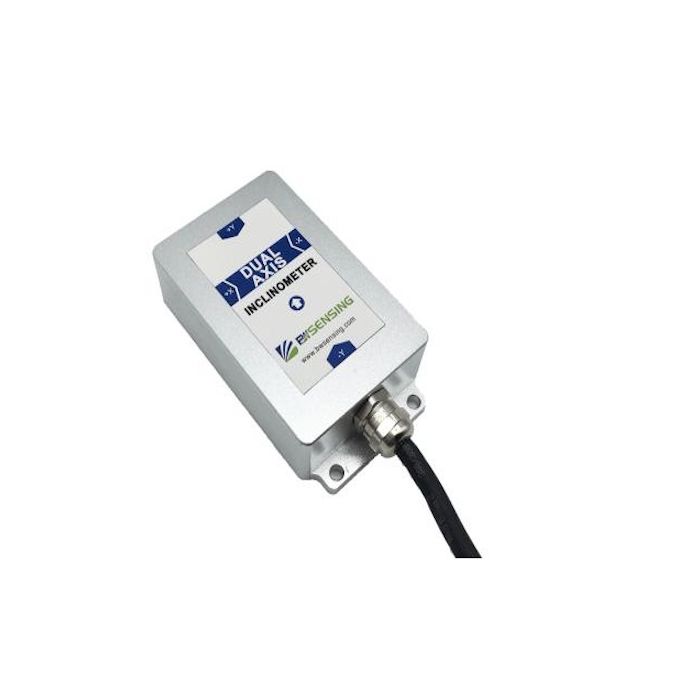
BWSENSING High-Precision Modbus Dual Axis Inclinometer (BWS2700)
In stock
- BRAND:
- BWSENSING
- PART #:
- BWS2700
- ORIGIN:
- China
- AVAILABILITY:
- SUBJECT TO AVAILABILITY
- SKU:
- BWSENSING-BWS2700
BWSENSING High-Precision Modbus Dual Axis Inclinometer (BWS2700)
Most structures move long before anyone can see them move. A pier settles a fraction of a degree, a crane boom creeps, a solar tracker drifts off its line, and by the time the change is visible to the eye the data that might have prevented a problem has already been lost. The BWSENSING High-Precision Modbus Dual Axis Inclinometer (BWS2700) exists for that gap between what is happening and what can be seen: a dual-axis MEMS tilt sensor with digital output, a measurement range of ±30° and a maximum accuracy of 0.001°, housed in an anodised alloy shell built to be mounted outdoors and left there.
Robots Europa, based in Dublin, supplies the BWS2700 to engineering firms, integrators, research groups and operators throughout the European Union and the DACH region. Robots Europa prepares each quotation for the order code and range option your project requires, arranges delivery to your site and remains your point of contact for technical questions after installation.
Background
Bewis Sensing and the BWSENSING range
The BWS2700 was launched by Bewis Sensing, the manufacturer behind the BWSENSING brand, whose portfolio concentrates on inclination and attitude measurement. The range runs from cost-oriented single-axis and dual-axis sensors for general machine levelling to high-precision instruments such as this one, intended for monitoring tasks in which the smallest change in angle carries meaning. Buyers comparing the wider family can browse the BWSensing category, where the more economical dual-axis and single-axis models are listed alongside the BWS2700.
MEMS sensing with a digital output
The BWS2700 is built on MEMS technology. A micro-machined sensing element responds to the direction of gravity, and on-board electronics turn that response into calibrated angle values on two axes. Because the output is digital rather than analogue, the angle reaches the controller or data logger as a value rather than as a voltage that must be scaled and protected from interference along the cable. The output frequency and the serial baud rate are both adjustable, so the same sensor can feed a slow monitoring logger or a faster control loop. For commissioning, the manufacturer supplies serial port debugging software that connects the inclinometer to a computer and displays the angle, which allows installers to check alignment and readings before the sensor is wired into the final system.
Technical Specifications
| Specification | Value |
|---|---|
| Product type | Dual-axis high-precision inclinometer, MEMS technology, digital output |
| Measurement range | ±30° |
| Maximum accuracy | 0.001° |
| Resolution (completely still) | 0.0005° |
| Zero bias (temperature drift) | ±0.0007 °/℃ (-40~85℃) |
| Supply voltage | 9-36VDC |
| Output frequency | 5~100Hz adjustable |
| Baud rate | 2400~115200 adjustable |
| Protection level | IP67 (waterproof to IP67 after gluing) |
| Shell material | Magnesium aluminium alloy, anodised |
| Dimensions | L103.8*W55.4*H26 (mm) |
| MTBF | ≥90000 h |
| Impact resistance | 2000g |
| Operating temperature | -40 to 85 ℃ |
| Configuration software | Serial port debugging software displaying the angle on a computer |
Specifications as published by the manufacturer; confirmed against the datasheet at quotation.
The manufacturer has not published the weight, the power consumption in watts, the contents of the box, the Modbus register map or the dynamic accuracy; these are confirmed at quotation.
The BWS2700 is offered under the order codes BWS2700-30-485, BWS2700-30-232 and BWS2700-30-TTL, with range options of ±5°, ±15° and ±30°. The maximum accuracy of 0.001° belongs to the ±30° range, and Robots Europa matches the order code and range to your installation when the quotation is prepared.
What makes the BWS2700 different from a cost-effective inclinometer?
The difference lies less in what the BWS2700 measures than in how small a change it can still report and how well that reading holds over temperature and time. A maximum accuracy of 0.001° and a resolution of 0.0005° when completely still place it in the monitoring class, where the task is to detect slow movement in a structure rather than to tell a machine roughly which way it is leaning. For a levelling platform that only needs to know whether it is within tolerance, that precision is more than the application uses; for a deformation survey on a retaining wall or a tower, it is the reason to install a sensor at all.
Temperature is the second argument. An outdoor sensor sees frost at night and direct sun by day, and a precision figure is worth little if the zero point wanders with the weather. The BWS2700 has a zero bias of ±0.0007 °/℃ across -40~85℃, matching an operating temperature range of -40 to 85 ℃. That combination is what allows a long-term record to be read as movement of the structure rather than as movement of the thermometer.
The third argument is endurance. The magnesium aluminium alloy shell is anodised, the enclosure reaches IP67 once glued, impact resistance is rated at 2000g, and the MTBF is ≥90000 h. For an installation on a bridge, a mast or a piece of heavy plant, where every site visit costs time and access equipment, these figures speak to how rarely the sensor should need attention.
How does the BWS2700 fit into an existing control or monitoring system?
The BWS2700 is designed to sit on an existing serial bus rather than to require a dedicated acquisition system. The wide 9-36VDC input accepts the supply rails commonly found in industrial cabinets and vehicles, which simplifies power distribution on site. The adjustable baud rate, from 2400 to 115200, lets the integrator match the speed of the bus already in place, and the adjustable output frequency of 5~100Hz lets the sensor report as often as the application genuinely needs, keeping traffic light on shared lines.
The three order codes, ending in 485, 232 and TTL, indicate that the electrical interface is chosen at the time of ordering, so the decision should be made with the target controller in mind. Robots Europa recommends obtaining the Modbus register map before software development begins. During commissioning, the serial port debugging software provides a quick way to verify readings on a laptop before the sensor is handed over to the PLC or logger.
Who is the BWSENSING High-Precision Modbus Dual Axis Inclinometer (BWS2700) for?
The first group is structural health monitoring: engineering consultancies and asset owners who track the tilt of bridges, towers, retaining walls, tunnels and historic buildings over months or years. For them the resolution, the low temperature drift and the long MTBF are the decisive features, and the dual-axis measurement captures movement in both directions from a single mounting point.
The second group is machine and equipment builders who need a reliable angle reference on cranes, aerial work platforms, drilling rigs or agricultural and construction machinery. Here the impact resistance, the sealed alloy housing and the wide supply range matter as much as precision.
The third group is robotics and automation integrators, along with research laboratories, who need a precise tilt reference for mobile platforms, antenna and satellite equipment positioning, test rigs or calibration benches. The adjustable output frequency and digital interface allow the sensor to be integrated directly into custom control software.
Where an application only needs to know whether a machine is roughly level, the precision of the BWS2700 may exceed what the task requires. In that case the more economical models in the BWSensing range, or the wider selection in our Sensors category, are worth comparing, and Robots Europa can advise on which specification suits the job.
What is the BWSENSING High-Precision Modbus Dual Axis Inclinometer (BWS2700) used for?
- Structural health monitoring — long-term tilt records for bridges, towers, dams and retaining walls.
- Building and heritage surveillance — detecting settlement or lean in buildings adjacent to excavation or tunnelling works.
- Crane and lifting equipment — an angle reference for booms, outriggers and chassis levelling on heavy plant.
- Antenna and satellite equipment — checking the levelling and pointing attitude of dishes, masts and solar trackers.
- Robotics and mobile platforms — a precise tilt input for stabilisation, levelling and attitude control.
- Test benches and calibration — a digital reference for setting and verifying angles in laboratories and production lines.
Pricing and Availability
Robots Europa supplies the BWS2700 on quotation, so that the order code, the interface and the range option are matched to your project before you commit. Tell us the controller or logger you will connect, the range you need and the number of measurement points, and we will match the order code to your installation. Delivery, customs and after-sales support are arranged with the quotation. To begin, use the quotation request available on this page.
Frequently Asked Questions
What measurement range and accuracy does the BWS2700 offer?
The BWS2700 has a measurement range of ±30° and a maximum accuracy of 0.001°. Range options of ±5° and ±15° are also offered.
Which interfaces are available?
The BWS2700 is offered as BWS2700-30-485, BWS2700-30-232 and BWS2700-30-TTL. Choose the code that matches your controller.
Can the BWS2700 be installed outdoors?
Yes. The housing is anodised magnesium aluminium alloy and reaches IP67 after gluing, and the operating temperature range is -40 to 85 ℃.
What power supply does it need?
The sensor accepts a wide input of 9-36VDC, which suits the supply rails found in most industrial cabinets and vehicles.
How do I check the sensor during commissioning?
The manufacturer provides serial port debugging software that connects the inclinometer to a computer and displays the angle, so readings can be verified before integration.
How robust is the BWS2700?
Impact resistance is rated at 2000g and the MTBF is ≥90000 h. The anodised alloy shell is intended for long-term installation on structures and machinery.
Where can I buy the BWSENSING High-Precision Modbus Dual Axis Inclinometer (BWS2700) and what does it cost?
You can buy it from Robots Europa, which supplies customers across the EU and the DACH region. The cost depends on the order code, range option and quantity, so please request a quotation through this page.
Summary
The value of a precision inclinometer is measured by the movements it catches before anyone else notices them. The BWS2700 combines a maximum accuracy of 0.001° and a resolution of 0.0005° with low temperature drift, an anodised alloy housing, IP67 sealing after gluing and an MTBF of ≥90000 h, so that small, slow changes in a structure or a machine become data rather than surprises. Its adjustable baud rate and output frequency, wide supply range and choice of order codes let it join an existing bus without a dedicated acquisition system. If you need to see what the eye cannot, this page is the starting point.


