
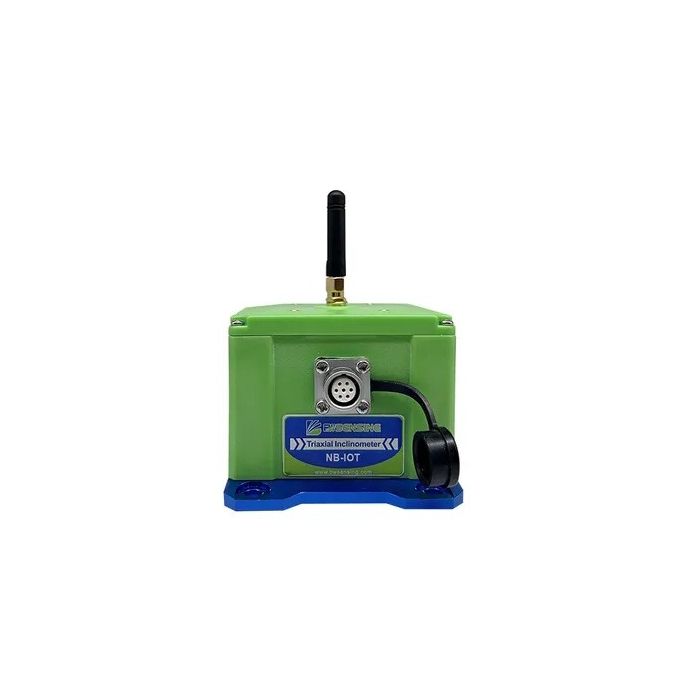
BWSENSING Dual Axis Wireless NB-Iot Inclinometer (NB-WM410)
In stock
- BRAND:
- BWSENSING
- PART #:
- NB-WM410
- ORIGIN:
- China
- AVAILABILITY:
- SUBJECT TO AVAILABILITY
- SKU:
- BWSENSING-NB-WM410
BWSENSING Dual Axis Wireless NB-Iot Inclinometer (NB-WM410)
On a monitoring project, measuring tilt is rarely the hard part. Getting the reading from a remote slope, a tower base or a retaining wall back to an engineer's screen usually is, because cables, loggers and mains power can cost more than the sensor itself. The BWSENSING Dual Axis Wireless NB-Iot Inclinometer (NB-WM410) addresses that problem directly. It measures inclination on two axes, recharges from the sun, and sends its data over cellular networks to a monitoring cloud. Instruments can therefore be placed where the structure needs watching, not where the infrastructure happens to reach.
Robots Europa, based in Dublin, supplies the NB-WM410 to organisations across the European Union and the DACH region. Robots Europa prepares each quotation, arranges delivery to the project site and provides support after installation. Engineering firms, asset owners and research groups therefore deal with one European point of contact from the first enquiry onwards.
Background
Bewis Sensing and its roots at Peking University
The NB-WM410 is made by Bewis Sensing Technology LLC, a company established in 2010. It was founded within the Institute of Microelectronics (IME) of Peking University, so its origins lie in microelectronics research rather than general manufacturing. Since 2019 the company has traded under BWSENSING as its global brand, which is the name used across its range of inclination and motion sensors. Engineers comparing instruments will find the wider family in the BWSensing category. It includes a number of digital-output inclinometers designed for wired installations.
Measuring tilt without a cable run
The NB-WM410 belongs to the NB-WM410/WS2000 series, which BWSENSING describes as a high-accuracy wireless tilt sensor supporting two network modes, NB-IoT and GSM. NB-IoT (Narrowband Internet of Things) is a cellular technology designed for small, infrequent data packets and wide coverage. It suits sensors that report slowly changing values over long periods. GSM provides a second path for sites where narrowband coverage is weak or not yet available. The sensor therefore combines three elements: a dual-axis measuring unit, solar charging and cellular communication. Together they make the device independent of local wiring for both power and data.
Technical Specifications
| Specification | Value |
|---|---|
| Model | NB-WM410 |
| Type | Dual Axis wireless NB-IoT inclinometer |
| Accuracy | 0.01° |
| Resolution | 0.0007° |
| Charging | Solar charging |
| Network | NB-IoT and 2G-GSM |
| Max transmission distance | No limit |
| Cloud system | Customizable Monitoring Cloud System |
Specifications as published by the manufacturer; confirmed against the datasheet at quotation.
The manufacturer has not published the measuring range, dimensions, weight, IP rating, operating temperature, battery capacity, power supply, package contents, output frequency or zero temperature drift; Robots Europa confirms these with you at quotation.
What makes the NB-WM410 different from a wired inclinometer?
A conventional digital inclinometer is one part of a chain. Its signal travels over cable to a logger, the logger needs power, and the data then needs a route to the office. Each link in that chain adds installation work and another point of failure. It also requires periodic site visits. The NB-WM410 shortens the chain to the sensor and the network. Solar charging handles power, and the cellular connection handles data. The Customizable Monitoring Cloud System receives and presents the readings.
This changes how a project is planned. With wired instruments, the layout often follows the cable routes. With a cellular tilt sensor, it can follow the engineering question. Engineers can place a unit at the crest of a cutting, a second on a pylon foundation several kilometres away, and a third on a building next to an excavation. No physical connection between them is needed. The maximum transmission distance is unlimited because the reading travels over a public mobile network rather than a local radio link, so mobile coverage at each location is the condition to check.
Wireless operation does not mean lower measurement quality. The NB-WM410 has an accuracy of 0.01° and a resolution of 0.0007°. This allows very small changes in inclination to be tracked over time, which is what deformation monitoring depends on. Wired instruments still have a role where data must be sampled rapidly or fed into a local control system. For those applications, the digital-output models in the BWSensing range are the more natural comparison.
Why does the NB-WM410 support both NB-IoT and 2G-GSM?
The sensor's value depends on whether its readings arrive. Network coverage across Europe is uneven: NB-IoT rollout differs between operators and countries, and rural or mountainous sites are often the places where monitoring matters most. Supporting both NB-IoT and 2G-GSM gives a project two options rather than one. Where narrowband coverage is good, NB-IoT is designed for low-power telemetry. Where it is not, GSM offers an alternative. Before deployment, we recommend checking network availability for each operator and location, and confirming which mode the units will use. Robots Europa can take these points into account when preparing the quotation.
Who is the BWSENSING Dual Axis Wireless NB-Iot Inclinometer (NB-WM410) for?
The first group is geotechnical and structural engineering consultancies. They need to instrument slopes, embankments, retaining structures or foundations for months or years, often at sites without power or a secure location for a logger. For these teams, the main benefit is reduced installation work: there are no trenches for cable and no generator to service.
The second group is infrastructure owners and operators: railway and road authorities, energy network operators and telecommunications companies with towers spread across large areas. These assets are numerous and widely dispersed, so sending staff to collect data manually becomes expensive. A cellular inclinometer reporting to a customisable cloud system brings the readings into one view.
Contractors on construction sites form the third group. Excavation, dewatering or tunnelling can affect neighbouring buildings and structures, and contractors must monitor them during the works. The ability to install a unit quickly and remove it when the works are finished suits short- and medium-term deployments.
Universities and research institutes form the fourth group, particularly those studying slope stability, hazards or the long-term behaviour of structures. For them, a self-powered, networked sensor makes long observation campaigns at remote sites practical. The series also includes the NB-WS2000, and Robots Europa will set out how the two models differ on request. Buyers looking at the wider market can browse the Sensors category.
What is the BWSENSING Dual Axis Wireless NB-Iot Inclinometer (NB-WM410) used for?
- Slope and landslide monitoring: detecting slow movement on cuttings, embankments and natural slopes before it develops into failure.
- Retaining wall surveillance: tracking the rotation of walls and sheet piling that hold back soil or water.
- Tower and pylon inclination: monitoring the verticality of transmission towers, masts and wind measurement structures over large networks.
- Building and foundation settlement: recording the tilt of structures next to excavations, tunnelling or groundwater changes.
- Bridge and civil structure health: following long-term changes in the inclination of piers, abutments and decks.
- Heritage and ageing structures: observing historic walls, towers and facades where cabling would be intrusive or not permitted.
Pricing and Availability
Robots Europa supplies the NB-WM410 on a quotation basis, so that each offer reflects the quantity, the network mode and the requirements of the project. Delivery, customs and support are arranged together with the quotation, so the commercial and logistical terms are agreed in one document. If you are planning a monitoring project in the EU or the DACH region, please send us the number of units, the type of site and your timeline. To begin, use the quotation request available on this page.
Frequently Asked Questions
How accurate is the NB-WM410?
The NB-WM410 has an accuracy of 0.01° and a resolution of 0.0007°. This makes it suitable for tracking small, gradual changes in inclination.
Which networks does the sensor use?
The sensor supports NB-IoT and 2G-GSM. We recommend confirming coverage from local operators at each installation site before deployment.
Does the NB-WM410 need mains power?
No mains power is needed, as the NB-WM410 uses solar charging. This suits sites without a power connection.
How far can the data be transmitted?
There is no limit on transmission distance, because the readings travel over cellular networks. The practical requirement is mobile coverage at the installation site.
Where are the readings displayed?
The readings are sent to the Customizable Monitoring Cloud System. Engineers can view and review the data there without visiting the site.
Can the NB-WM410 be installed where there is no cabling?
Yes. With solar charging for power and cellular networks for data, the sensor needs neither a cable run nor a local logger.
Where can I buy the BWSENSING Dual Axis Wireless NB-Iot Inclinometer (NB-WM410) and what does it cost?
You can buy the NB-WM410 from Robots Europa, which supplies customers across the EU and the DACH region. The cost depends on quantity and project requirements, so please request a quotation through this page.
Summary
Every tilt monitoring project has to solve two problems: measuring the movement and getting the reading back to the people responsible for the structure. The NB-WM410 handles the first with 0.01° accuracy and 0.0007° resolution. It handles the second with solar charging, NB-IoT and 2G-GSM connectivity, and a customisable monitoring cloud, which removes much of the cabling and power infrastructure that remote sites would otherwise need. The sensor comes from a manufacturer founded within Peking University's Institute of Microelectronics, and Robots Europa supplies and supports it from Dublin. For engineers who need to monitor sites far from any power or data connection, this page is the starting point.


