Dobot Dobot MG400 (Dobot MG400)
In stock
- BRAND:
- DOBOT
- PART #:
- 1200000013
- ORIGIN:
- China
- AVAILABILITY:
- SUBJECT TO AVAILABILITY
- SKU:
- Dobot-Dobot-MG400
Dobot Dobot MG400 (Dobot MG400)
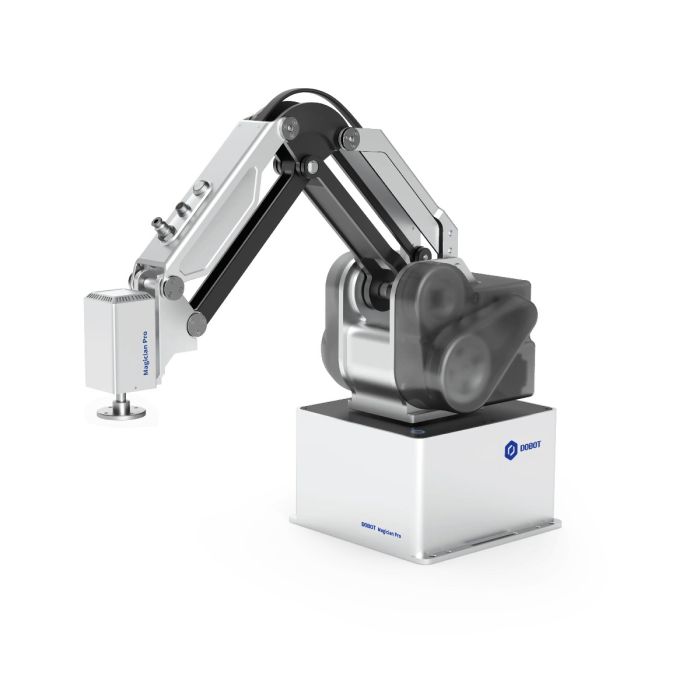
Most automation projects begin with a question about floor space. This one begins with a sheet of paper. The Dobot Dobot MG400 (Dobot MG400) stands on a footprint smaller than an A4 page, yet it brings four axes, a 440 mm working radius and ±0.05 mm repeatability to the workbench. Industrial arms have long lived behind fences and inside dedicated cells. This machine is different: it can share a desk with a microscope, a test fixture or a laptop, and an operator can teach it a task by guiding it by hand.
Robots Europa, based in Dublin, supplies the MG400 to laboratories, system integrators, manufacturers and educational institutions throughout the European Union and the DACH region. Robots Europa prepares each quotation, arranges delivery to your site and provides support once the arm is in service. Buyers in Germany, Austria, Switzerland and the wider EU therefore deal with a single European point of contact from the first enquiry to commissioning.
Background
DOBOT and its desktop lineage
DOBOT is a robotics manufacturer from Shenzhen. It first became known for compact arms aimed at classrooms and makers. It then extended its range to industrial and collaborative robots and, more recently, to humanoid platforms. That progression is visible in the MG400, which carries the approachability of an educational product into a machine specified for real automation work. Its controls and teaching methods are familiar to anyone who has used a desktop arm, but the mechanical specification is meant for repeatable production-style tasks. The complete DOBOT range offered by Robots Europa is collected in the Dobot category.
Positioning and key technology
DOBOT positions the MG400 as a cost-effective option for smart automation tasks, and the feature set explains that positioning. With drag-to-teach, an operator moves the arm through a motion by hand and records it. This lowers the threshold for staff who have never written a robot program. Collision detection is part of the specification, which matters on a crowded bench where people and equipment are close by. A vibration suppression algorithm increases multi-joint motion stability time by 60% and reduces residual vibration by 70%. This helps when the arm has to settle precisely at the end of a move. For more structured work, the MG400 can also be programmed in Lua or through a graphical interface. As a result, the same arm can serve a first-year student and an experienced developer.
Technical Specifications
| Specification | Value |
|---|---|
| Product type | Ultra compact desktop grade robotic arm, footprint smaller than an A4 sheet |
| Number of axes | 4 |
| Payload | 500 g (Max. 750 g) |
| Working radius | 440 mm |
| Repeatability | ±0.05 mm |
| Range of motion J1 | ±160° |
| Range of motion J2 | -25°~85° |
| Range of motion J3 | -25°~105° |
| Power | 100~240V AC, 50/60 Hz |
| Rated voltage | 48V |
| Power consumption | 150W |
| Communication interface | TCP/IP, Modbus TCP |
| Installation | Desktop |
| Weight | 8 kg |
| Base size | 190 mm × 190 mm |
| Operating environment | 0° ~ 40° C |
| Programming | Drag-to-teach, Lua, graphical interface |
| Safety and motion features | Collision detection, vibration suppression algorithm |
Specifications are as published by the manufacturer and are confirmed against the datasheet at quotation. The manufacturer has not published the ingress protection rating, the noise level, details of the brakes, the certifications held or the contents of the package; Robots Europa confirms these at quotation.
How does the Dobot MG400 differ from a full-size industrial arm?
The first difference is scale. Industrial arms of the conventional kind are usually bolted to a pedestal or the floor, wired into a cabinet and enclosed in a guarded cell. The MG400 is designed for desktop installation. Its base measures 190 mm × 190 mm and the arm weighs 8 kg, so it can be placed on an ordinary bench and moved to another bench when a project changes. It runs from a standard 100~240V AC supply and draws 150W. That makes it far easier to bring into a laboratory, a classroom or an office-based development team than a machine that needs its own electrical installation.
The second difference is the way it is taught. Programming a traditional industrial robot usually involves a teach pendant, a proprietary language and trained specialists. On the MG400, drag-to-teach makes guiding the arm by hand a legitimate programming method. Lua and the graphical interface cover the steps in between. For organisations that want to test an automation idea before they commit to a production cell, this is often the deciding factor.
The third difference is integration. The MG400 communicates over TCP/IP and Modbus TCP, which lets it exchange signals with PLCs, PCs and supervisory software through common Ethernet-based protocols. A four-axis layout does not replace a six-axis arm where complex orientations are required. For the planar pick, place and positioning tasks that make up much of benchtop automation, however, it is a deliberate and economical choice.
What does the MG400's payload rating mean in practice?
DOBOT gives two payload figures: 500 g as the rated payload and 750 g as the maximum. The distinction is useful when planning a task. The rated figure is the sensible basis for continuous work. The maximum figure marks the upper limit and should not be treated as a working target. Any gripper, suction cup or tool mounted on the arm counts towards that load, so the end effector and the workpiece have to be considered together.
In practice, this places the MG400 among arms for light objects: electronic components, sample tubes, small mechanical parts, packaging inserts and similar items. Combined with ±0.05 mm repeatability and the vibration suppression algorithm, this suits tasks where precision and consistency matter more than force. When we prepare a quotation, Robots Europa can review the intended tooling and workpiece weight against the arm's payload rating.
Who is the Dobot MG400 for?
Universities, colleges and vocational training centres are a natural fit. The combination of drag-to-teach, a graphical interface and Lua lets one machine accompany students from their first taught motion to scripted programs and network integration. Because the arm is desktop-sized, a teaching laboratory can run several workstations in a modest room.
Research and development laboratories form a second group. Teams automating repetitive bench tasks, or building test rigs for new products, benefit from an arm that sits next to their existing instruments and talks over TCP/IP or Modbus TCP. Small and medium-sized manufacturers make up a third group. For them, the MG400 is an accessible way to pilot automation of light assembly, testing or handling steps before investing in a larger cell.
System integrators and software developers may also find it a practical platform for prototyping applications, demonstrating concepts to clients or developing vision and control software at a desk. The fact sheet names no other version of the MG400. Organisations whose interest lies in humanoid or embodied AI research rather than benchtop handling will find DOBOT's humanoid platforms in the Dobot category.
What is the Dobot MG400 used for?
- Small-part pick-and-place – moving light components between trays, fixtures and conveyors on a workbench.
- Laboratory automation – handling sample containers and repetitive bench steps alongside existing instruments.
- Education and training – teaching robotics, programming and automation principles from drag-to-teach to Lua scripting.
- Inspection and testing – presenting parts to cameras, sensors or test fixtures with consistent positioning.
- Light assembly and dispensing – performing repeatable, precise motions on small assemblies at a desk-scale workstation.
- Automation prototyping – validating a process concept and its PLC or PC integration before scaling up to a production cell.
Pricing and Availability
Robots Europa supplies the MG400 on a quotation basis, so that each offer reflects your configuration, the tooling you intend to use and your delivery location within the EU or the DACH region. Delivery, customs and support are arranged with the quotation. If you would like to discuss the arm for a specific task, our team can also review the details of your application when we prepare the offer. To begin, please request a quotation using the form available on this page.
Frequently Asked Questions
How many axes does the Dobot MG400 have?
The MG400 has 4 axes. Its ranges of motion are ±160° for J1, -25°~85° for J2 and -25°~105° for J3.
How much can the MG400 carry?
The rated payload is 500 g and the maximum payload is 750 g. The weight of any gripper or tool counts towards this figure.
How is the MG400 programmed?
The arm can be taught by hand using drag-to-teach, or programmed in Lua or through a graphical interface. This makes it suitable for beginners and experienced developers alike.
Which communication interfaces does it support?
The MG400 supports TCP/IP and Modbus TCP. This allows it to communicate with PCs, PLCs and other networked equipment.
What are the power requirements and the footprint?
The arm takes 100~240V AC at 50/60 Hz, with a rated voltage of 48V and a power consumption of 150W. Its base measures 190 mm × 190 mm and it weighs 8 kg.
In what operating environment can the MG400 be used?
The MG400 is designed for desktop installation in an operating environment of 0° ~ 40° C. This makes it well suited to laboratories, classrooms and indoor workshops.
Where can I buy the Dobot MG400 and what does it cost?
You can buy the MG400 from Robots Europa, which supplies it across the EU and the DACH region. The price is set in an individual quotation, which you can request on this page.
Summary
The MG400 turns the sheet of paper on your desk into a credible automation cell. On a base smaller than A4, it combines four axes, a 440 mm working radius, ±0.05 mm repeatability and a payload of 500 g (Max. 750 g). It adds drag-to-teach, collision detection and a vibration suppression algorithm, and it can be programmed in Lua or graphically and connected over TCP/IP or Modbus TCP. For teaching laboratories, research teams, smaller manufacturers and integrators who want to bring precise, repeatable motion into an ordinary room, it is a compact and approachable choice. Robots Europa quotes, delivers and supports it across the EU and the DACH region. For anyone planning to bring automation to the workbench, this page is the starting point.