
Elephant Robotics myBuddy 280 Pi (4010100014)
In stock
- BRAND:
- ELEPHANT ROBOTICS
- MODEL:
- MYBUDDY 280 Pi
- PART #:
- 4010100014
- ORIGIN:
- China
- AVAILABILITY:
- SUBJECT TO AVAILABILITY
- SKU:
- Elephant-Robotics-4010100014
Elephant Robotics myBuddy 280 Pi (4010100014)
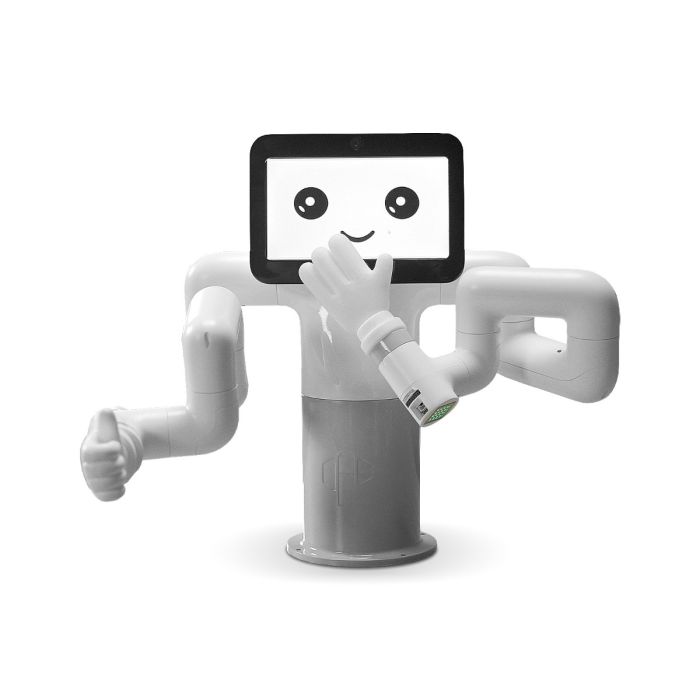
Most desktop robot arms teach one lesson: how a single limb reaches a point in space. The harder lesson, and the one every service robot eventually has to learn, is how two limbs share a task without getting in each other's way. The Elephant Robotics myBuddy 280 Pi (4010100014) brings that lesson to the tabletop. It is a compact humanoid torso with a pair of arms, an interactive screen for a face and cameras that let it see what it is handling. Coordination, machine vision and human–robot interaction stop being three separate projects and become one platform that can be studied, programmed and modified on a single desk.
Robots Europa, based in Dublin, supplies the myBuddy 280 Pi to universities, schools, research groups and companies across the European Union and the DACH region. We prepare each quotation for the package configuration you require, arrange delivery to your premises and remain your point of contact for technical questions once the robot is in use.
Background
Elephant Robotics and its desktop range
Elephant Robotics is a Shenzhen-based manufacturer that has built its reputation on compact collaborative robots for education, research and light commercial work, with the myCobot arms being the best-known part of its range. The company's approach has been to make robotics hardware approachable: open software interfaces, graphical programming for beginners and support for the tools professional developers already use. myBuddy carries that thinking into a dual-arm, humanoid form, giving teaching and research teams a way to explore tasks that a single arm cannot represent. The wider family of products is available in our Elephant category.
A Raspberry Pi at the core
The "Pi" in the name points to the robot's controller. A Raspberry Pi 4 single board computer, offered with 2GB or 4GB RAM, drives the display and communicates with the ESP32 modules that handle the robot's motion hardware. For a developer, this means the robot's brain is a familiar Linux computer rather than a closed control box. A ROS development environment is built in, complete with RVIZ and MOVEIT cases, and the robot's URDF configuration documents are open, so users can carry out secondary modification and development of their own. Beginners can start with myBlockly, while more experienced users move on to Python or ROS on the same hardware.
Technical Specifications
| Specification | Value |
|---|---|
| Working radius (single arm) | 280mm |
| Maximum payload (single arm) | 250g |
| Repeatability | 0.5MM |
| Degrees of freedom | 13 |
| Controller | Raspberry Pi 4 (2GB or 4GB RAM), controls the display and communicates with the ESP32 modules |
| Display | 7-inch interactive display screen |
| Cameras | Two 2-million-pixel HD cameras |
| Camera functions | 45-degree lower camera: area location positioning, object and QR code recognition; second camera: face and body recognition |
| Interfaces | 3.3V I/O ports, Lego ports |
| Power supply | 24V/9.2A |
| Life span | 500 hours |
| Weight | 3 kg |
| Operating system compatibility | Android, Windows, macOS, Linux |
| Programming | myBlockly, ROS, Python |
| ROS environment | Built in, with RVIZ and MOVEIT cases; open URDF configuration documents |
| Compatible accessories | Suction pump, grippers and others |
| Package options | myBuddy; myBuddy+G Shape Base; myBuddy+Left Hand; myBuddy+Right Hand; myBuddy+Left & Right Hand |
| In the box | myBuddy 280 cobot, power supply with DC connector, user manual |
Specifications are as published by the manufacturer and are confirmed against the datasheet at quotation.
The manufacturer has not published the overall dimensions, the IP rating, the operating temperature range, the noise level, the joint speeds or its own net weight figure; these details are confirmed at quotation.
What makes the myBuddy 280 Pi different from a single-arm desktop cobot?
A single-arm desktop cobot is an excellent tool for learning kinematics, path planning and pick-and-place. What it cannot show is the problem of two manipulators working in a shared space: handing an object from one side to the other, holding a part steady while the other arm acts on it, or planning motions that avoid a collision with the robot's own body. With 13 degrees of freedom spread across a humanoid torso, myBuddy makes these problems concrete. Each arm has a working radius of 280mm and lifts up to 250g, which suits light objects such as blocks, tokens, cards and small tools on a lab bench.
The second difference is perception. Many desktop arms need an external camera bolted to a stand before any vision work can begin. myBuddy carries two 2-million-pixel HD cameras on board. The camera angled at 45 degrees below handles area location positioning and recognises objects and QR codes, while the other is dedicated to face and body recognition. Together with the 7-inch interactive display, which acts as the robot's face, this gives a platform that can both see what is on the table and respond to the person standing in front of it.
Finally, the openness of the software sets it apart. Because the URDF files are published and the ROS environment arrives with RVIZ and MOVEIT cases, a dual-arm model can be simulated, visualised and adapted without reverse-engineering anything. The 3.3V I/O ports and Lego ports add a hardware route for sensors, actuators and student-built extensions.
Which myBuddy package should I choose?
Elephant Robotics offers myBuddy in several packages. The base myBuddy package contains the robot itself, its power supply with DC connector and the user manual, and suits teams that plan to fit their own end effectors or work mainly in software. The myBuddy+G Shape Base package adds the G-shaped base for setups that call for it. The hand packages, available as Left Hand, Right Hand or Left & Right Hand, add articulated hands capable of gestures such as yeah, point and praise, as well as grabbing. A single hand is a sensible choice when one arm is reserved for a suction pump or gripper; both hands make the most of the humanoid character for interaction and demonstration work. Robots Europa will confirm the exact contents of each package in your quotation.
Who is the myBuddy 280 Pi for?
Universities and technical colleges are the most natural fit. Courses in robotics, mechatronics and computer science can use the robot to move from graphical programming in myBlockly to Python scripts and finally to ROS projects, all without changing hardware. The dual-arm layout gives lecturers material for coordination and motion-planning assignments that a single arm does not provide.
Research groups working on human–robot interaction will value the combination of a screen face, face and body recognition and gesture-capable hands. It provides a compact, approachable platform for studies on how people respond to a humanoid robot at close quarters.
Developers and makers who already work with Raspberry Pi will find the controller familiar, and compatibility with Android, Windows, macOS and Linux means the robot slots into existing workstations. Museums, innovation centres and corporate showrooms can also use myBuddy for interactive exhibits, where its expressive display and gestures attract visitors. For heavier industrial payloads or full-size humanoid research, the broader Elephant Robotics range and our Shop list other platforms that Robots Europa can quote alongside it.
What is the myBuddy 280 Pi used for?
- Teaching dual-arm coordination: students program both arms to hand over, hold and manipulate light objects in a shared workspace.
- ROS and MoveIt development: the built-in environment and open URDF files support simulation, motion planning and custom modification.
- Machine vision exercises: the lower camera locates areas and recognises objects and QR codes for sorting and positioning tasks.
- Human–robot interaction research: face and body recognition combined with the interactive display allow the robot to react to people.
- Gesture and expression demonstrations: with the hand packages, the robot can point, signal and grab for engaging presentations.
- Accessory-based handling: fitted with a suction pump or gripper, each arm performs light pick-and-place work on the desk.
Pricing and Availability
Robots Europa supplies the myBuddy 280 Pi on a quotation basis, so that the package, accessories and any additional items match your project rather than a fixed catalogue bundle. Let us know which configuration you are considering, whether it is the base robot, the G Shape Base or one of the hand packages, together with your intended application, and we will prepare a tailored offer. Delivery, customs and support are arranged with the quotation. To begin, the request form for your personalised quotation is available on this page.
Frequently Asked Questions
Does the myBuddy 280 Pi support ROS?
Yes. It comes with a built-in ROS development environment that includes RVIZ and MOVEIT cases, and its URDF configuration documents are open for secondary development.
Which programming methods can be used?
The robot can be programmed with myBlockly, Python and ROS. This allows beginners to start with graphical blocks and progress to code on the same machine.
What can the on-board cameras do?
The camera mounted at 45 degrees below supports area location positioning as well as object and QR code recognition. The second camera handles face and body recognition.
How much can each arm lift?
A single arm has a maximum payload of 250g and a working radius of 280mm. That makes the robot suited to light objects rather than industrial loads.
Which operating systems is it compatible with?
myBuddy is compatible with Android, Windows, macOS and Linux. The Raspberry Pi 4 controller itself is offered with 2GB or 4GB RAM.
What is included in the delivery?
The box contains the myBuddy 280 cobot, a power supply with DC connector and the user manual. The G Shape Base and the left, right or both hands are supplied as separate package options.
Where can I buy the Elephant Robotics myBuddy 280 Pi and what does it cost?
You can buy it from Robots Europa, which supplies customers across the EU and the DACH region. The cost depends on the package and accessories you choose, so please request a quotation through this page.
Summary
The step from one robot arm to two is where robotics becomes truly interesting: coordination, shared workspaces and interaction with people all come into play. The Elephant Robotics myBuddy 280 Pi takes that step in a format that fits on a desk. Its 13 degrees of freedom, on-board cameras with object, QR code, face and body recognition, interactive screen face and open ROS environment turn advanced topics into hands-on exercises. Robots Europa quotes, delivers and supports the robot across the EU and the DACH region; for anyone ready to teach, research or demonstrate dual-arm robotics, this page is the starting point.


