
Engineered Arts RoboThespian Humanoid Robot
In stock
- BRAND:
- ENGINEERED ARTS
- MODEL:
- RoboThespian
- ORIGIN:
- United Kingdom
- AVAILABILITY:
- SUBJECT TO AVAILABILITY
- SKU:
- Engineered-Arts-RoboThespian
Engineered Arts RoboThespian Humanoid Robot
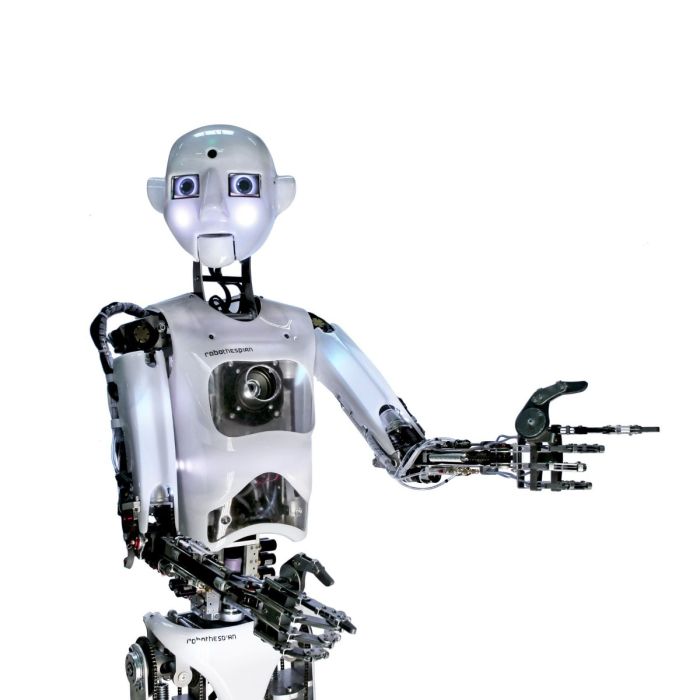
Most humanoid robots are judged by what they can carry or how far they can walk. The Engineered Arts RoboThespian Humanoid Robot is judged by a harder test: whether a crowd stops, turns and listens. It is a performer before it is anything else. It is built to deliver a script, catch a visitor's eye and hold a conversation. Every part of its design follows from that brief: expressive fingers in place of heavy lifting, a face that speaks in light and colour, and a body that gestures as a presenter would on stage.
Robots Europa, based in Dublin, supplies the RoboThespian to museums, visitor attractions, universities and corporate clients throughout the European Union and the DACH region. Robots Europa prepares the quotation for the configuration you choose and arranges delivery to your venue. It also remains your point of contact for support once the robot is in front of its audience.
Background
Engineered Arts and the idea of a robot actor
Engineered Arts was founded by Will Jackson in 2004, and the RoboThespian is the robot most closely associated with the company's name. As the name suggests, it was conceived as a robot actor. The aim was to give a machine the presence of a human presenter, rather than to build a machine that does physical work. That ambition shapes the engineering as well as the appearance. Engineered Arts does not run its robots on an off-the-shelf operating system such as ROS. It uses its own operating system, called Tritium. The same company that builds the hardware therefore also develops the software that drives the robot's performances.
The RT4 and its family of configurations
The current model, RT4, is a life size, interactive, fully programmable humanoid robot exhibit suitable for public display, demonstration and academic research. Its upper body, arms, fingers, head and jaw are all actuated, and they are designed to mimic human expression and gesture. Around that core, the sources name several configurations. The Hard Face head uses LCD screens for the eyes, RGB LEDs in the cheeks and a high speed servo that synchronises the mouth with speech. The Projected Face head uses a pico projector to project the entire face. Gripping Hands add an adaptive grip for grasping objects. Active Legs is a customer specific variant with a further axis of movement that lets the robot bend at the knees. A RoboThespian is therefore specified as much as it is purchased.
Technical Specifications
| Specification | Value |
|---|---|
| Model | RT4 |
| Height | 1.75 metres (5 ft 9 in) |
| Weight | 33 kilograms (73 lb) |
| Chassis | Aluminium |
| Body shell | Polyethylene terephthalate plastic |
| Axes of movement | Over 30 |
| Eyes (Hard Face) | 2 LCD screens |
| Mains power | Standard domestic mains power, 100v - 250v AC |
| Compressed air supply | Un-oiled, 6bar (87psi), filtered to 10µm |
| Peak air consumption | 30L/min (7.9 US gpm) at 6bar (87psi) maximum |
| Airline connection | 8mm (5/16in) outside diameter Push-In-Fitting |
| Operating environment | Indoor use only |
| Recommended room temperature | 10°C - 30°C |
| Recommended relative humidity | 45% - 60% |
| Network | Wired internet connection with good bandwidth |
| Operating system | Tritium |
Specifications are as published by the manufacturer and are confirmed against the datasheet at quotation.
The manufacturer has not published the dimensions of the base and console, the payload, the battery or runtime, the power consumption, the contents of the box or the IP rating; Robots Europa confirms these with you at quotation.
What is the difference between the Hard Face and the Projected Face?
The choice of head decides how the robot's expression reaches the audience, and it is the first decision most buyers make. The Hard Face is a physical, sculpted head. Two LCD screens animate the eyes, and RGB LEDs in the cheeks can show any colour. A high speed servo moves the mouth in time with speech. The result is a face with real mechanical movement in the jaw. It reads clearly from a distance and suits a figure that delivers speeches, sings or tells jokes to a gathered crowd.
The Projected Face takes a different route. A pico projector inside a different head design projects the entire face of the robot, so the features are drawn in light rather than moulded in plastic. Because the face is an image, its look can change with the content. That is attractive for venues that want one robot to take on different characters, or for research groups that study how people respond to facial expression. Neither head is simply the better one. The Hard Face favours physical presence, and the Projected Face favours visual flexibility. Robots Europa can discuss which suits your space and programme when you request a quotation.
What does a RoboThespian installation need on site?
Unlike a battery-powered service robot, the RoboThespian is designed as a fixed exhibit, and it depends on three utilities at its location. The first is standard domestic mains power in the range 100v - 250v AC. The second is compressed air: un-oiled, at 6bar (87psi) and filtered to 10µm, delivered through an 8mm (5/16in) outside diameter Push-In-Fitting. Peak consumption is 30L/min (7.9 US gpm) at 6bar (87psi) maximum, and average consumption is much lower. The third is a wired internet connection with good bandwidth. This connection is required for TinMan Telepresence, remote administration and support, and the installation of updates and new software and content features.
The room matters as well. The robot is suitable for indoor use only, with a recommended temperature of 10°C - 30°C and relative humidity of 45% - 60%. In practice, the planning of an installation involves the building's facilities team as much as the exhibition designers. It is worth confirming the air supply and network point before the robot arrives.
Who is the Engineered Arts RoboThespian Humanoid Robot for?
The clearest fit is any organisation whose business is attention. Museums and science centres use a robot presenter to explain exhibits and to make technology tangible for visitors. Visitor attractions, theme venues and brand experience centres use it as a character that greets, entertains and is remembered. Corporate showrooms and trade fair stands use it to start conversations that a printed banner never would. For academic groups, the RT4's fully programmable design and expressive face make it a platform for studying human-robot interaction, communication and social robotics.
The configuration should follow the use. Buyers who need the robot to hold or hand over objects should look at the Gripping Hands option and its adaptive grip. Projects that call for more of the body to move, such as a figure that bows or crouches, may suit the customer specific Active Legs variant, which adds the ability to bend at the knees. Those comparing the RoboThespian with other platforms can browse our Humanoids category, which brings together humanoid robots for research, service and entertainment.
What is the Engineered Arts RoboThespian Humanoid Robot used for?
- Museum presentation — introducing galleries and explaining exhibits to visitors in a lively, memorable voice.
- Science communication — demonstrating robotics to school groups and families at science centres and festivals.
- Visitor attractions — performing as a resident character that sings, jokes and interacts with guests.
- Trade fairs and showrooms — drawing visitors to a stand and presenting a brand's message in person.
- Human-robot interaction research — studying how people respond to gesture, gaze and facial expression in a programmable humanoid.
- Telepresence — letting a remote operator speak and gesture through the robot via TinMan Telepresence.
Pricing and Availability
Each RoboThespian is configured to its venue, with the choice of head, hands and legs, the content and the installation conditions. For that reason, Robots Europa quotes for every order individually rather than listing a fixed figure. Tell us about your space, your audience and the role you have in mind for the robot, and we will prepare a quotation for the configuration that fits. Delivery, customs and support are arranged with the quotation, so the commercial and logistical terms reach you together. To begin, the quotation request form is available on this page.
Frequently Asked Questions
Can the RoboThespian walk?
The published description covers an actuated upper body, arms, fingers, head and jaw. Walking is not among the stated capabilities. The customer specific Active Legs variant adds a further axis of movement that allows the robot to bend at the knees.
Can the robot be installed outdoors?
No. The RoboThespian is suitable for indoor use only, with a recommended room temperature of 10°C - 30°C and relative humidity of 45% - 60%.
Why does it need compressed air?
The robot requires an un-oiled compressed air supply at 6bar (87psi), filtered to 10µm and connected through an 8mm (5/16in) Push-In-Fitting. Peak consumption is 30L/min (7.9 US gpm), and average consumption is much lower.
Can the robot be operated remotely?
Yes. With a wired network connection, TinMan Telepresence allows remote operation of the robot. The same connection supports remote administration, support and software updates.
Which software does the RoboThespian run?
Engineered Arts uses its own operating system, Tritium, rather than an off-the-shelf system such as ROS.
Can the RoboThespian pick up objects?
On the Hard Face configuration, the fingers can be opened and closed independently for pointing, counting and other gestures. For grasping objects, the Gripping Hands option provides an adaptive grip.
Where can I buy the Engineered Arts RoboThespian Humanoid Robot and what does it cost?
Robots Europa supplies the RoboThespian across the EU and the DACH region. The cost depends on the configuration and the installation, so we provide it in an individual quotation that you can request on this page.
Summary
The RoboThespian answers a question that most humanoids never ask: how to make a room full of people pay attention. Engineered Arts answered it with a performer's toolkit. That toolkit includes a life size RT4 body with actuated arms, fingers, head and jaw, a choice between a sculpted Hard Face and a Projected Face, and options that add grip or knee movement. It runs on the company's own Tritium operating system and can be operated remotely through TinMan Telepresence. It does ask something of its venue in return: mains power, a clean compressed air supply, a wired network and an indoor room within the recommended climate. For a museum, attraction, showroom or research group that wants a robot people remember, Robots Europa can help you define the right configuration, and this page is the starting point.


