
Fairino Cobot (FR3)
In stock
- BRAND:
- FAIRINO
- PART #:
- FR3
- ORIGIN:
- China
- AVAILABILITY:
- SUBJECT TO AVAILABILITY
- SKU:
- Fairino-FR3
Fairino Cobot (FR3)
Most automation projects stall not on the robot but on the space around it: a bench already crowded with fixtures, a line that cannot be stopped for weeks, an operator who still needs to reach in. The Fairino Cobot (FR3) is built for that cramped reality. Its base footprint is 128mm and the arm weighs ≈15kg, so it fits where a conventional industrial robot and its guarding would never go. Across a 622mm reach it still holds ±0.02mm pose repeatability. It sits at the compact end of the FAIRINO range, and its appeal lies in how little it asks of the workstation it joins.
Robots Europa, based in Dublin, supplies the Fairino Cobot (FR3) to manufacturers, integrators and research institutions throughout the European Union and the DACH region. We prepare quotations for the IP54 and IP65 versions and coordinate delivery to your site. After commissioning, we remain your point of contact for technical questions, so that one partner looks after the arm from the first enquiry to everyday operation.
Background
FAIRINO and the FR series
FAIRINO builds its collaborative robots as a family. The arms share a common architecture, from compact models for benchtop work to larger arms for heavier handling. For a user, the practical benefit is consistency. The programming environment, the teach pendant and the software interfaces stay the same as payload requirements grow. A team that has learnt to deploy one FAIRINO arm can apply that knowledge to the next without starting again. The FR3 is the entry point to this family. It is the model most often chosen where the parts are small, the cell is tight and precision matters more than lifting capacity. You will find the wider range on our Fairino overview page.
A cobot designed around the compact workstation
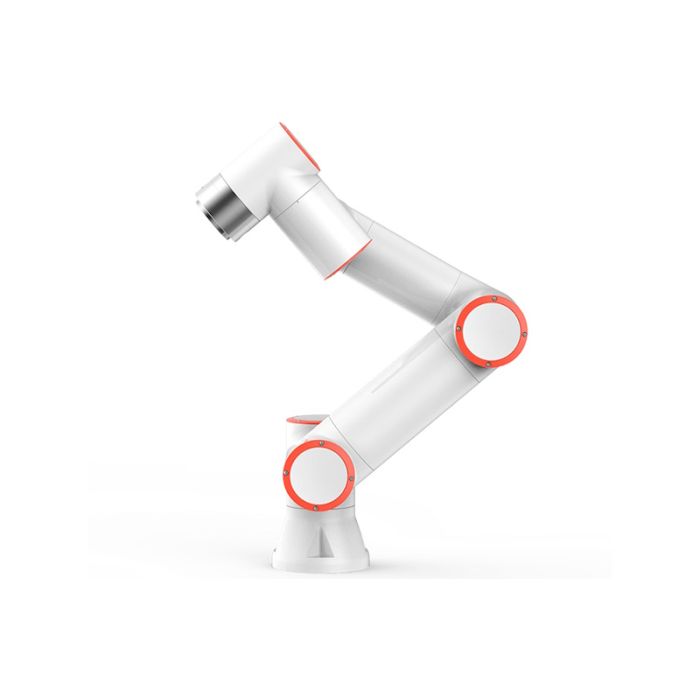
The FR3 is a 6-axis cobot with six rotating joints. It is designed to automate compact workstations quickly and precisely, and three design choices support that aim. The first is mounting: the arm can be installed in any orientation, so it can sit on a bench, hang from a gantry or be fixed to a wall, wherever the process is best served. The second is commissioning. The robot can be programmed by direct teaching, in which the operator guides the arm by hand through the required positions. It can also be programmed through a web interface or on the 10.1 inch teach pendant, which shortens the time between delivery and productive work. The third is openness: developers can work in C, C++ or Python and connect the arm to ROS and ROS2. This makes the FR3 as comfortable in a university laboratory as on a production floor.
Technical Specifications
| Specification | Value |
|---|---|
| Payload | 3kg |
| Reach | 622mm |
| Degrees of freedom | 6 rotating joints |
| Pose repeatability | ±0.02mm |
| Typical TCP speed | 1m/s |
| IP classification | IP54 (IP65 optional) |
| Noise | <65dB |
| Robot mounting | Any orientation |
| Tool I/O ports | (DI) 2 (DO) 2 (AI) 1 (AO) 1 |
| Footprint | 128mm |
| Weight | ≈15kg |
| Operating temperature | 0–45°C |
| Typical average power | 220W |
| Typical peak power | 280W |
| Human-machine interface | 10.1 inch teach pendant or mobile terminal Web App |
| Software development | C/C++/Python / ROS/ROS2 |
| Programming methods | Direct teaching, web interface, teach pendant |
Specifications are as published by the manufacturer and are confirmed against the datasheet at quotation.
FAIRINO has not published the rated supply voltage of the arm, the joint torque limits, the collision detection sensitivity, the cable length between arm and controller, the accessories included in the box or the safety certifications; Robots Europa confirms each of these at quotation.
What makes the FR3 different from the larger FAIRINO cobots?
The difference is one of proportion rather than capability. The FR3 has a 3kg payload, so it suits grippers, suction cups, small screwdrivers and dispensing valves rather than heavy workpieces. In return, it brings a set of advantages that larger arms cannot match in a small cell.
The base footprint of 128mm takes up very little of a workbench. At ≈15kg, the arm can be moved between stations by two people without lifting equipment. Typical average power is 220W and peak power 280W, a modest load on the electrical supply of a workshop or laboratory. Noise remains below 65dB, which matters when the robot works next to people for an entire shift.
Precision is the other distinguishing point. With a pose repeatability of ±0.02mm, the FR3 returns to a taught position consistently enough for fine assembly, the insertion of small components and accurate dispensing. Together with the typical TCP speed of 1m/s, this makes the arm a sound choice for short, repetitive cycles, where the accuracy of each movement counts more than raw lifting capacity.
IP54 or IP65: which version of the FR3 do you need?
The FR3 comes with IP54 protection as standard, and an IP65 version is available as an option for dusty and damp environments. In most clean assembly areas, electronics production and laboratories, the standard IP54 version will be sufficient. The IP65 version is the better choice where the arm is exposed to fine dust, coolant spray or regular cleaning. This applies, for example, beside machine tools or in food-related packaging tasks. If you describe your environment when you enquire, Robots Europa will recommend the appropriate version.
Who is the Fairino Cobot (FR3) for?
Electronics and precision manufacturers are the most natural buyers. Their parts are small and their tolerances tight, and their benches leave little room for additional equipment. The FR3 can take over repetitive placement, testing and dispensing work without a redesign of the line.
Small and medium-sized enterprises introducing their first cobot benefit from the three programming methods. A production employee can teach a task by guiding the arm by hand, without first learning a robot programming language. Because the arm can be mounted in any orientation and is easy to move, it can also be redeployed when production changes.
Universities, research institutes and development teams will value support for C, C++, Python, ROS and ROS2. The arm integrates into existing research software environments, and its compact size makes it practical for teaching laboratories.
System integrators can use the FR3 as a standard building block for compact cells and offer their customers a consistent platform across several projects.
Where the gripper and workpiece together exceed the 3kg payload, or where a longer reach is required, a larger model is the better choice. The Fairino FR5 Collaborative Robot (Cobot), the Fairino FR10 Collaborative Robot (Cobot) and the Fairino Cobot (FR16) continue the range with the same operating concept. Further options are listed in our Cobots category.
What is the Fairino Cobot (FR3) used for?
- Small-part assembly: inserting, joining and fitting light components where repeatable positioning is essential.
- Pick and place: transferring parts between trays, conveyors and fixtures in short, steady cycles.
- Dispensing and gluing: guiding a valve along a seam or contour with consistent accuracy.
- Screwdriving: carrying a lightweight electric screwdriver for repetitive fastening on small assemblies.
- Inspection and testing: presenting parts to cameras or test fixtures, or moving a sensor over a workpiece.
- Research and education: serving as a ROS and Python platform for robotics teaching, prototyping and algorithm development.
Pricing and Availability
Robots Europa supplies the Fairino Cobot (FR3) on the basis of an individual quotation, so that the version, the configuration and any accessories match your application. Tell us about your task, the environment and the preferred version, and we will prepare a tailored offer. Delivery, customs and support are arranged together with the quotation. The quotation request for the Fairino Cobot (FR3) is available on this page.
Frequently Asked Questions
What payload can the Fairino Cobot (FR3) handle?
The FR3 has a payload of 3kg. This load must include the gripper or tool as well as the workpiece.
How precise is the FR3?
The FR3 has a pose repeatability of ±0.02mm. It is well suited to fine assembly and accurate dispensing.
Can the FR3 be mounted on a wall or ceiling?
Yes. The arm can be mounted in any orientation, including on benches, walls and overhead structures.
How is the FR3 programmed?
You can program it by direct teaching, through a web interface or on the 10.1 inch teach pendant. For software development, C, C++, Python, ROS and ROS2 are supported.
Is the FR3 suitable for dusty or damp environments?
The standard version is rated IP54, and an IP65 version is available for dusty and damp environments. Robots Europa will advise you on which version suits your site.
How much power does the FR3 draw?
Typical average power is 220W and typical peak power is 280W. That is a modest demand for the electrical supply of a workshop or laboratory.
Where can I buy the Fairino Cobot (FR3) and what does it cost?
You can buy the Fairino Cobot (FR3) from Robots Europa, which supplies customers across the EU and the DACH region. The cost depends on the version and configuration, so please request a tailored quotation on this page.
Summary
The Fairino Cobot (FR3) answers a question many workshops face: how to automate a task when there is barely room for the robot. Its base footprint is 128mm and it weighs ≈15kg. It can be mounted in any orientation and offers ±0.02mm pose repeatability, so it fits in where space is tight without compromising on precision. Three programming methods and open interfaces to C, C++, Python, ROS and ROS2 shorten the route to productive operation, and the IP54 and IP65 versions cover a range of environments. Robots Europa supplies, delivers and supports the arm across the EU and the DACH region. For a compact cell that needs a precise, unobtrusive helper, this page is the starting point.


