
DISCONTINUED - Fourier GR1 Humanoid Robot (GR-1)
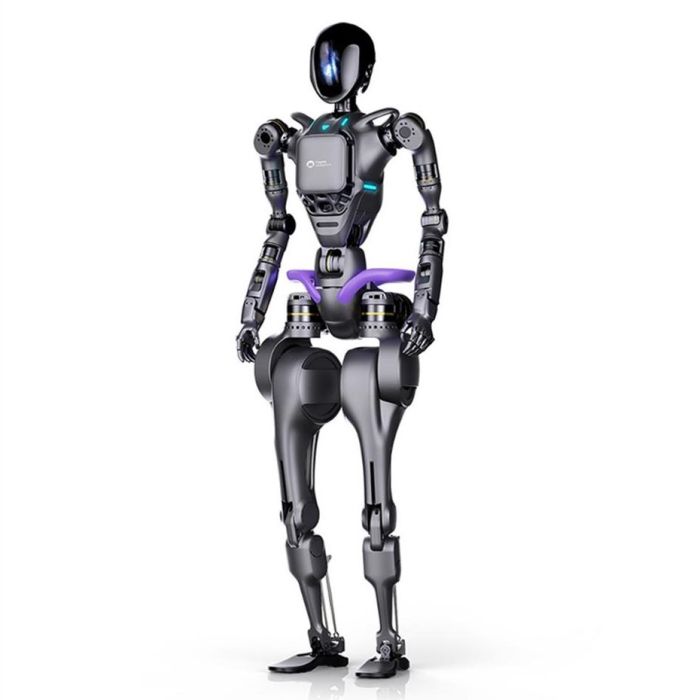
Out of stock
- BRAND:
- FOURIER
- MODEL:
- GR1
- ORIGIN:
- China
- AVAILABILITY:
- SUBJECT TO AVAILABILITY
- SKU:
- Fourier-GR1
DISCONTINUED - Fourier GR1 Humanoid Robot (GR-1)
Most humanoid robots are sold on the promise of what they will do next year. The DISCONTINUED - Fourier GR1 Humanoid Robot (GR-1) deserves attention for the opposite reason: its design is settled. It stands 1650 mm tall, weighs around 55 kg and moves on 44 joint actuators. It is the machine with which Fourier stepped from rehabilitation equipment into full-size bipedal robotics. For a laboratory that wants a human-scale platform running Ubuntu and ROS 2, a design that no longer changes beneath its feet can be an advantage rather than a drawback.
Robots Europa, based in Dublin, supplies the GR-1 to universities, research institutes and companies across the European Union and the DACH region. As the model is discontinued, each enquiry is handled individually. Robots Europa establishes what can still be sourced, prepares a written quotation, and arranges delivery and support for the buyer's country.
Background
Fourier: from rehabilitation to humanoids
Fourier built its reputation in rehabilitation robotics, developing devices that guide and support human limbs during therapy, such as the AnkleMotus ankle joint equipment. That work centres on the same problems a humanoid has to solve: controlling joints smoothly, measuring forces precisely, and moving safely in close proximity to people. The step from exoskeletons and therapy devices to a complete bipedal robot was therefore a logical one. The GR-1 was the result: a robot that applies Fourier's actuator and control experience to a full human-shaped body rather than to a single limb.
Where the GR-1 sits in the GR series
The GR-1 opened Fourier's GR series of general-purpose humanoids, and the figures below are those of that series. It was conceived as a platform rather than a finished appliance. It is meant to be programmed, instrumented and extended by the people who buy it. That positioning shows in its specification: a standard Linux and ROS 2 software base, a commercial depth camera, and external ports for peripherals. Fourier has since extended the range with further humanoids, which is why the GR-1 is now listed as discontinued. For research groups, however, the first model of a series often remains the reference point against which later work is compared.
Technical Specifications
| Specification | Value |
|---|---|
| Standing size | 1650 x 515 x 320 mm |
| Arm span | 1680 mm |
| Net weight | ≈ 55 kg |
| Materials | Aluminium alloy, engineering plastics |
| Walk speed | 5 km/h |
| Single hand payload | ≈ 3 kg |
| Total joint actuators | 44 |
| FSA actuators | 32 |
| Max. joint torque | 230 N.m |
| Battery capacity | 483 Wh |
| Battery type | Lithium battery |
| Cruise duration | ≈ 60 min |
| Walk cruise duration | ≈ 45 min |
| Full charge time | 315 min |
| Depth camera | Realsense |
| Operating system | Ubuntu20.04+ROS 2 |
| Wireless connection | Wi-Fi,EEE 80211a/b/g/n/ac, bluetooth 4.2 |
| External interfaces | HDMIx1,Type-C x 3(fast charge,USB,peripheral extension ports) |
Specifications are as published by the manufacturer for the GR series and are confirmed against the datasheet at quotation.
Fourier has not published the IP rating, the operating temperature range, the maximum incline, the degrees of freedom of the hands, the package contents or the maximum running speed; Robots Europa confirms these at quotation.
What do 44 joint actuators and ROS 2 mean for a research team?
The actuator count is the figure that defines this robot. The GR-1 has 44 joint actuators, 32 of them FSA units, with a maximum joint torque of 230 N.m. This gives a research team a body with enough articulation to study whole-body motion rather than isolated movements. Balance, arm coordination and gait can be investigated on the same machine, and the torque available at the strongest joints is what allows a robot of around 55 kg to carry its own weight on two legs at a walking speed of 5 km/h.
The software base matters just as much. The GR-1 runs Ubuntu20.04+ROS 2, so a group that already works with ROS 2 can bring its existing tools, messages and habits to the robot instead of learning a proprietary environment first. Perception is handled by a Realsense depth camera, a sensor family that many laboratories already use on other platforms. An HDMI port and three Type-C ports, covering fast charging, USB and peripheral extension, give room to add sensors, displays or development hardware. Wi-Fi and Bluetooth 4.2 provide wireless connection for tele-operation and data transfer.
Taken together, this is a robot designed to be worked on. The figures describe a system for experimentation rather than a closed product with a fixed set of behaviours.
Is a discontinued humanoid still a sensible purchase?
A discontinued label deters some buyers. For others it is precisely the point. A design that is no longer being revised offers a stable target: code written today will not have to chase a hardware revision next quarter, and results can be compared with the body of work other groups have already produced on the same platform.
There are practical questions that deserve a clear answer before any order, and Robots Europa addresses them in the quotation. These cover the availability of spare parts, the state of software updates, the warranty terms that apply, and the condition and origin of the unit offered. Session planning is also worth considering. The cruise duration is around 60 minutes, or around 45 minutes when walking, and a full charge takes 315 minutes from the 483 Wh lithium battery. A laboratory will typically schedule experiments around charging cycles, and that rhythm is easier to plan when the figures are known in advance.
Where a buyer needs a platform that is still actively developed, a newer Fourier model may be the better choice. The next section points to the alternatives.
Who is the GR-1 for?
The GR-1 suits university laboratories and research institutes working on bipedal locomotion, whole-body control, human–robot interaction and embodied artificial intelligence. It also suits teams that want a human-scale robot for these fields without first building their own. Its ROS 2 basis makes it a natural fit for groups that already teach or develop in that ecosystem. Engineering faculties can use it as a teaching platform, where students work on a real full-size humanoid rather than on a simulation alone. Innovation centres, museums and corporate showrooms may also value it as a recognisable machine for demonstrations of humanoid technology.
Some buyers will be better served elsewhere in the range. Organisations that need a current, supported Fourier humanoid should look at the Fourier GR2 Humanoid Robot. Developers who place open-source access at the top of their requirements will find the Fourier N1 Open-Source Humanoid Robot worth comparing. Where the task centres on two-armed manipulation and walking is not required, the Fourier GRW Wheeled Bi-Arm Robot may be the more direct answer. The wider selection can be found among our Bipedal Humanoids and in the full Humanoids category.
What is the GR-1 used for?
- Locomotion research — studying balance, gait generation and fall recovery on a full-size bipedal body.
- Manipulation studies — testing grasping and handling strategies within a single hand payload of around 3 kg.
- Perception and navigation — combining the Realsense depth camera with mapping and obstacle-avoidance algorithms.
- ROS 2 software development — building and validating control and behaviour stacks on Ubuntu20.04+ROS 2.
- Teaching and training — giving engineering students hands-on experience with a real humanoid in laboratory courses.
- Demonstrations and public engagement — presenting humanoid robotics at exhibitions, open days and innovation centres.
Pricing and Availability
Robots Europa supplies the GR-1 on quotation only. Because the model is discontinued, the quotation is where availability, the condition of the unit and the support terms are set out in writing. Please describe your intended application and your country of delivery in your enquiry, so that the offer reflects your actual requirements. Delivery, customs and support are arranged with the quotation. To begin, use the quotation request available on this page.
Frequently Asked Questions
Is the Fourier GR-1 still in production?
No, the GR-1 is listed as discontinued. Robots Europa states in the quotation whether a unit can be supplied and on what terms.
What software does the GR-1 run?
The GR-1 runs Ubuntu20.04+ROS 2. Teams familiar with ROS 2 can therefore work with their existing tools.
How long does the GR-1 operate on one charge?
The cruise duration is around 60 minutes, or around 45 minutes when walking, from a 483 Wh lithium battery. A full charge takes 315 minutes.
How much can the GR-1 carry?
The single hand payload is around 3 kg. Its arm span is 1680 mm.
Which camera does the GR-1 use for perception?
The GR-1 uses a Realsense depth camera. It is a sensor family that many laboratories already work with on other platforms.
How does the GR-1 connect to other equipment?
It offers Wi-Fi and Bluetooth 4.2 for wireless connection. For cabled peripherals there is one HDMI port and three Type-C ports for fast charging, USB and peripheral extension.
Where can I buy the DISCONTINUED - Fourier GR1 Humanoid Robot (GR-1) and what does it cost?
Robots Europa supplies the GR-1 across the EU and the DACH region. The price is set out in a written quotation, which you can request on this page.
Summary
The GR-1 is no longer a promise about the future. It is the humanoid with which Fourier carried its rehabilitation expertise into a complete bipedal body, and its specification is now fixed. That stability is its argument: 44 joint actuators, a maximum joint torque of 230 N.m, a Realsense depth camera and a familiar Ubuntu and ROS 2 software base, offered to teams that value a known platform over the newest one. Robots Europa sets out availability and support in writing before any commitment, and points buyers to newer Fourier models where those fit better. For a laboratory weighing up a full-size humanoid with a settled design, this page is the starting point.


