
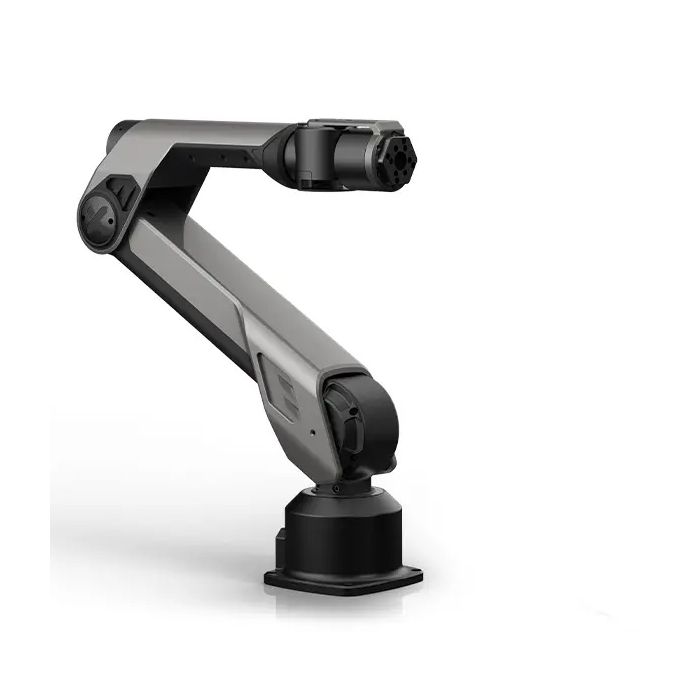
Galaxea A1 Robotic Arm (A1)
In stock
- BRAND:
- GALAXEA
- PART #:
- A1
- ORIGIN:
- China
- AVAILABILITY:
- SUBJECT TO AVAILABILITY
- SKU:
- Galaxea-A1
Galaxea A1 Robotic Arm (A1)
Ask a humanoid robot to fold a towel or clear a table, and it is the arms that do the real work; the wheels, torso and cameras exist mainly to place them in the right spot. The Galaxea A1 Robotic Arm (A1) is one of those arms, offered on its own. It is the lightweight, force-controlled manipulator that GALAXEA fits in pairs to its Galaxea R1 wheeled humanoid, made available here for a bench, a mobile base or a research cell of your own design. It brings six degrees of freedom, a maximum reach of 700 mm and a 48 V rated supply to teams that want the same limb without the rest of the robot.
Robots Europa, based in Dublin, supplies the Galaxea A1 to universities, research institutes and industrial development teams across the European Union and the DACH region. Robots Europa prepares each quotation to match the intended set-up, arranges delivery to your site and remains your point of contact for technical questions and support once the arm is in service.
Background
GALAXEA and its embodied AI hardware
GALAXEA builds hardware for embodied artificial intelligence, the field concerned with machines that learn to act in the physical world rather than only to process text or images. Its range spans complete robots, such as the Galaxea R1 Wheeled Humanoid Robot, as well as the components from which those robots are assembled. The A1 belongs to the second group: a building block that the company uses in its own platforms and also offers to researchers who prefer to assemble their own systems. The sources name several versions of the arm, namely the A1, A1X, A1Z and A1XY; this page concerns the A1.
A limb designed for a two-armed robot
The Galaxea R1 features two Galaxea A1 robot arms and two Galaxea G1 grippers. That origin shapes the arm's character. An arm intended to work as one of a pair on a mobile humanoid must be light enough to be carried by the robot's body and must behave safely when working close to people and objects. GALAXEA describes the A1 as lightweight and force-controlled, engineered for agility and confident payload handling, and the arm delivers full-stroke motion across all six joints. In practice this positions the A1 less as a fenced-off production machine and more as a manipulator for interaction-rich research, where the arm is expected to touch, push and adapt rather than simply move between fixed points.
Technical Specifications
| Specification | Value |
|---|---|
| Product type | Lightweight, force-controlled robotic arm |
| Degrees of freedom | 6 |
| Joint motion | Full-stroke motion across all six joints |
| Maximum reach | 700 mm |
| Rated voltage | 48 V |
| Used in | Galaxea R1 (two A1 arms with two Galaxea G1 grippers) |
Specifications are as published by the manufacturer and are confirmed against the datasheet at quotation.
The manufacturer has not published the IP rating, the operating temperature range, the package contents, the software or SDK support, the operating noise level or the control interface protocol; Robots Europa confirms each of these with you at quotation.
What does force control add to a six-axis arm?
Most industrial arms are position-controlled: they are told where to go and they go there, regardless of what lies in the way. That is ideal for repetitive work in a guarded cell, but it makes contact difficult. A force-controlled arm, by contrast, can regulate how hard it presses as well as where it moves, which is what tasks such as inserting a part, wiping a surface or handing an object to a person actually require.
Combined with six degrees of freedom, force control gives the A1 the ability to reach a point from different orientations while remaining compliant on contact. For research groups training manipulation policies, this matters a great deal: learning algorithms make mistakes, and an arm that yields rather than resists when a trial goes wrong protects both the hardware and the objects in the scene. GALAXEA designed the A1 for exactly this kind of agile, interactive work, which is why it is the arm chosen for its own humanoid.
How does the A1 relate to the Galaxea R1?
The relationship is direct: the A1 is the arm, and the R1 is a robot built around two of them. Buying the A1 separately therefore makes sense in a few distinct situations. A laboratory may want to develop and test manipulation skills on a fixed bench before moving to a full humanoid; working with the same arm reduces the gap between bench results and behaviour on the complete robot. A team may also wish to build a custom dual-arm station or mount the arm on its own mobile base. And an organisation already running R1 robots may value a standalone arm for parallel experiments or as a spare.
Where the goal is a complete mobile manipulation platform from the outset, the R1 itself is the more direct route, since it integrates the arms, grippers and mobile base in one system. Robots Europa can advise on which path suits a given programme.
Who is the Galaxea A1 for?
The A1 is aimed first at research groups in robotics and artificial intelligence: university departments, public research institutes and corporate laboratories that study manipulation, imitation learning or human-robot interaction. For these buyers, the combination of light weight, force control and a 700 mm reach provides a capable working envelope without the infrastructure that a heavy industrial robot demands.
A second group consists of engineering teams prototyping new robotic products, for example service robots or mobile manipulators, who need a proven arm to integrate into their own designs. A third consists of educators running advanced robotics courses, where students benefit from working with a modern force-controlled manipulator rather than a toy arm.
Buyers planning work in harsh or wet surroundings are welcome to describe their environment in the enquiry. Those whose project calls for a different configuration of the arm may also wish to compare the Galaxea A1 XY Robotic Arm (A1 XY); Robots Europa can explain the differences between the versions. The wider ranges of robot arms and cobots offer further alternatives for comparison.
What is the Galaxea A1 used for?
- Manipulation research: studying grasping, placing and tool use on a six-axis arm with a generous working envelope.
- Embodied AI training: collecting demonstration data and testing learned policies on real hardware rather than in simulation alone.
- Contact-rich tasks: exploring insertion, wiping, pushing and other work in which controlled force matters as much as position.
- Dual-arm systems: building bimanual stations in the spirit of the Galaxea R1, which pairs two A1 arms.
- Mobile manipulation prototypes: mounting a lightweight arm on a mobile base to develop service and logistics robots.
- Advanced robotics teaching: giving students hands-on experience of force-controlled manipulation in laboratory courses.
Pricing and Availability
Robots Europa supplies the Galaxea A1 on quotation, so that the offer reflects your configuration, intended use and destination within the EU or the DACH region. Delivery, customs formalities and technical support are arranged together with the quotation. Robots Europa can also advise on how the arm fits into your existing laboratory or development set-up. To begin, simply send your enquiry using the quotation request available on this page.
Frequently Asked Questions
How many degrees of freedom does the Galaxea A1 have?
The A1 has six degrees of freedom, with full-stroke motion across all six joints.
What is the maximum reach of the A1?
The A1 has a maximum reach of 700 mm.
What supply voltage does the arm require?
The A1 has a rated voltage of 48 V.
Is this the same arm that is used in the Galaxea R1?
Yes. The Galaxea R1 features two Galaxea A1 robot arms together with two Galaxea G1 grippers.
Is the A1 a force-controlled arm?
Yes. GALAXEA describes the A1 as a lightweight, force-controlled robotic arm engineered for agility and confident payload handling.
Which versions of the A1 arm exist?
The sources name the A1, A1X, A1Z and A1XY. This page covers the A1, and Robots Europa can help you compare it with the other versions.
Where can I buy the Galaxea A1 Robotic Arm (A1) and what does it cost?
You can buy the Galaxea A1 from Robots Europa, which supplies customers across the EU and the DACH region. The cost depends on your configuration and destination and is set out in a personal quotation, which you can request on this page.
Summary
The Galaxea A1 is the arm that does the work on GALAXEA's own humanoid, now available to teams who want that limb in a system of their own. It combines a lightweight, force-controlled design with six degrees of freedom, full-stroke joint motion, a maximum reach of 700 mm and a 48 V rated supply, making it well suited to manipulation research, embodied AI and prototyping in which the arm must interact gently and capably with its surroundings. Robots Europa supplies it across the EU and the DACH region and supports it after delivery. For anyone who wants to work with the same arm that powers the Galaxea R1, this page is the starting point.


