
MagicLab MagicBot Z1 Development Edition Humanoid Robot
In stock
- BRAND:
- MAGICLAB
- MODEL:
- MAGICBOT Z1 DEVELOPMENT EDITION
- ORIGIN:
- China
- Warranty:
- 12 MONTHS
- AVAILABILITY:
- SUBJECT TO AVAILABILITY
- SKU:
- MagicLab-MagicBot-Z1-Dev
MagicLab MagicBot Z1 Development Edition Humanoid Robot
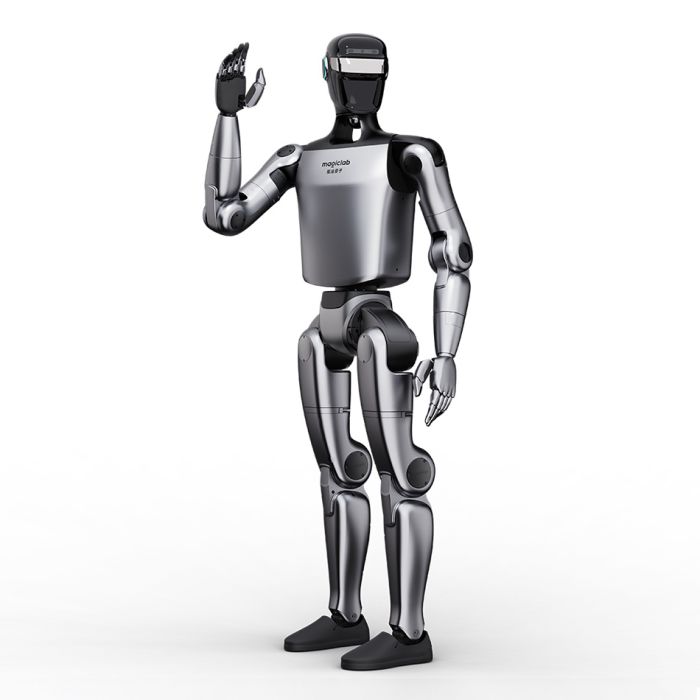
Most machines are engineered never to fall. A humanoid built for research has to be allowed to, because balance, recovery and whole-body control are learnt at the edge of stability, not safely inside it. The MagicLab MagicBot Z1 Development Edition Humanoid Robot is designed with that reality in mind: a compact, highly dynamic biped that walks, runs and gets itself up again after a fall. Its joints run on industrial-grade high-rigidity roller bearings, chosen to absorb the knocks that a busy experimental programme inevitably delivers, so the platform keeps working long after the first stumble.
Robots Europa, based in Dublin, supplies the MagicBot Z1 Development Edition to universities, research laboratories, system integrators and commercial organisations across the EU and the DACH region. Robots Europa prepares each quotation, arranges delivery to the customer's site and provides support once the robot is in use, giving European teams a single point of contact from the first enquiry onwards.
Background
MagicLab and the MagicBot line
The robot is manufactured by Magiclab Robotics Technology (Wuxi) Co., Ltd., a company based in Wuxi, in Jiangsu Province, China. MagicLab develops humanoid and legged robots under its MagicBot and MagicDog names, and the Z1 is its compact humanoid. The Z1 comes in two versions: the Standard Edition and the Development Edition described on this page. It is a highly dynamic humanoid robot for scientific research and education, exhibitions and exchanges, commercial performances and entertainment, and home companionship, which places it between the laboratory bench and the public-facing stage.
That breadth matters. A robot intended only for demonstrations can be tuned for a narrow repertoire of movements, whereas one intended for research must accept new code, new sensors and new tasks. The Z1 is pitched at both audiences, and the Development Edition is the configuration that names development in its title.
A platform built to be extended
The defining idea behind the Z1 is expandability. The body starts with 24 basic degrees of freedom and can be expanded up to 50 DoF. Each arm offers 5+ degrees of freedom, with the optional addition of 2 wrist DoF, and an optional 11-DoF WeiKuan dexterous hand can be fitted for manipulation work. Computing follows the same logic: an 8-core high-performance CPU forms the basic configuration, and an optional high-computing-power module is available for heavier workloads such as perception models or on-board learning.
On the software side, the Z1 supports OTA updates and secondary development, so a research group can build its own behaviours on top of the robot's motion capabilities rather than working around a closed system. Perception comes from a 3D LiDAR, a depth camera and a binocular fisheye camera, and the robot accepts voice commands and supports chatbot voice interaction, which gives developers a full sensing and interaction stack to experiment with.
Technical Specifications
| Specification | Value |
|---|---|
| Standing dimensions (H × W × T) | 1369 × 422 × 200 mm (136.9 × 42.2 × 20 cm) |
| Total weight | Approx. 40 kg+ (with battery) |
| Degrees of freedom | 24 basic DoF, expandable up to 50 DoF |
| Single-arm DoF | 5+ (optional addition of 2 wrist DoF) |
| Dexterous hand | Optional 11-DoF WeiKuan dexterous hand |
| Maximum joint torque | 130 N·m |
| Joint range of motion | Up to 320° (some joints); knee joint –152°, head Z-axis ±40° |
| Battery | 10000 mAh (quick-release smart battery) |
| Sensor configuration | 3D LiDAR, depth camera, binocular fisheye camera |
| Computing module | 8-core high-performance CPU (basic), optional high-computing-power module |
| Audio | Voice commands, chatbot voice interaction |
| Motion capabilities | Humanoid walking, humanoid running, getting up after falling |
| Software / development | Supports OTA / secondary development |
| Joint structure | Industrial-grade high-rigidity roller bearings |
| Manufacturer | Magiclab Robotics Technology (Wuxi) Co., Ltd., Wuxi, Jiangsu, China |
Specifications as published by the manufacturer; they are confirmed against the datasheet at quotation.
The manufacturer has not published the charging time, the IP rating, the maximum walking speed, the charger rating or the contents of the box for the Development Edition; these details are confirmed at quotation.
What makes the MagicBot Z1 Development Edition suited to secondary development?
A development platform is judged less by what it does out of the box than by how far it can be taken. Here the Z1 offers several levers at once. The degree-of-freedom count can grow from 24 basic DoF up to 50 DoF, which means a team can begin with locomotion and later add wrists and the optional 11-DoF WeiKuan dexterous hand when the research moves towards manipulation. The arms themselves offer 5+ DoF each, with 2 further wrist DoF available as an option.
Processing can scale in the same way. The basic 8-core high-performance CPU handles the robot's own control, while the optional high-computing-power module gives headroom for vision, mapping and learning experiments that would otherwise need to run off-board. Combined with support for OTA updates and secondary development, this lets a laboratory treat the Z1 as a long-term research asset whose capabilities grow with the project, rather than a fixed demonstrator.
The sensor suite completes the picture. A 3D LiDAR, a depth camera and a binocular fisheye camera give developers complementary data for navigation, obstacle perception and scene understanding, and the voice command and chatbot interaction features open the door to human–robot interaction studies.
How does the MagicBot Z1 cope with falls and demanding motion?
Dynamic locomotion research means pushing a robot until it loses balance. The Z1 supports humanoid walking, humanoid running and getting up after falling, so a fall becomes part of the experiment rather than the end of it. Its joints deliver up to 130 N·m of torque, powering dynamic walking and motion testing, and the range of motion reaches up to 320° on some joints, with the knee joint reaching –152° and the head Z-axis turning ±40°.
Mechanical durability is addressed at the joint level. Industrial-grade high-rigidity roller bearings help the structure withstand impact during robot experiments. The quick-release smart battery, rated at 10000 mAh, also suits laboratory routines in which test sessions are planned around battery changes rather than long pauses.
Who is the MagicBot Z1 Development Edition for?
The clearest audience is academic and corporate research. University robotics groups working on bipedal control, reinforcement learning or embodied AI need a humanoid that tolerates repeated falls, exposes its software for secondary development and can be expanded as the work progresses. Teams comparing platforms in this field can browse the wider selection of Research Robots and Bipedal Humanoids offered by Robots Europa.
Education is a second segment. Engineering faculties, technical colleges and training centres can use the Z1 to teach kinematics, perception and programming on real hardware with a compact footprint suited to classrooms and teaching labs.
A third group consists of organisations that put robots in front of people: exhibition organisers, trade-fair exhibitors, science centres and companies staging commercial performances or entertainment. Home companionship is a further intended scenario for the Z1, which interests developers building interactive and assistive applications.
Buyers who are weighing both configurations of the Z1 can compare this version with the MagicLab MagicBot Z1 Standard Edition Humanoid Robot; Robots Europa helps match the version to the intended programme of work.
What is the MagicBot Z1 Development Edition used for?
- Locomotion research: developing and testing walking and running controllers on a dynamic humanoid.
- Fall recovery studies: investigating balance loss and the robot's ability to get up after falling.
- Perception and navigation: building mapping and obstacle-awareness software on the LiDAR, depth and fisheye cameras.
- Manipulation development: exploring grasping tasks with the optional wrist DoF and WeiKuan dexterous hand.
- Teaching and training: giving students hands-on experience of humanoid programming and control.
- Exhibitions and performances: presenting interactive, voice-enabled demonstrations to visitors and audiences.
Pricing and Availability
Because the Z1 Development Edition can be configured with additional degrees of freedom, the optional dexterous hand and the optional high-computing-power module, Robots Europa prices each order by quotation rather than publishing a single figure. Tell us about your intended application, the configuration you need and your delivery location within the EU or the DACH region, and we will prepare a tailored offer. Delivery, customs and support are arranged together with the quotation. To begin, submit your request through the quotation form available on this page.
Frequently Asked Questions
How tall is the MagicBot Z1 Development Edition?
Its standing dimensions are 1369 × 422 × 200 mm (H × W × T), which makes it a compact humanoid that fits comfortably in laboratories and teaching spaces.
How many degrees of freedom does the robot have?
The Z1 has 24 basic degrees of freedom and can be expanded up to 50 DoF, including optional wrist joints and the optional 11-DoF WeiKuan dexterous hand.
Which sensors are fitted?
The sensor configuration comprises a 3D LiDAR, a depth camera and a binocular fisheye camera.
Can I develop my own software for the robot?
Yes. The Z1 supports OTA updates and secondary development, so research teams can build their own behaviours and applications.
Can the robot get up by itself after a fall?
Yes. The Z1 supports getting up after falling, alongside humanoid walking and humanoid running.
What battery does it use?
The Z1 uses a 10000 mAh quick-release smart battery, which can be exchanged quickly between test sessions.
Where can I buy the MagicBot Z1 Development Edition and what does it cost?
You can buy it from Robots Europa, which supplies customers across the EU and the DACH region. The cost depends on the configuration you choose, so we provide it in a personalised quotation.
Summary
The MagicBot Z1 Development Edition takes the awkward truth of humanoid research, that robots must fall in order to learn, and builds a platform around it. Roller-bearing joints that withstand impact, a getting-up capability, joint torque of up to 130 N·m and a degree-of-freedom count that expands from 24 to 50 make it a humanoid that can be pushed hard and extended over time. Its LiDAR and camera suite, scalable computing and support for secondary development turn it into a long-term base for research, teaching and public demonstration alike. Robots Europa supplies, delivers and supports it throughout the EU and the DACH region, and for anyone ready to put a dynamic humanoid to work, this page is the starting point.


