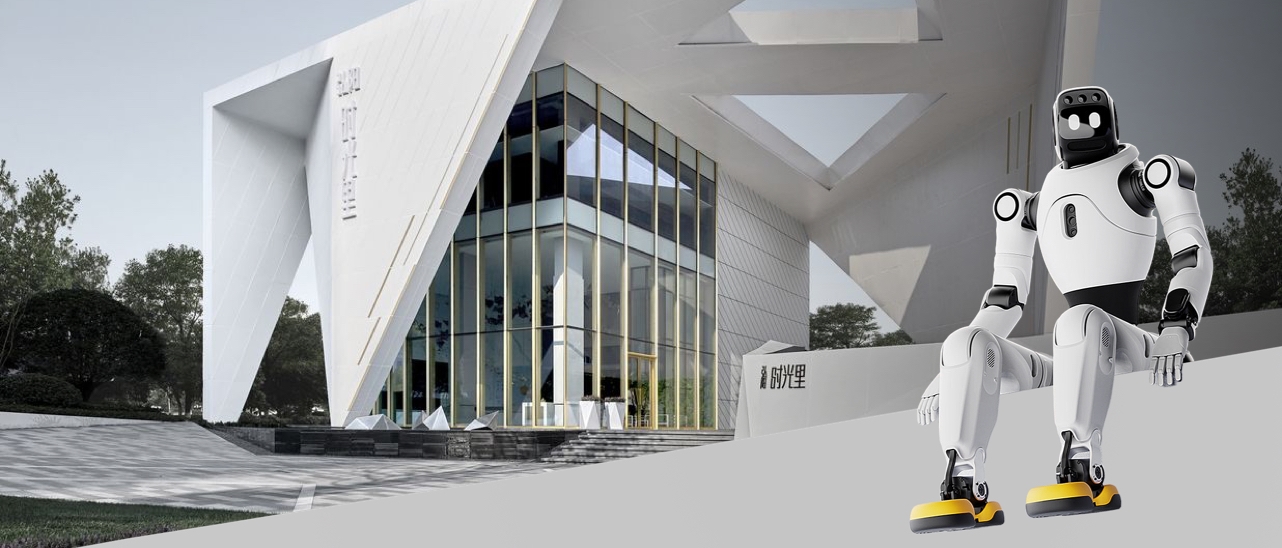
PUDU Robotics D9 Humanoid Robot

In stock
- BRAND:
- PUDU ROBOTICS
- PART #:
- D9
- ORIGIN:
- China
- AVAILABILITY:
- SUBJECT TO AVAILABILITY
- SKU:
- Pudu-Robotics-D9
PUDU Robotics D9 Humanoid Robot
Cameras can tell a robot where a cup stands; only touch can tell it how firmly to hold that cup once its fingers close around it. That gap between seeing and handling is where many humanoid projects stall, and it is the gap the PUDU Robotics D9 Humanoid Robot is built to address. Each arm ends in a PUDU DH11 dexterous hand with tactile sensing regions, while the rest of the body is shaped like an adult: two legs that walk, climb stairs and handle slopes, two arms with seven degrees of freedom each, and an onboard computer that turns vision, touch, force and sound into action. The result is a machine meant to work in rooms that were furnished for people, without asking anyone to rearrange them first.
Robots Europa, based in Dublin, supplies the PUDU Robotics D9 Humanoid Robot to customers across the European Union and the DACH region. Our team prepares each quotation, arranges delivery to your site and provides support after installation, so research groups, integrators and companies planning a pilot deal with a single European contact from the first enquiry to the first working day of the robot.
Background
PUDU Robotics and its move into humanoids
PUDU Robotics is best known in Europe for commercial service robots: delivery robots in restaurants and hotels, and cleaning robots for offices, shops and public buildings. That background matters for a humanoid. A company that has already placed robots in busy, public spaces understands what real deployments demand, from navigating among people to running reliably shift after shift. The D9 sits within PUDU's research-led X-Lab range, alongside other platforms exploring legged and humanoid forms, and it represents the company's step from task-specific machines towards general-purpose embodied intelligence.
Positioning: touch, mobility and onboard intelligence together
Many humanoids excel at one discipline. Some walk impressively but carry little; others manipulate well but stay bolted to a bench. The D9 is positioned as a combination of the three things a general-purpose robot needs in a human environment. Its bipedal structure lets it walk at a pace comparable to an adult and cope with stairs, slopes and other challenging urban terrain. Its visual semantic navigation system builds a 3D semantic map in real time, giving the robot an understanding of what surrounds it rather than merely where the obstacles are. And its multimodal sensing, covering visual, tactile, force and auditory information, feeds AI models that allow it to interact with objects and with people. It belongs to the Bipedal Humanoids category for exactly that reason: legs, arms and hands are designed to work as one system.
Technical Specifications
| Specification | Value |
|---|---|
| Height | 170 cm (66.93 inches) |
| Weight | 65 kg (143.30 pounds) |
| Leg length | Thigh 325 mm (12.80 inches); Calf 383 mm (15.08 inches) |
| Arm length | Arm 580 mm (22.83 inches); Hand 220 mm (8.66 inches) |
| Degrees of freedom | Total DOF 42; Single-leg DOF 6; Single-arm DOF 7 |
| Maximum joint torque | 352 N·m |
| Maximum payload | 20 kg (44.09 pounds); Single-arm 10 kg (22.05 pounds) (Testing Environment) |
| Dexterous hand (PUDU DH11) | 12 Tactile Sensing Regions; Active DOF 6; Passive DOF 5 |
| Sensors | RGB, RGBD, Tactile sensors, IMU |
| Computing power | 275 TOPS |
| Battery | 15 Ah (0.72 kWh) |
| Maximum walking speed | Up to 2 m/s on flat surfaces |
| Terrain | Stairs, slopes and other challenging urban terrains |
| Navigation | Visual semantic navigation with real-time 3D semantic mapping |
Specifications are as published by the manufacturer and are confirmed against the datasheet at quotation. PUDU has not published the battery runtime per charge, the charging time, the IP rating, the operating system, the connectivity options, the operating temperature range or the contents of the box; we confirm these with you at quotation.
How does the PUDU D9 sense what it touches?
The D9 approaches manipulation as a sensing problem first. Its RGB and RGBD cameras locate an object and estimate its shape and distance, but contact is handled by the PUDU DH11 dexterous hand. Each DH11 has 12 tactile sensing regions spread across the hand, six active degrees of freedom driven by actuators and five passive degrees of freedom that allow the fingers to conform to an object as they close. In practice, this means the hand can register where it is making contact and adapt its grip, rather than simply clamping to a preset position.
Force and tactile signals are combined with vision and sound by the onboard computer, rated at 275 TOPS, which runs the AI models behind the robot's multimodal interaction. An IMU keeps track of the body's orientation, which is essential when the robot is reaching for something while balancing on two legs. For developers, this combination is the real attraction: it provides the raw material for grasping research, learning from demonstration and fine manipulation that a simple two-finger gripper cannot offer.
Why choose a bipedal humanoid rather than a wheeled robot?
Wheels are efficient on level floors, and for many tasks they are the sensible choice. Legs earn their place when the environment includes steps, thresholds, ramps and uneven ground. The D9 can navigate stairs and slopes, and on flat surfaces it reaches walking speeds of up to 2 m/s, comparable to an adult. Its legs have six degrees of freedom each, and joints deliver a maximum torque of 352 N·m, which supports both locomotion and the work of carrying loads: the D9 has a maximum payload of 20 kg in its testing environment, with 10 kg for a single arm.
The other argument for a bipedal form is reach. At 170 cm tall, with an arm length of 580 mm plus a 220 mm hand, the D9 operates at the working heights of shelves, counters and doors already designed for people. For organisations studying how robots can join existing workflows without rebuilding the site, that compatibility with human-scale spaces is the central point.
Who is the PUDU Robotics D9 Humanoid Robot for?
The first group is research: university laboratories and corporate R&D teams working on embodied AI, locomotion, dexterous manipulation or human–robot interaction. For them, a full-sized platform with tactile hands, a high degree-of-freedom body and substantial onboard compute is a foundation for experiments that would otherwise require building hardware from scratch.
The second group is system integrators and innovation teams preparing pilot projects in retail, hospitality, logistics or light manufacturing. These buyers want to test how a humanoid copes with real stairs, real shelves and real members of the public before committing to a wider rollout.
The third group is education and public engagement: technology centres, demonstration halls and training facilities that need a humanoid capable of showing walking, perception and manipulation in one machine.
Where a site is entirely level and stair climbing is not required, it is worth comparing the D9 with the PUDU D7 Wheeled Humanoid Robot, which pairs a humanoid upper body with a wheeled base. Robots Europa can help you weigh the two against your floor plan and task list.
What is the PUDU Robotics D9 Humanoid Robot used for?
- Embodied AI research: a full-body platform for developing and testing models that link perception, decision-making and movement.
- Dexterous manipulation studies: tactile DH11 hands for experiments in grasping, in-hand adjustment and handling delicate objects.
- Locomotion development: bipedal walking, stair climbing and slope handling for work on balance and gait in real buildings.
- Service pilots in public spaces: trials of fetching, carrying and guiding tasks in hotels, shops and offices furnished for people.
- Human–robot interaction: visual, tactile, force and auditory sensing as a basis for studying natural interaction with staff and visitors.
- Education and demonstration: a showcase for students and visitors that brings mobility, perception and manipulation together in one robot.
Pricing and Availability
Robots Europa supplies the PUDU Robotics D9 Humanoid Robot on a quotation basis, so that the configuration, documentation and service arrangements match your project. Delivery, customs clearance and support are arranged together with your quotation. Tell us about your intended application, your site and your timeline, and we will prepare an offer tailored to it. A quotation request form is available on this page.
Frequently Asked Questions
How tall and how heavy is the PUDU D9?
The D9 stands 170 cm (66.93 inches) tall and weighs 65 kg (143.30 pounds), proportions that suit spaces designed for adults.
How many degrees of freedom does the D9 have?
The robot has 42 degrees of freedom in total, with six in each leg and seven in each arm. Each PUDU DH11 hand adds six active and five passive degrees of freedom.
How much can the D9 carry?
The D9 has a maximum payload of 20 kg (44.09 pounds) in its testing environment, and 10 kg (22.05 pounds) for a single arm.
Can the D9 climb stairs?
Yes. Its bipedal structure allows it to navigate stairs, slopes and other challenging urban terrain, and it walks at up to 2 m/s on flat surfaces.
What sensors does the D9 use?
It carries RGB and RGBD cameras, tactile sensors, an IMU, and force and auditory sensing, all processed by an onboard computer rated at 275 TOPS.
What battery does the D9 use?
The D9 runs on a 15 Ah (0.72 kWh) battery. Robots Europa can discuss how your intended duty cycle fits around charging when preparing your offer.
Where can I buy the PUDU Robotics D9 Humanoid Robot and what does it cost?
You can buy the D9 from Robots Europa, which supplies customers across the EU and the DACH region from Dublin. The cost depends on configuration and project requirements, so please request a quotation.
Summary
The PUDU Robotics D9 Humanoid Robot is built on the idea that seeing an object is only half of handling it. Tactile DH11 hands, force and auditory sensing and 275 TOPS of onboard compute give it the means to feel and adjust, while a bipedal body with 42 degrees of freedom carries those hands up stairs, across slopes and to the working heights of human spaces. For research teams, integrators and pilot projects that want to test a humanoid in the world as it is, rather than in a world reshaped for robots, the D9 is a serious candidate. To discuss your project with Robots Europa and receive a quotation, this page is the starting point.