
PaXini TORA DOUBLE ONE Lightweight Humanoid Robot
In stock
- BRAND:
- PAXINI
- MODEL:
- TORA DOUBLE ONE
- ORIGIN:
- China
- AVAILABILITY:
- SUBJECT TO AVAILABILITY
- SKU:
- Paxini-TORA-DOUBLE-ONE
PaXini TORA DOUBLE ONE Lightweight Humanoid Robot
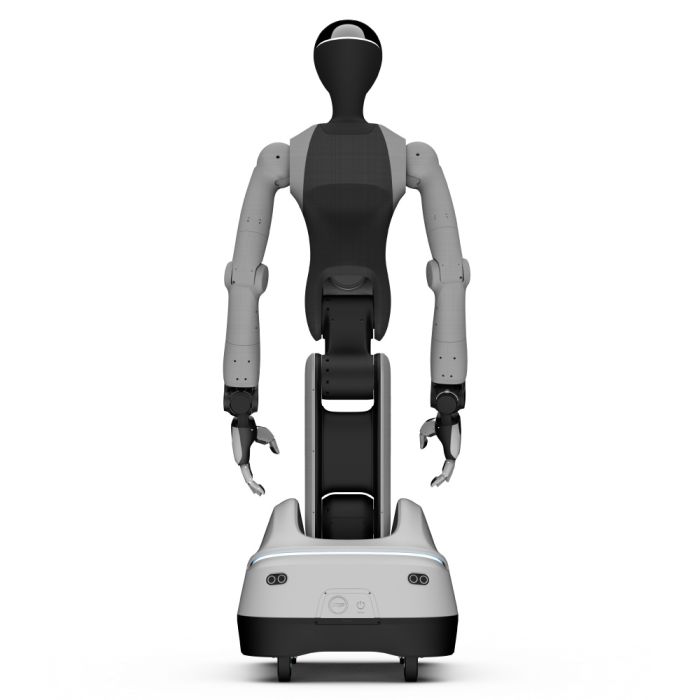
Most humanoid robots are judged by how tall they stand and how far they can reach. The PaXini TORA DOUBLE ONE Lightweight Humanoid Robot raises a second question: how compact can it become when the shift is over? Both chassis models fold to a minimum height of less than 60cm, so a robot that works at a bench or a shelf can also be packed away, carried between sites and brought back into service. Above that chassis sits an upper body with up to 52 degrees of freedom, guided by a control system that combines vision with touch.
Robots Europa, based in Dublin, supplies the PaXini TORA DOUBLE ONE to organisations across the European Union and the DACH region. We prepare each quotation for the chassis configuration and dexterous hands your project requires, and we coordinate delivery and after-sales support from our European base.
Background
PaXini and multi-dimensional tactile sensing
PaXini develops its robots around the sense of touch. The TORA DOUBLE ONE can be fitted with any hand from the company's full line of multi-dimensional tactile dexterous hands, which means the end effector can be chosen for the task rather than fixed at the factory. For buyers, this modularity matters: one humanoid platform can be configured for fine handling in one project and for different grasping work in the next, without replacing the robot itself.
OmniVTLA and PX-Core: combining sight and touch
The robot runs OmniVTLA, PaXini's own embodied intelligence model, on an AGX Orin compute platform with very high processing capacity. Low-level behaviour is handled by PX-Core visual-tactile dual-modal control, which brings together what the robot sees and what its hands feel. Perception is supported by a sensor suite comprising 3D LiDAR, a fisheye camera, a depth camera and circular microphone arrays, giving the system awareness of its surroundings as it moves and works.
Technical Specifications
| Specification | Value |
|---|---|
| Maximum degrees of freedom | Up to 52 joint degrees of freedom |
| Minimum folded height | Less than 60cm (both chassis models) |
| AI model | OmniVTLA embodied intelligence model (developed in-house by PaXini) |
| Compute platform | AGX Orin |
| Control | PX-Core visual-tactile dual-modal control |
| Sensors | 3D LiDAR, fisheye camera, depth camera, circular microphone arrays |
| Chassis options | Omnidirectional chassis or obstacle-crossing chassis |
| Omnidirectional chassis (Model P) | Dual-steer AGV design for flexible steering and lateral movement; intended for stability on industrial floors |
| Obstacle-crossing chassis (Model X) | 4WD folding, deformable design that lifts its legs to adapt to complex terrain; intended for tight spaces and varied ground |
| Slope climbing | Up to 8.5 degrees |
| Obstacle crossing | 21.5cm |
| Compatible hands | PaXini's full line of multi-dimensional tactile dexterous hands |
Specifications are as published by the manufacturer and are confirmed against the datasheet at quotation.
PaXini has not published the weight, payload, battery capacity, ingress protection rating, overall dimensions, box contents, connectivity or operating system; these are confirmed at quotation.
How do the Model P and Model X chassis differ?
The choice of chassis is the main configuration decision, and it follows the floor the robot will work on. The omnidirectional Model P uses a dual-steer AGV design. Its two steerable wheels allow the robot to turn and move sideways, which suits smooth, even surfaces such as production halls, laboratories and logistics areas, where the robot must line up precisely with a workstation or a rack.
The obstacle-crossing Model X takes a different approach. Its four-wheel-drive chassis is deformable and folds; it can lift its legs to adapt to complex terrain, and it is intended for confined spaces and mixed ground conditions. Where a site has thresholds, uneven transitions or cramped corners, the Model X is the more natural fit.
Both share the same upper body, the same control system and the same folding behaviour, with a minimum folded height of less than 60cm on either model. The TORA DOUBLE ONE climbs slopes of up to 8.5 degrees and overcomes obstacles of 21.5cm, which matters on sites with ramps, cable covers and raised thresholds.
What does visual-tactile control add to a humanoid?
A robot guided by vision alone must infer how firmly it is holding something from what it sees. PX-Core combines visual input with tactile feedback from PaXini's dexterous hands, so contact itself becomes a source of information. In practical terms, this is the difference between a robot that sees an object and one that can also register how that object responds to its grip.
Paired with OmniVTLA running on the AGX Orin platform and up to 52 degrees of freedom, this approach is aimed at manipulation where position alone is not enough: handling items of varying shape, firmness or surface finish. For integrators, the combination of a large embodied model, on-board compute and tactile hands from the same manufacturer also reduces the number of separate suppliers in a project.
Who is the PaXini TORA DOUBLE ONE for?
The first group is industrial teams piloting mobile manipulation. A robot that drives to a station and works with its hands, rather than being bolted in place, lets a plant test automation across several locations with one machine. These buyers will usually specify the Model P chassis for its stability on industrial floors.
The second group is research institutions and university laboratories working on embodied AI, tactile sensing and human-robot interaction. The combination of an in-house embodied model, a broad sensor suite and interchangeable tactile hands gives them a platform for experiments in perception and grasping.
The third group is system integrators and service-robotics developers who must deploy in buildings that were not designed for robots. The Model X chassis, with its four-wheel-drive folding design for tight spaces and varied ground, suits these sites; the compact folded height also helps where robots must be moved between locations.
Buyers comparing platforms will find related machines in our Wheeled Humanoids category, and the wider range in Humanoids.
What is the PaXini TORA DOUBLE ONE used for?
- Workstation tending – moving between benches or machines to load, unload and handle parts.
- Embodied AI research – a platform for studying vision-touch-language-action models in real environments.
- Tactile manipulation studies – testing grasping strategies with PaXini's multi-dimensional tactile hands.
- Logistics and picking trials – evaluating mobile manipulation alongside racks and shelving in warehouses.
- Service robotics in public buildings – trials in reception areas, retail or hospitality settings with mixed floors.
- Demonstration and training – a foldable humanoid that can be transported to trade fairs, classrooms and customer sites.
Pricing and Availability
The PaXini TORA DOUBLE ONE is supplied on quotation, because its configuration depends on the chassis model, the choice of dexterous hands and the requirements of your application. Tell us which chassis you are considering, the environment the robot will work in and the tasks you have in mind, and Robots Europa will prepare an offer for your project. Delivery, customs and support are arranged together with the quotation. To begin, please use the quotation request available on this page.
Frequently Asked Questions
How many degrees of freedom does the TORA DOUBLE ONE have?
The robot offers up to 52 joint degrees of freedom across its humanoid body.
Which chassis options are available?
There are two: the omnidirectional Model P with a dual-steer AGV design, and the obstacle-crossing Model X with a four-wheel-drive folding chassis.
Which compute platform and AI model does it use?
It runs PaXini's own OmniVTLA embodied intelligence model on an AGX Orin compute platform, with PX-Core visual-tactile dual-modal control.
Which sensors are fitted?
The robot perceives its surroundings through 3D LiDAR, a fisheye camera, a depth camera and circular microphone arrays.
Can I choose the robot hands?
Yes. The TORA DOUBLE ONE can be fitted with hands from PaXini's full line of multi-dimensional tactile dexterous hands, and Robots Europa helps you select the hand that suits your task.
Does the robot fold for transport and storage?
Yes. Both chassis models fold to a minimum height of less than 60cm, which makes the robot easier to move between sites and to store.
Where can I buy the PaXini TORA DOUBLE ONE and what does it cost?
You can buy the PaXini TORA DOUBLE ONE from Robots Europa, which supplies customers across the EU and the DACH region. The cost depends on the configuration, so please request a quotation through this page.
Summary
The PaXini TORA DOUBLE ONE is a humanoid to be measured twice: at full height, where up to 52 degrees of freedom, OmniVTLA, the AGX Orin platform and PX-Core visual-tactile control take on manipulation work, and folded, where both chassis models drop below 60cm for transport and storage. The Model P suits steady industrial floors; the Model X suits tight spaces and uneven ground. For a configuration fitted to your site and your tasks, this page is the starting point.


