
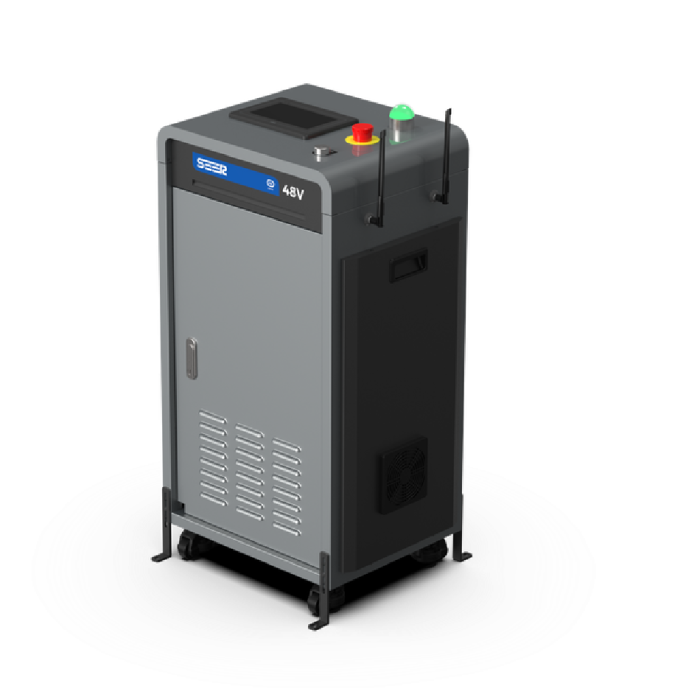
SEER Robotics Robotic Automatic Charging Station (SCS-C4850D)
In stock
- BRAND:
- SEER ROBOTICS
- MODEL:
- SCS-C4850D
- PART #:
- SCS-C4850D
- ORIGIN:
- China
- Warranty:
- 12 MONTHS
- AVAILABILITY:
- SUBJECT TO AVAILABILITY
- SKU:
- SEER-Robotics-SCS-C4850D
SEER Robotics Robotic Automatic Charging Station (SCS-C4850D)
An autonomous forklift earns its keep only while it is moving pallets; every minute it spends connected to a slow charger is a minute the fleet plan has to absorb somewhere else. The SEER Robotics Robotic Automatic Charging Station (SCS-C4850D) is designed around that arithmetic. It is a dedicated station for 48 V autonomous forklifts that delivers up to 3 kW and can bring a battery to full charge in as fast as 1 hour. It also gives the operator a choice of how each charge is controlled and a way to supervise the whole process from a distance.
Robots Europa, based in Dublin, supplies the SCS-C4850D to customers throughout the European Union and the DACH region. We prepare a quotation for your site, check the configuration against the manufacturer's datasheet with you, and remain your point of contact for delivery, commissioning questions and after-sales support.
Background
SEER Robotics and the Robot Brain
SEER Robotics is listed on the Hong Kong stock exchange under the code 06106.HK. The company describes itself as a platform-based embodied intelligent robotics company built around what it calls the Robot Brain, and it serves more than 2,500 customers worldwide with intelligent robotics solutions. That platform thinking matters for a charging product: a charger from the same ecosystem as the robots it supplies can be monitored and controlled through the same software environment, rather than standing apart as an isolated piece of electrical equipment. In the case of the SCS-C4850D, that environment is Roboshop, through which the station can be monitored and controlled remotely.
Charging as part of the automation system
In a manually operated warehouse, charging is a chore that drivers fit around their shifts. In an automated one, it becomes a scheduled process that the fleet must perform on its own, reliably and without supervision on the floor. A charging station for autonomous vehicles therefore has to do more than convert mains power: it needs to work with the battery's own management, protect both vehicle and building from electrical faults, and report what it is doing. The SCS-C4850D addresses each of these points. It supports three charging modes, protocol-based, state-based and voltage-based, together with charging curves that the user can customise. It carries six built-in safeguards, an integrated human-machine interface and several network options for integration into the site's infrastructure.
Technical Specifications
| Specification | Value |
|---|---|
| Dimensions (L x W x H) | 580 x 460 x 980 mm |
| AC input voltage | 110 V to 120 V / 220 V to 240 V |
| Input frequency | 50 / 60 Hz |
| DC output voltage | 32 V to 60 V |
| Maximum output power | 1500 / 3000W |
| Charging voltage and current | 48 V / 60 A |
| Charging time | Full charge in as fast as 1 hour |
| Connector for manual charging | REMA160 |
| Network | Wi-Fi (recommended), Wired, 5G |
| Working temperature | 0℃ to 40℃ |
| Reference standard | EN 62477-1:2012+A11:2014+A1:2017+A12:2021 |
| Suitable product model | 48 V, autonomous forklift |
| Battery compatibility | Various lithium batteries |
| Charging modes | Protocol-based, state-based, voltage-based; user-customisable charging curves |
| Protection | Over-voltage, over-current, short-circuit, reverse connection, leakage, overheating |
| HMI functions | Data display, parameter adjustment, network setup, log event query, device control |
| Remote monitoring | Via Roboshop |
The figures above are as SEER Robotics publishes them and are confirmed against the datasheet at quotation.
SEER Robotics has not published the package contents, the charging efficiency, the cable length, the mounting method or the certifications; Robots Europa confirms these with you at quotation.
How does the SCS-C4850D keep fast charging safe for a 48 V forklift battery?
Speed and safety pull in opposite directions in any charging system: the more power is delivered, the less margin there is for a fault. The SCS-C4850D answers this in two layers. The first is protective. The station guards against over-voltage, over-current, short-circuit, reverse connection, leakage and overheating, so the most common electrical failure modes are covered within the unit itself rather than left to external switchgear alone.
The second layer is control. With protocol-based charging, the station works with the information the battery provides; with state-based and voltage-based charging, it follows the battery's condition or its terminal voltage. Where a fleet uses a particular lithium chemistry or a battery supplier recommends a specific profile, the charging curve can be customised by the user. In practice, this means the same station can be tuned to the battery rather than the battery having to tolerate a fixed charger behaviour, which is a sensible precaution for operators who run various lithium batteries across their fleet. The working temperature range of 0℃ to 40℃ should be considered when planning where the station will stand, particularly in unheated warehouse zones.
Can the SCS-C4850D run without a central fleet system?
Yes. The integrated human-machine interface provides data display, parameter adjustment, network setup, log event query and device control, and SEER Robotics states that the station is ready to operate independently upon deployment. A maintenance technician can therefore read the station's status, adjust parameters and review logged events directly at the unit.
For sites that prefer central oversight, the station can be monitored and controlled remotely through Roboshop, keeping its operational status under constant supervision. Connection to the site network is possible by Wi-Fi, which the manufacturer recommends, by a wired link or over 5G. This flexibility is useful in buildings where Wi-Fi coverage is uneven or where IT policy favours cabled connections for fixed equipment. For vehicles that need attention outside the automatic routine, the REMA160 connector allows manual charging, so a forklift returning from maintenance can be topped up without waiting for its next automatic cycle.
Who is the SCS-C4850D for?
The station is aimed first at operators of 48 V autonomous forklift fleets in warehouses, distribution centres and production intralogistics, where charging time translates directly into available vehicle hours. Its capacity to deliver up to 3 kW, with a full charge in as fast as 1 hour, suits operations that cannot afford long periods of downtime.
System integrators form a second group. Because the station offers three charging modes, customisable curves and wired, Wi-Fi or 5G connectivity, it can be adapted to the battery and network conditions of each project instead of forcing a single configuration onto every site. The AC input range of 110 V to 120 V / 220 V to 240 V also gives integrators working across different markets a familiar starting point for electrical planning.
Maintenance and facilities teams are the third group: the local HMI, the event log and remote supervision via Roboshop give them the visibility they need to keep charging reliable. If your vehicles run at a different voltage or are not forklifts, the SCS-C4850D is not the right match; the wider range of Charging Stations is the place to compare alternatives, and the Factory Robots category shows the type of equipment such stations support.
What is the SCS-C4850D used for?
- Automated forklift charging: keeping 48 V autonomous forklifts powered with minimal intervention from staff.
- High-throughput warehouses: returning vehicles to service quickly thanks to up to 3 kW of charging power.
- Mixed lithium battery fleets: matching protocol-based, state-based or voltage-based charging to each battery type.
- Manual top-up charging: using the REMA160 connector for vehicles outside the automatic charging cycle.
- Remote fleet supervision: monitoring and controlling charging status from a control room through Roboshop.
- Fault diagnosis and maintenance: reviewing logged events at the HMI to trace and resolve charging issues.
Pricing and Availability
Robots Europa supplies the SCS-C4850D on a quotation basis, so that the offer reflects your site's electrical supply, network set-up and fleet requirements. Delivery, customs and support are arranged together with the quotation. Tell us about your forklifts, battery type and intended location, and we will confirm the configuration against the manufacturer's datasheet before you commit. The quotation request for the SEER Robotics Robotic Automatic Charging Station (SCS-C4850D) is available on this page.
Frequently Asked Questions
Which vehicles is the SCS-C4850D designed for?
The station is specified for 48 V autonomous forklifts. It is compatible with various lithium batteries.
How quickly can the station charge a forklift?
It delivers up to 3 kW at 48 V / 60 A and can charge a battery fully in as fast as 1 hour. The actual time in your operation depends on the battery and its state of charge.
Can batteries also be charged manually?
Yes. The station has a REMA160 connector for manual charging.
Which protective functions are built in?
The station protects against over-voltage, over-current, short-circuit, reverse connection, leakage and overheating.
How is the station connected and monitored?
It connects by Wi-Fi, which the manufacturer recommends, by a wired link or via 5G. It can be monitored and controlled remotely through Roboshop, as well as locally at its integrated HMI.
Which standard does the station refer to?
The reference standard is EN 62477-1:2012+A11:2014+A1:2017+A12:2021. The certifications have not been published by the manufacturer and are confirmed at quotation.
Where can I buy the SEER Robotics Robotic Automatic Charging Station (SCS-C4850D) and what does it cost?
You can buy it from Robots Europa, which supplies customers in the EU and the DACH region. The cost depends on your configuration and is set out in an individual quotation, which you can request on this page.
Summary
For an autonomous forklift fleet, the charger quietly decides how many hours the vehicles actually work. The SEER Robotics Robotic Automatic Charging Station (SCS-C4850D) tips that balance towards productivity: up to 3 kW for 48 V autonomous forklifts, a full charge in as fast as 1 hour, six built-in protective functions and three charging modes with customisable curves. Its local HMI lets it operate independently, while Roboshop, Wi-Fi, wired and 5G connectivity bring it into central supervision, and the REMA160 connector covers manual charging. Robots Europa quotes, delivers and supports the station across the EU and the DACH region. If you want your forklifts spending less time at the charger and more time moving goods, this page is the starting point.


