
SEER Robotics SJV-SW600 (SJV-SW600)
In stock
- BRAND:
- SEER ROBOTICS
- MODEL:
- SJV-SW600
- PART #:
- SJV-SW600
- ORIGIN:
- China
- Warranty:
- 12 MONTHS
- AVAILABILITY:
- SUBJECT TO AVAILABILITY
- SKU:
- SEER-Robotics-SJV-SW600
SEER Robotics SJV-SW600 (SJV-SW600)
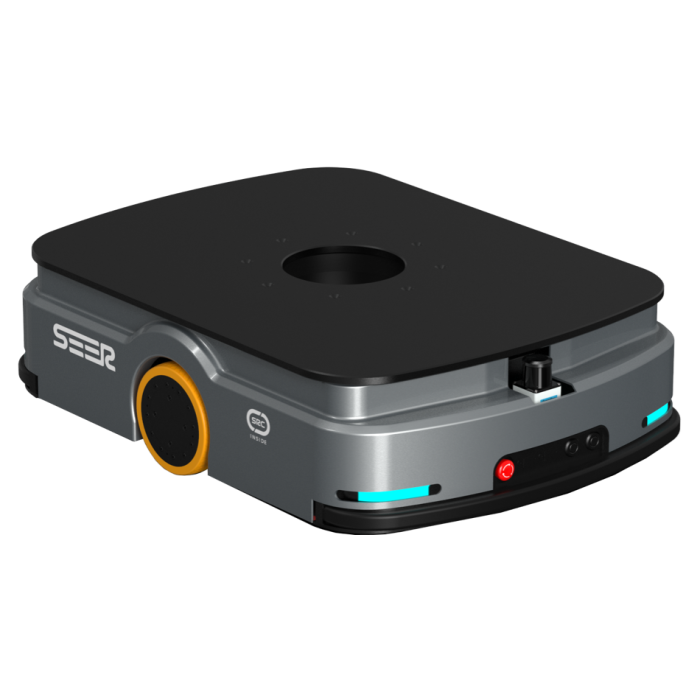
Picture a loaded shelf unit that stays perfectly square to the aisle while the machine beneath it turns through a full circle. That is the core idea behind the SEER Robotics SJV-SW600 (SJV-SW600), a Laser SLAM Rotary Lifting Robot whose chassis and lifting plate rotate separately. It resolves a familiar tension in intralogistics: a robot strong enough to carry 600 kg normally needs room to manoeuvre, yet the most valuable floor space in a warehouse is the space it would take away. Here, the robot body can change direction without swinging the load into neighbouring racks, and it works in aisles as narrow as 790 mm.
Robots Europa, based in Dublin, supplies the SJV-SW600 to customers throughout the EU and the DACH region. Robots Europa prepares each quotation for the specific site, coordinates delivery and import formalities, and remains the point of contact for support once the robot is in service.
Background
SEER Robotics and the Robot Brain
SEER Robotics, listed in Hong Kong as 06106.HK, is a platform-based embodied intelligent robotics company built around the Robot Brain. The company serves more than 2,500 customers worldwide with intelligent robotics solutions. Its approach centres on shared control and navigation technology that runs across a family of mobile robots, rather than treating each vehicle as an isolated product. For a buyer, that platform thinking matters because a lifting robot rarely works alone: it shares floors, charging points and traffic rules with other vehicles and with people.
A lifting robot built around separate rotation
Lifting robots of this class travel underneath a load, raise it a short distance off the floor and carry it to its destination. They are widely used to bring shelving to picking stations, to move carts between process steps and to reorganise storage without forklifts. What distinguishes the SJV-SW600 is its spin function: the robot body and the lifting plate can rotate separately. An integrated SRC controller synchronously controls both the robot's steering and the rotation of the lifted goods, so the load can keep its orientation while the chassis turns, or be turned deliberately to present a different face at a workstation. Navigation is by laser SLAM, with QR code and laser reflector navigation also supported.
Technical Specifications
| Specification | Value |
|---|---|
| Product name | Laser SLAM Rotary Lifting Robot |
| Navigation type | Laser SLAM |
| Supported navigation methods | SLAM, QR code, laser reflector |
| Dimensions (L x W x H) | 950 x 650 x 250 mm |
| Rotation diameter | 1015 mm |
| Weight (with battery) | 170 kg |
| Rated load | 600 kg |
| Chassis ground clearance | 25 mm |
| Lifting platform dimensions | 924 x 650 mm |
| Maximum lifting stroke | 60±2 mm |
| Minimum aisle width | 790 mm |
| Navigation position accuracy | ±5 mm |
| Navigation angle accuracy | ±0.5° |
| Driving speed | ≤1.5 m/s |
| Maximum running speed | 1.5 m/s fully loaded; 2 m/s unloaded |
| Battery specifications | 48 V / 24 Ah (lithium iron phosphate) |
| Comprehensive battery life | 8 h |
| Charging time (10% to 80%) | ≤2 h |
| Charging method | Manual / Automatic |
| Lidar number | 2 (navigation laser at the front, obstacle avoidance laser at the rear) |
| Controller | Integrated SRC controller |
| Safety and indicator hardware (standard) | E-stop button, speaker, ambient lamp, bumper strip |
| Ambient temperature and humidity range | TEMP: 0°C to 50°C / RH: 10% to 90%, no compression, no condensation |
Specifications are as published by the manufacturer and are confirmed against the datasheet at quotation.
SEER Robotics has not published the IP rating, the controller model, the communication interfaces, the package contents, the noise level or the safety certifications for this robot; Robots Europa confirms these details at quotation.
How does separate rotation help in narrow aisles?
On a conventional lifting robot, turning the chassis turns the load with it. A loaded shelf unit then sweeps an arc wider than the robot itself, and the aisle has to be planned around that arc. On the SJV-SW600, the lifting plate can counter-rotate while the body turns, so the load holds its orientation and the robot changes heading underneath it. This lets the robot move effortlessly through tight spaces such as narrow aisles and densely packed shelves.
The published geometry makes the point concrete. The robot measures 950 x 650 x 250 mm, its rotation diameter is 1015 mm and its minimum aisle width is 790 mm. The low 250 mm height and the 924 x 650 mm lifting platform suit under-ride handling, and a maximum lifting stroke of 60±2 mm is enough to clear a load from the floor for transport. Positioning matters as much as turning: with a navigation position accuracy of ±5 mm and an angle accuracy of ±0.5°, the robot can set a load down where a picking station, a rack location or a conveyor interface expects it.
What does the dual-lidar layout mean for a shared floor?
The SJV-SW600 carries two lidars with distinct jobs: a navigation laser at the front and an obstacle avoidance laser at the rear. Separating the roles means the forward sensor can concentrate on mapping and localisation while the rear sensor watches the zone behind the robot, which is relevant for a vehicle that turns in place and may reverse out of a station. The E-stop button, speaker, ambient lamp and bumper strip are fitted as standard, giving people on the floor an audible and visible signal of the robot's intentions and a physical means of stopping it.
Because the robot supports laser SLAM as well as QR code and laser reflector navigation, a site can choose the method that fits its layout. SLAM avoids floor markers altogether; QR codes or reflectors can be added where a site prefers fixed references in particular zones.
Who is the SEER Robotics SJV-SW600 (SJV-SW600) for?
The robot is aimed at operations that move heavy units on a short lift and value floor space highly. Warehouse and e-commerce fulfilment centres running goods-to-person picking are an obvious fit, as are manufacturers supplying production lines from mobile racks. Third-party logistics providers with dense storage, where aisles have been narrowed to gain locations, benefit most from the separate rotation of body and plate.
Multi-shift sites should note the energy profile: a 48 V / 24 Ah lithium iron phosphate battery with a comprehensive battery life of 8 h, charging from 10% to 80% in ≤2 h, and the option of automatic charging so the robot can top up between tasks. The operating range of 0°C to 50°C covers typical warehouse and factory halls. Buyers comparing it with other under-ride and jacking vehicles will find the wider range in the Lifting Robots category, and the SEER Robotics line-up specifically in the SEER Lifting Robots overview.
What is the SEER Robotics SJV-SW600 (SJV-SW600) used for?
- Goods-to-person picking: bringing shelf units to pick stations and presenting the required face of the load.
- Line-side supply: carrying mobile racks of components from storage to assembly cells on a fixed schedule.
- Dense storage reorganisation: repositioning loaded units in narrow aisles without swinging them into neighbouring racks.
- Staging and buffering: moving loads between receiving, buffer and dispatch zones with accurate set-down.
- Station interfacing: docking at workstations or conveyors where position and angle accuracy determine hand-over quality.
- Multi-shift transport: sustaining continuous operation with automatic charging between tasks.
Pricing and Availability
Robots Europa supplies the SJV-SW600 on quotation, prepared around your layout, load types and navigation method. Delivery, customs and support are arranged together with the quotation, so the commercial and logistical picture is settled in a single step. To begin, send your requirements through the quotation request available on this page.
Frequently Asked Questions
How much can the SJV-SW600 lift?
The rated load is 600 kg, and the maximum lifting stroke is 60±2 mm.
How narrow an aisle can the robot work in?
The minimum aisle width is 790 mm. The separate rotation of body and lifting plate keeps the load's orientation while the robot turns.
Which navigation methods does it support?
The robot navigates by laser SLAM and also supports QR code and laser reflector navigation, so it can work with or without floor markers.
How long does the battery last and how quickly does it charge?
Comprehensive battery life is 8 h from a 48 V / 24 Ah lithium iron phosphate battery. Charging from 10% to 80% takes ≤2 h, either manually or automatically.
How fast does it travel?
The maximum running speed is 1.5 m/s when fully loaded and 2 m/s when unloaded.
What safety equipment is fitted as standard?
An E-stop button, a speaker, an ambient lamp and a bumper strip are standard. A rear obstacle avoidance laser complements the front navigation laser.
Where can I buy the SEER Robotics SJV-SW600 (SJV-SW600) and what does it cost?
Robots Europa supplies the robot across the EU and the DACH region. Pricing depends on your configuration and project, so it is provided in a written quotation requested from this page.
Summary
The SJV-SW600 answers a simple question that shapes many warehouse layouts: how do you move a heavy load through a tight space without the load becoming the obstacle? By letting the chassis and the lifting plate rotate separately, under the synchronised control of its integrated SRC controller, it carries 600 kg through aisles from 790 mm and sets loads down to ±5 mm. Dual lidars, standard safety hardware, a choice of SLAM, QR code or reflector navigation and an 8 h battery life round out a robot designed for dense, busy floors. For a quotation with delivery, customs and support arranged by Robots Europa, this page is the starting point.


