
SIASUN Mobile Robot Transport Control System (Mobile Robot Transport Control System)
In stock
- BRAND:
- SIASUN
- MODEL:
- Mobile Robot Transport Control System
- PART #:
- Mobile Robot Transport Control System
- ORIGIN:
- China
- Warranty:
- 12 MONTHS
- AVAILABILITY:
- SUBJECT TO AVAILABILITY
- SKU:
- SIASUN-Mobile-Robot-Transport-Control-System
SIASUN Mobile Robot Transport Control System (Mobile Robot Transport Control System)
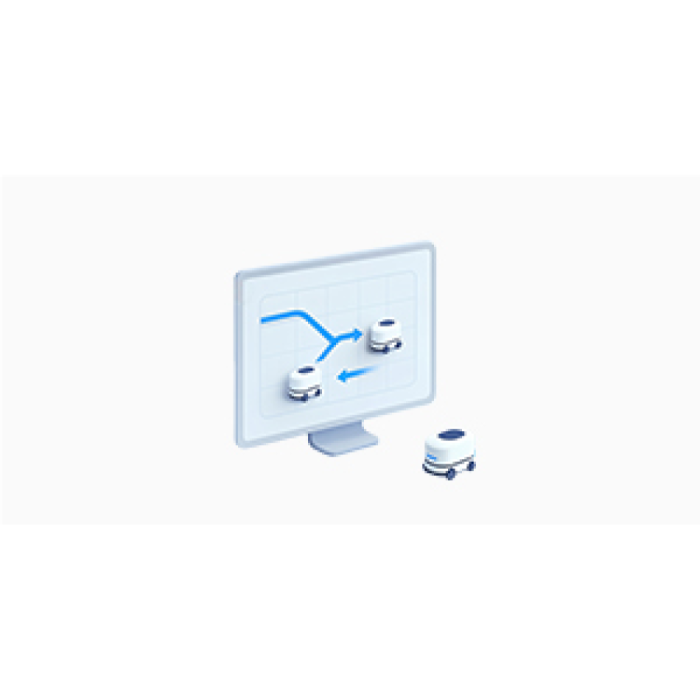
Add enough robots to a factory floor and the bottleneck stops being the vehicles. It moves to the junctions, the narrow aisles and the transfer points where several machines want the same stretch of floor at the same moment. The SIASUN Mobile Robot Transport Control System (Mobile Robot Transport Control System) is built for that problem. Rather than simply handing out jobs and leaving the vehicles to sort out the traffic among themselves, it applies AI-powered traffic models to the whole fleet. It estimates where congestion is building, sends vehicles on intelligent detours, handles intelligent obstacle avoidance and resolves jams dynamically while production carries on.
Robots Europa, based in Dublin, supplies the SIASUN Mobile Robot Transport Control System to manufacturers, logistics operators and system integrators throughout the European Union and the DACH region. We prepare the quotation, coordinate delivery to your site and remain your point of contact for support once the system is directing traffic on your shop floor.
Background
SIASUN Mobile Robotics and its lineage
SIASUN Mobile Robotics has been developing its own mobile robot scheduling and management systems since its establishment in 2000. That work has concentrated on a small number of demanding sectors: automotive manufacturing, new energy power batteries, semiconductors and photovoltaics. In these industries material flow is tightly timed, production lines are expensive to stop and internal transport has to be both dense and dependable. Fleet control software shaped by such environments is designed around the assumption that many vehicles will share limited space and that a delay at one point quickly spreads to the rest of the plant.
Because SIASUN develops both mobile robots and the software that schedules them, its control systems are designed as part of a complete intralogistics offering rather than as an add-on. For buyers, this means the transport control layer comes from a manufacturer with long experience of what actually happens when automated vehicles operate at scale in production halls.
Traffic control within the iMRS 2.0 platform
The Transport Control System, abbreviated TCS, is one module of SIASUN's iMRS 2.0 platform. The manufacturer presents this platform with TCS, LWS and SAS modules and describes it as encompassing six key sub-modules for an end-to-end solution across processes, scenarios and customer needs. Within that platform, TCS is the part responsible for keeping traffic moving efficiently. The wider iMRS 2.0 platform supports multi-robot dispatching, route optimisation, data analytics and digital twins, giving operators intelligent control from the individual vehicle up to plant-level material flow.
The platform is centred on mobile robotics and supports several communication protocols: VDA5050, the Alliance Protocol and SIASUN's proprietary protocol. It is capable of large-scale, hybrid scheduling for up to thousands of units and is positioned as an integrated solution for material storage and distribution at plant and workshop level.
Technical Specifications
| Specification | Value |
|---|---|
| Product function (TCS) | AI-powered traffic models to enhance transportation efficiency |
| Traffic features (TCS) | Congestion estimation, intelligent detours, intelligent obstacle avoidance, dynamic congestion resolution |
| Platform | iMRS 2.0 platform with TCS, LWS and SAS modules |
| Platform sub-modules (iMRS 2.0) | Six key sub-modules |
| Supported protocols (iMRS 2.0) | VDA5050, Alliance Protocol, SIASUN's proprietary protocol |
| Scheduling scale (iMRS 2.0) | Large-scale, hybrid scheduling for up to thousands of units |
| Platform functions (iMRS 2.0) | Multi-robot dispatching, route optimisation, data analytics, digital twins |
| Customisation services (iMRS 2.0) | Secondary development, low-code development, predictive maintenance |
| Deployment time (iMRS 2.0) | Relatively mature scenario within one month; more complex scenarios within two months, once site conditions are met |
| Manufacturer | SIASUN Mobile Robotics, developing scheduling and management systems since 2000 |
Specifications are as published by the manufacturer and are confirmed against the datasheet at quotation.
The manufacturer has not published the server hardware requirements, the supported operating systems, the maximum fleet size for TCS on its own, the interfaces and APIs, the licensing model, the package contents or the software version; Robots Europa confirms each of these at quotation.
How does the Transport Control System keep a busy fleet moving?
A fleet that only receives tasks will still lose time wherever vehicles meet. SIASUN's approach with TCS is to treat transport as a traffic problem in its own right. Congestion estimation looks ahead at where vehicles are likely to bunch together, so that the system can act before a queue forms rather than after it has already blocked an aisle. Intelligent detours then route vehicles around the affected area, accepting a slightly different path in exchange for keeping the overall flow intact.
Intelligent obstacle avoidance deals with the reality that factory floors are never perfectly clear: pallets are set down, people cross routes and equipment is moved. Finally, dynamic congestion resolution untangles situations that could not be avoided, releasing vehicles in an order that restores movement. Taken together, these functions serve a single aim: greater transportation efficiency across the fleet as a whole, not merely faster individual journeys.
What does the iMRS 2.0 platform add around TCS?
TCS does not operate in isolation. Around it, the iMRS 2.0 platform supplies multi-robot dispatching, route optimisation, data analytics and digital twins. Dispatching decides which vehicle takes which task, route optimisation shapes the paths they follow, and TCS keeps those paths flowing when vehicles interact. Data analytics and digital twins give planners a way to understand performance and to examine changes to layouts or processes before applying them on the floor.
Protocol support matters for any site that is not built around a single vehicle type. With VDA5050, the Alliance Protocol and SIASUN's proprietary protocol on the platform, and hybrid scheduling at a scale of up to thousands of units, the iMRS 2.0 environment is designed for plants where the fleet will grow and diversify over time. The platform also comes with services for secondary development, low-code development and predictive maintenance, which SIASUN offers to help customers respond to rapid process changes with customised features. Where customer site conditions are met, a relatively mature scenario can be implemented within one month and more complex scenarios within two months.
Who is the SIASUN Mobile Robot Transport Control System for?
The clearest fit is a plant in one of the sectors SIASUN has focused on since 2000: automotive manufacturing, new energy power battery production, semiconductor fabrication and photovoltaics. In these environments, transport is part of the production rhythm, and traffic delays translate directly into idle stations.
System integrators building intralogistics projects for European customers form a second group. For them, protocol support including VDA5050 is often a starting requirement, and the availability of secondary and low-code development lets a project be adapted to a customer's processes rather than the reverse.
A third group consists of operators whose fleets have outgrown simple task assignment. If vehicles increasingly wait for one another at junctions or transfer points, a dedicated traffic control layer addresses the cause rather than the symptoms.
Buyers who are still selecting vehicles can browse our Mobile Robots category and the wider Factory Robots range; Robots Europa will gladly advise on combining specific vehicles with TCS.
What is the SIASUN Mobile Robot Transport Control System used for?
- Junction management — keeping vehicles moving through shared crossings and narrow aisles without standstills.
- Congestion prevention — estimating where traffic will build up and steering vehicles away before queues form.
- Dynamic rerouting — sending vehicles on intelligent detours when a route is blocked or overloaded.
- Obstacle handling — managing intelligent obstacle avoidance on floors shared with people and equipment.
- Plant-level material distribution — supporting storage and distribution flows at plant and workshop level within the iMRS 2.0 platform.
- Fleet expansion — keeping traffic efficient as fleets grow towards large-scale, hybrid operation.
Pricing and Availability
The SIASUN Mobile Robot Transport Control System is supplied on a quotation basis, because the right configuration depends on your site, your fleet and the modules of the iMRS 2.0 platform you intend to use. Robots Europa reviews your requirements with you before an order is placed. Delivery, customs and support are arranged with the quotation. To begin, please submit your details using the quotation request available on this page.
Frequently Asked Questions
What does the SIASUN Mobile Robot Transport Control System do?
It uses AI-powered traffic models to enhance transportation efficiency in a mobile robot fleet. Its functions include congestion estimation, intelligent detours, intelligent obstacle avoidance and dynamic congestion resolution.
Which protocols does the platform support?
The iMRS 2.0 platform supports VDA5050, the Alliance Protocol and SIASUN's proprietary protocol.
How large a fleet can the platform schedule?
The iMRS 2.0 platform is capable of large-scale, hybrid scheduling for up to thousands of units.
How long does deployment take?
When customer site conditions are met, a relatively mature scenario can be implemented within one month. More complex scenarios are implemented within two months.
Can the system be adapted to our processes?
Yes. SIASUN offers secondary development, low-code development and predictive maintenance services so that customers can add customised features as their processes change.
Which industries is the system designed for?
SIASUN Mobile Robotics has focused its scheduling and management systems on automotive manufacturing, new energy power batteries, semiconductors and photovoltaics. These sectors combine dense internal transport with tightly timed production.
Where can I buy the SIASUN Mobile Robot Transport Control System and what does it cost?
You can buy it from Robots Europa, which supplies customers across the EU and the DACH region. Pricing depends on your configuration and is provided in a tailored quotation; please use the request form on this page.
Summary
Once a fleet passes a certain density, the vehicles themselves are rarely the limiting factor; the traffic between them is. The SIASUN Mobile Robot Transport Control System addresses that directly, applying AI-powered traffic models for congestion estimation, intelligent detours, obstacle avoidance and dynamic congestion resolution. It sits within the iMRS 2.0 platform, which adds multi-robot dispatching, route optimisation, data analytics and digital twins. The platform supports VDA5050, the Alliance Protocol and SIASUN's proprietary protocol and schedules hybrid fleets at large scale. Behind it stands a manufacturer that has developed scheduling and management systems since 2000 for automotive, battery, semiconductor and photovoltaic production. If your aisles and junctions are where your transport time disappears, Robots Europa can prepare a quotation tailored to your site, and this page is the starting point.


