
SIASUN SA7A-7/0.70 (SA7A-7/0.70)
In stock
- BRAND:
- SIASUN
- MODEL:
- SA7A-7/0.70
- PART #:
- SA7A-7/0.70
- ORIGIN:
- China
- Warranty:
- 12 MONTHS
- AVAILABILITY:
- SUBJECT TO AVAILABILITY
- SKU:
- SIASUN-SA7A-7-0-70
SIASUN SA7A-7/0.70 (SA7A-7/0.70)
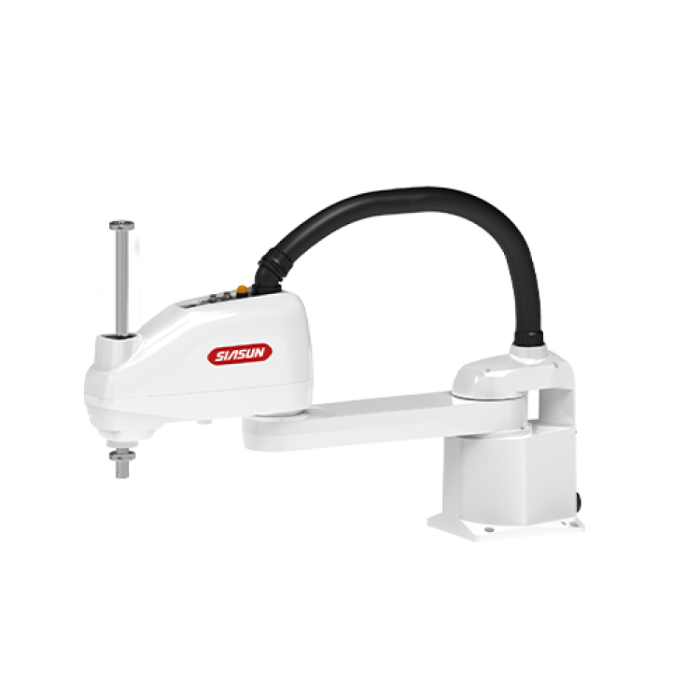
On a crowded production line, every robot is a negotiation between how far it has to reach and how much room it is allowed to take. The SIASUN SA7A-7/0.70 (SA7A-7/0.70) handles that negotiation on the line's terms. It is a SCARA arm with a 700mm reach and a 7 kg payload, built with a lower overall height so that it sits more comfortably under guarding, beside conveyors and inside cells where vertical clearance is scarce. It belongs to the SA7A series, SIASUN's brand-new generation of SCARA robots. The series is designed for the fast, repetitive and precise work that electronics, battery and solar manufacturing demand every shift.
Robots Europa, based in Dublin, supplies the SA7A-7/0.70 to manufacturers, system integrators and engineering teams across the European Union and the DACH region. Robots Europa prepares the quotation, arranges delivery to your site and remains your point of contact for technical support once the robot is installed. One company therefore stands behind the arm from the first enquiry to production.
Background
SIASUN and the SA7A generation
SIASUN builds industrial robots in several families. Its SCARA range spans the SA4A, SA7A, SA10A and SA20A series, and the full selection is listed in our SCARA category. The SA7A series is the manufacturer's brand-new generation in this range. It is not a refresh of an earlier arm: SIASUN has equipped it with all-new proprietary core components, so the parts that determine how the arm moves and holds position are the manufacturer's own. For a buyer, this means the behaviour of the mechanism is engineered as a whole rather than assembled from a generic parts list.
Within the series, the sources name three versions of the SA7A: the SA7A-7/0.50, the SA7A-7/0.60 and the SA7A-7/0.70 described on this page. Every figure quoted below belongs to the SA7A-7/0.70 alone.
Dual support and modular design
Two design decisions shape the SA7A series. The first is a dual-support structure, which delivers enhanced load capacity, higher precision, faster speed, greater rigidity and reduced vibration. In any SCARA robot, the stiffness of the arm decides how quickly it settles at the end of a move. A rigid arm that vibrates less can begin its next action sooner and hold its position more faithfully, which matters on lines that measure output in fractions of a second.
The second decision is a modular design, which allows the robot to serve more automation scenarios while reducing maintenance costs. Modularity of this kind generally simplifies servicing, because assemblies can be exchanged rather than rebuilt. It also lets one robot platform be adapted to different cells across a plant. Together with the lower overall height and a lightweight, compact structure, these choices position the SA7A-7/0.70 as an arm that integrators can deploy widely rather than as a single specialist.
Technical Specifications
| Specification | Value |
|---|---|
| Model | SA7A-7/0.70 |
| Robot type | SCARA robot, SA7A series |
| Payload | 7 kg (15.4 lbs) |
| Reach | 700mm |
| Repeatability | J1+J2/±0.02mm, J3/±0.01mm, J4/±0.01° |
| Protection | IP20 |
| Control cabinet | New generation S series control cabinet |
Specifications are as published by the manufacturer and are confirmed against the datasheet at quotation.
SIASUN has not published the weight, power supply, maximum speed, cycle time, axis ranges of motion, controller model, contents of the delivery, mounting options, communication interfaces or operating temperature of the SA7A-7/0.70; Robots Europa confirms these details with your quotation.
What does the dual-support structure mean for precision work?
Precision in a SCARA robot is spread across its axes, and the repeatability of the SA7A-7/0.70 is specified axis by axis. The two horizontal arm joints, J1 and J2, repeat to ±0.02mm together. The vertical axis, J3, repeats to ±0.01mm, and the rotation of the tool flange, J4, to ±0.01°. This breakdown is useful to an engineer planning an assembly task. Placing a component into a fixture depends mainly on the horizontal figure, while pressing, inserting or dispensing to a controlled height depends on the vertical one. The rotary figure governs how accurately a part can be oriented before it is set down.
The dual-support structure supports these numbers. With greater rigidity and reduced vibration, the arm can carry its full 7 kg payload at the end of a 700mm reach without the flex that would otherwise erode positional consistency. Tools and grippers can therefore be designed around the payload rather than within a safety margin forced by a flexible arm. Gluing heads, vacuum grippers and screwdriving units all benefit from a mechanism that stops where it was told to stop.
How does the SA7A-7/0.70 fit into a production cell?
A robot is only as useful as the cell around it, and the SA7A-7/0.70 is designed with integration in mind. The main unit carries abundant user cables, so the signal and supply lines for an end-of-arm tool can be routed through the robot rather than draped along the outside of the arm. Loose cabling is a common cause of snagging and wear in fast pick-and-place cells.
The arm works with a new generation of S series control cabinet and supports multiple programming and teaching methods. Teams can therefore choose the approach that suits them, whether that is teaching positions directly on the line or preparing programs offline. This expandability meets more automation scenarios while maintaining the overall machine cost.
Physically, the lower overall height reduces space constraints, and the lightweight, compact structure eases installation in existing lines. The IP20 protection rating places the robot among arms intended for clean, dry indoor environments such as electronics assembly halls. Applications exposed to liquids, coolants or heavy dust should be discussed with Robots Europa before ordering, so that suitable guarding or an alternative can be considered.
Who is the SIASUN SA7A-7/0.70 for?
The main application industries of the SA7A series are 3C, lithium battery, photovoltaic, automotive electronics and related sectors. The SA7A-7/0.70 therefore speaks first to production engineers in consumer electronics, where small parts are handled, placed and joined at high rates. It also suits battery cell and module lines, solar component manufacturing and suppliers of electronic assemblies to the automotive industry. In each case, the combination of a 700mm reach and a compact build allows one arm to serve several stations or a wide tray without occupying more floor space than necessary.
System integrators are a second audience. A modular arm with internal user cabling and a choice of programming methods can serve as a standard building block across many customer projects, which shortens engineering time from one cell to the next. Plant managers who are focused on uptime will also value the design's emphasis on lower maintenance costs.
Not every application needs this size of arm. Where the parts and the workspace are smaller, the SIASUN SA4A-4/0.40 (SA4A-4/0.40) is another member of the SIASUN SCARA range worth comparing. Where a task outgrows this arm, the SA10A series, such as the SIASUN SA10A-10/0.70 (SA10A-10/0.70), can be reviewed on its own page. The SA7A-7/0.50 and SA7A-7/0.60 versions of this series can also be requested from Robots Europa. The wider Industrial Robots category shows the remainder of the SIASUN range.
What is the SIASUN SA7A-7/0.70 used for?
- Handling: moving components between trays, conveyors and fixtures with consistent placement shift after shift.
- Sorting: separating parts by type or inspection result into the correct output lanes at line speed.
- Assembly: placing, inserting and joining components where vertical and rotational repeatability decide the quality of the fit.
- Gluing: guiding a dispensing head along a defined path to apply adhesive accurately.
- 3C and automotive electronics: serving compact assembly cells for consumer devices and vehicle electronic modules.
- Lithium battery and photovoltaic production: automating repetitive handling and assembly steps in cell, module and panel manufacturing.
Pricing and Availability
Robots Europa supplies the SIASUN SA7A-7/0.70 on the basis of a written quotation tailored to your application and site. Tell us about the task, the parts involved and the cell layout you have in mind, and we will propose the configuration that suits your cell. Delivery, customs and support are arranged together with the quotation. A quotation for the SIASUN SA7A-7/0.70 is available on this page.
Frequently Asked Questions
What payload does the SIASUN SA7A-7/0.70 handle?
The SA7A-7/0.70 carries a payload of 7 kg (15.4 lbs). This figure applies to this version of the SA7A series.
How far does the SA7A-7/0.70 reach?
Its reach is 700mm. With a lower overall height, it covers a wide working area without taking up much vertical space.
How precise is the SA7A-7/0.70?
Repeatability is ±0.02mm for J1 and J2 combined, ±0.01mm for the vertical J3 axis and ±0.01° for the J4 rotation. The dual-support structure adds rigidity and reduces vibration.
Can the SA7A-7/0.70 be used in wet or dusty environments?
The robot carries an IP20 protection rating, which suits clean, dry indoor production areas. For harsher conditions, please discuss guarding or alternative solutions with Robots Europa before ordering.
Which controller does the SA7A-7/0.70 use?
It works with a new generation of SIASUN S series control cabinet. Robots Europa sets out the full controller configuration in your quotation.
How is the SA7A-7/0.70 programmed?
The robot supports multiple programming and teaching methods, so your team can work in the way that suits your line.
Where can I buy the SIASUN SA7A-7/0.70 and what does it cost?
You can buy the SA7A-7/0.70 from Robots Europa, which supplies customers across the EU and the DACH region. The cost depends on your configuration and is set out in a personal quotation, which you can request on this page.
Summary
The SA7A-7/0.70 answers the question every line designer faces: how to gain reach and capacity without giving up space. Its 700mm reach and 7 kg payload are paired with a lower overall height and a compact build. A dual-support structure provides rigidity and holds its axis-by-axis repeatability, while modular design and internal user cabling keep both integration and maintenance manageable. For manufacturers in 3C, battery, photovoltaic and automotive electronics, it is an arm built to fit the cell rather than force the cell to fit the arm. Robots Europa quotes, delivers and supports it across the EU and the DACH region, and for your next SCARA cell, this page is the starting point.


