
SIASUN Industrial Robot Arm (SR210A-210/3.05-DW)
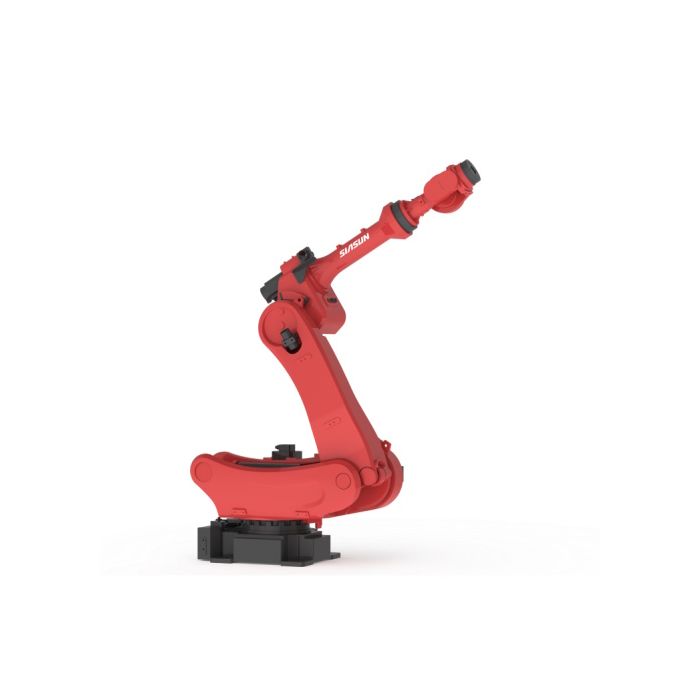
In stock
- BRAND:
- SIASUN
- PART #:
- SR210A-210/3.05-DW
- ORIGIN:
- China
- AVAILABILITY:
- SUBJECT TO AVAILABILITY
- SKU:
- SIASUN-SR210A-210/3.05-DW
SIASUN Industrial Robot Arm (SR210A-210/3.05-DW)
Most industrial arms are judged by how far they stretch outwards. On many shop floors, though, the harder problem runs the other way: a weld seam deep inside a car body, a casting sitting low in a fixture, a heavy part that must be lifted out of a cavity rather than picked off a table. The SIASUN Industrial Robot Arm (SR210A-210/3.05-DW) is built around that downward problem. It is a reach-down robot that leans over its work and into it, carrying a substantial load while it does so, and it can sit above a machine tool rather than beside it.
Robots Europa, based in Dublin, supplies the SR210A-210/3.05-DW to manufacturers, foundries and system integrators across the European Union and the DACH region. We prepare the quotation for your application, arrange delivery to your site and remain your point of contact for support once the robot is working, so that a single partner handles the project from the first enquiry onwards.
Background
SIASUN and its industrial robot range
SIASUN is a Chinese manufacturer of robots and automation systems whose industrial portfolio runs from compact arms for light assembly through to machines intended for heavy handling. Within that portfolio the SR210A-210/3.05-DW belongs to the upper tier, alongside the other models SIASUN positions in its Large Payload line. What sets this model apart from its neighbours is not simply the load it carries but the geometry it uses to carry it: the suffix in its name signals a variant designed for working downwards into the workpiece, a task that conventional heavy arms often handle awkwardly.
The reach-down concept
The defining feature is a forward-extending design that significantly increases the downward reach of the upper and lower arms. Instead of approaching a deep part at a steep angle from the side, the arm projects forward and then drops into the cavity, which gives it a maximum downward reach of 3050 mm. That motion range is what allows it to extend into narrow or deep spaces for precise operations. Combined with the option of mounting the robot on top of a machine tool, the design frees floor area that a pedestal-mounted arm and its safety envelope would otherwise occupy, which matters in crowded production halls where every square metre has a purpose.
Technical Specifications
| Specification | Value |
|---|---|
| Payload | 210 kg (463 lbs) |
| Reach | 3053mm |
| Maximum downward reach | 3050 mm |
| Repeatability | ±0.06mm |
| Protection (wrist) | IP67 |
Specifications as published by the manufacturer; confirmed against the datasheet at quotation.
SIASUN has not published the weight, the axis speeds, the axis ranges of motion, the power supply, the controller model, the wrist moment ratings, the operating temperature, the communication interfaces or the contents of the box; all of these are confirmed at quotation.
What makes a reach-down robot different from a conventional heavy-payload arm?
A conventional articulated arm is optimised for a working envelope that spreads around and in front of its base. It is excellent at lifting parts from one station and placing them at another, but when the target lies below and inside a structure, the arm has to fold itself into tight angles, and the wrist often ends up fighting the geometry rather than working with it. Engineers then compensate with raised pedestals, longer tooling or additional fixtures, each of which adds cost, deflection and complexity to the cell.
The SR210A-210/3.05-DW addresses this at the level of the arm itself. Its forward-extending upper and lower arms are shaped to project over the workpiece and reach down into it, giving a maximum downward reach of 3050 mm. This is why welding inside automobile bodies and the handling of large castings are its typical tasks: both require the tool to work at depth, inside a part, with a heavy end effector attached. The option of mounting the robot on top of a machine tool takes the idea further, placing the arm where it naturally looks down on its work while leaving the floor around the machine clear for operators, conveyors or material flow.
Can the SR210A-210/3.05-DW hold its accuracy when fully loaded?
Carrying 210 kg (463 lbs) at the end of a long, forward-projecting arm is a demanding mechanical task, and the obvious concern is whether precision degrades as the load increases. SIASUN's answer lies in the drive train and the structure: the robot uses advanced servo drives and a high-rigidity structure, and it maintains stability and positioning accuracy even when fully loaded. Its repeatability is ±0.06mm, which is the figure that matters for returning a welding torch or gripper to the same point cycle after cycle.
The wrist protection rating of IP67 supports the same goal from a different direction. The wrist is the part of the robot that sits closest to spatter, dust and coolant, and an IP67 rating indicates protection against dust ingress and against temporary immersion. For a robot that spends its working life inside car bodies and around castings, that protection at the tool end helps keep the arm dependable in conditions that are rarely clean.
Who is the SIASUN Industrial Robot Arm (SR210A-210/3.05-DW) for?
The clearest fit is automotive body production, where seams and joints inside the body shell are difficult to reach from outside and where a robot able to drop into the structure can take on work that would otherwise need awkward fixturing or manual effort. Foundries and casting finishers form a second group: large castings are heavy, bulky and often need to be lifted from deep moulds or fixtures, which is precisely the combination of load and downward reach this arm is designed for.
Machine shops and production lines short on floor space are a third segment. Because the robot can be mounted on top of machine tools, it suits operators who want automation without surrendering the area around the machine. Finally, system integrators building cells for deep-cavity tasks will find the reach-down geometry a useful starting point when a standard arm would force compromises in the layout.
Not every heavy-handling job needs the reach-down geometry. Where parts are presented in front of the robot rather than below it, a conventional long-reach arm such as the SIASUN Industrial Robot Arm with 3053 mm Reach, 120kg Max Payload, 6 DOF (SR210-120/3.05) may suit the task better, and where the load goes beyond what this model carries, the SIASUN Industrial Robot Arm with 2833mm Reach, 360kg Max Payload, 6 DOFs (SR500A-360/2.83) is the heavier option in the same family. The wider selection is available among our Robot Arms, and Robots Europa will gladly help you compare them for your application.
What is the SIASUN Industrial Robot Arm (SR210A-210/3.05-DW) used for?
- Welding inside automobile bodies — reaching down into the body shell to place welds on seams that are hard to access from the side.
- Handling large castings — lifting heavy cast parts from deep moulds, fixtures or containers with a stable, rigid arm.
- Machine-top installation — mounting above a machine tool to serve it from overhead while keeping the surrounding floor free.
- Deep-cavity operations — guiding tooling into narrow or deep spaces where a conventional arm would struggle to orient its wrist.
- Heavy tooling at depth — carrying substantial end effectors into a workpiece while retaining positioning accuracy under load.
- Work in dusty or wet zones — operating with an IP67-rated wrist where spatter, dust or coolant reach the tool end of the robot.
Pricing and Availability
Robots Europa supplies the SR210A-210/3.05-DW on the basis of a quotation prepared for your project, so that the configuration, accessories and documentation reflect the task you have in mind. Tell us about the workpiece, the cell layout and the mounting position you are considering, and we will tailor our reply to your application. Delivery, customs and support are arranged together with the quotation. To begin, request your quotation using the enquiry form available on this page.
Frequently Asked Questions
What is a reach-down robot?
It is an industrial robot whose arm geometry is designed to work downwards into a workpiece rather than mainly outwards from its base. On the SR210A-210/3.05-DW, a forward-extending design increases the downward reach of the upper and lower arms to a maximum of 3050 mm.
What payload does the SR210A-210/3.05-DW carry?
The payload is 210 kg (463 lbs). This load includes the tooling at the end of the arm, so the end effector should be considered when planning the application.
How precise is the robot?
The repeatability is ±0.06mm. Servo drives and a high-rigidity structure keep the robot stable and accurate even when fully loaded.
Can the robot be mounted on a machine tool?
Yes, it can be mounted on top of machine tools, which saves valuable workspace on the floor. We are happy to go through the mounting arrangement with you when planning your cell.
How well is the wrist protected against dust and liquids?
The wrist is rated IP67. This matters because the wrist sits closest to spatter, dust and coolant in welding and casting work.
Which tasks is the robot designed for?
It is designed for heavy-load, deep-cavity work such as welding inside automobile bodies and handling large castings. Its reach-down geometry lets it extend into narrow or deep spaces that conventional arms find difficult to access.
Where can I buy the SIASUN Industrial Robot Arm (SR210A-210/3.05-DW) and what does it cost?
You can buy it from Robots Europa, which supplies customers across the EU and the DACH region from Dublin. The cost depends on your configuration and project, so we provide it in a tailored quotation that you can request on this page.
Summary
The SR210A-210/3.05-DW turns the usual logic of a heavy industrial arm on its head: rather than measuring its value by how far it stretches outwards, it is designed to lean over a workpiece and work inside it. A forward-extending structure gives it a maximum downward reach of 3050 mm, a payload of 210 kg (463 lbs) lets it carry serious tooling and castings, and servo drives with a rigid structure keep its ±0.06mm repeatability meaningful under full load. Add an IP67-rated wrist and the option of mounting it on top of a machine tool, and the result is a robot aimed squarely at welding inside car bodies, handling large castings and any task where the work lies deep rather than wide. If your next automation project begins with a part that must be reached from above, this page is the starting point.


