
SIASUN Outdoor Trackless Guided Heavy Payload Mobile Robot (Harbour)
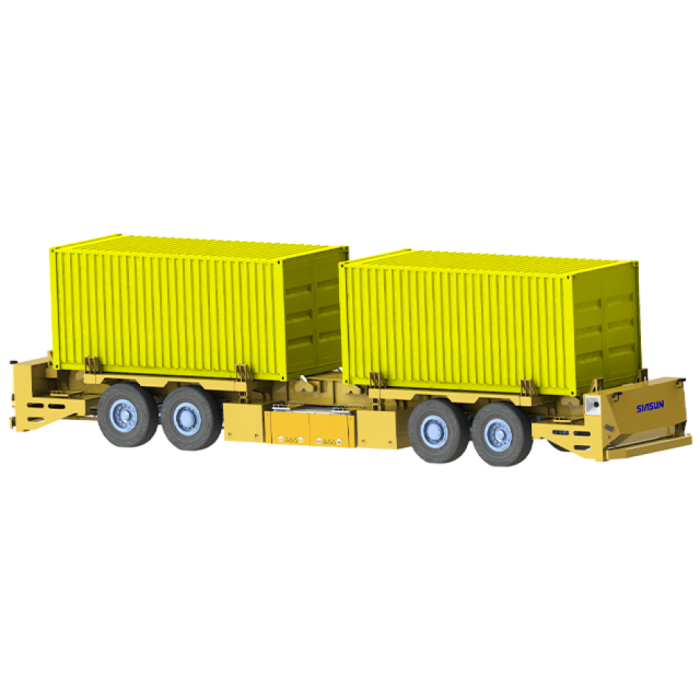
In stock
- BRAND:
- SIASUN
- MODEL:
- Outdoor Trackless Guided Heavy Payload Mobile Robot (Harbour)
- PART #:
- Outdoor Trackless Guided Heavy Payload Mobile Robot (Harbour)
- ORIGIN:
- China
- Warranty:
- 12 MONTHS
- AVAILABILITY:
- SUBJECT TO AVAILABILITY
- SKU:
- SIASUN-outdoor-trackless-guided-heavy-payload-mobile-robot-harbo
SIASUN Outdoor Trackless Guided Heavy Payload Mobile Robot (Harbour)
Every quay crane on a container terminal is only as productive as the vehicle waiting beneath it. When a box comes down and nothing is there to receive it, the crane pauses, the vessel's stay lengthens and the yard begins to fall behind. The SIASUN Outdoor Trackless Guided Heavy Payload Mobile Robot (Harbour) is designed to close that gap. It waits under the shore bridge, takes the container on its top deck and carries it to the yard area without a driver and without fixed track, crossing several work zones on the way.
Robots Europa, based in Dublin, supplies this harbour robot to port operators, terminal owners and automation integrators across the European Union and the DACH region. Robots Europa prepares the quotation, coordinates delivery to the terminal and remains the point of contact for support once the robots are in service. A terminal project on the North Sea, the Baltic or the Mediterranean therefore deals with a single supplier from first enquiry to daily operation.
Background
SIASUN and its move into port logistics
SIASUN builds heavy payload mobile robots, and its port range has grown well beyond its home market. Since 2020, SIASUN's heavy payload mobile robots have gone global, supplying large batches to the world's largest transshipment hub ports. This harbour model belongs to that export programme: it has been shipped overseas, stationed in world-famous ports and put into use. For a European buyer, this is a useful indication. The design has already worked in high-volume terminal operation, where availability matters more than any single specification.
Transshipment hubs place particular demands on horizontal transport. Boxes arrive and leave by sea, yard moves are constant and the quay must keep pace with the cranes around the clock. A product that has been supplied in batches to this type of port has been developed with exactly that rhythm in mind.
Trackless guidance built on many positioning methods
The word "trackless" sums up the robot's key technology. It does not run on rails or follow a single fixed path. Instead, it draws on a broad set of navigation methods: inertial guidance positioning, magnetic peg positioning, RTK differential positioning, UWB positioning, laser contour positioning, vision positioning, 5G positioning technology and GPS positioning, among others. Positioning accuracy is controlled at ±5cm. This precision allows the robot to stop exactly beneath the shore bridge so that the crane can set the container down without repeated corrections.
Because the route is calculated rather than built into the ground, the robot can change lanes. It performs a wedge-shaped lane change according to the system calculation. This gives it the flexibility and passing ability that a busy quay requires and protects the efficiency of the whole operation.
Technical Specifications
| Specification | Value |
|---|---|
| Function | Container transport from the shore bridge to the yard area |
| Cargo per single trip | 2x20ft containers, 2x20ft tanks, 40ft containers or 45ft containers, respectively |
| Travelling speed | Up to 7m/s for 95 tonnes of heavy loads |
| Positioning accuracy | ±5cm |
| Navigation methods | Inertial guidance, magnetic peg, RTK differential, UWB, laser contour, vision, 5G and GPS positioning, and others |
| Lane change | Wedge-shaped lane change according to the system calculation |
| Collision avoidance | Automatic stopping function |
| Battery swapping | Heavy-duty battery swap; batteries weighing up to 7 tonnes, swapped in 5 minutes |
| Fault diagnosis | Self-test and self-assessment with advance judgement |
Specifications are as published by the manufacturer and are confirmed against the datasheet at quotation.
The manufacturer has not published the dimensions, weight, rated payload of this model, battery capacity, ingress protection rating, gradeability, power supply voltage, operating temperature range, drive and steering type, or the scope of delivery; Robots Europa confirms these at quotation.
How does a trackless harbour robot change horizontal transport on the quay?
On many terminals, horizontal transport between quay and yard is still handled by manned tractors and trailers. Each vehicle depends on a driver, each shift change interrupts the flow, and each manoeuvre under the crane relies on human judgement. The SIASUN harbour robot takes a different approach. The shore bridge lifts the container from the ship and places it directly onto the top of the robot waiting below. The robot then carries the box to the yard area under system control.
Three features make this reliable in practice. First, the robot has to pass through multiple work areas, so it is fitted with an automatic stopping function to avoid collision. Second, the wedge-shaped lane change allows it to pass and re-route as the system calculates, rather than queuing behind a stopped vehicle. Third, the ±5cm positioning accuracy means the hand-off under the crane is repeatable from one cycle to the next. Together, these features allow unmanned operation across all work areas, and the quay crane always finds a vehicle in position.
Cargo flexibility is the other side of the argument. In a single trip, the robot carries 2x20ft containers, 2x20ft tanks, 40ft containers or 45ft containers, respectively. A terminal handling a mixed vessel can therefore work with one type of vehicle rather than a fleet split by box length.
How does battery swapping keep the robot in service?
A heavy electric vehicle is only as available as its energy supply. SIASUN addresses this with heavy-duty battery swap technology: batteries weighing up to 7 tonnes can be swapped in 5 minutes. The robot does not need to stand idle for a long charging cycle. It leaves the quay briefly, exchanges its battery and returns to the crane. For a terminal running continuous shifts, this changes how the fleet can be planned.
Availability also depends on predicting problems before they stop work. The robot can test and assess itself and judge faults in advance, which helps to keep the operation running efficiently. Maintenance can then be planned around the vessel schedule rather than forced upon it.
Who is the SIASUN Outdoor Trackless Guided Heavy Payload Mobile Robot (Harbour) for?
The first group is container terminal operators who want to automate horizontal transport between the quay and the stacking yard. This is especially relevant where crane productivity is limited by the vehicles serving the cranes. The second is port authorities and terminal developers planning a new automated berth or the conversion of an existing one. For them, trackless guidance means fewer fixed installations in the quay surface than rail-bound systems would require.
System integrators form a third group. They design the terminal operating logic and need a vehicle that accepts system-calculated routing, including the wedge-shaped lane change. Transshipment hubs and terminals that handle tank containers alongside standard boxes will value the range of loads the robot carries in a single trip.
Buyers who do not move containers but pallets or loads within warehouses and factories should look at the wider Mobile Robots range and the Logistics Robots category. There, Robots Europa lists SIASUN equipment intended for those settings.
What is the SIASUN Outdoor Trackless Guided Heavy Payload Mobile Robot (Harbour) used for?
- Quay-to-yard transfer: receiving containers directly from the shore bridge and delivering them to the yard area.
- Twin twenty-foot moves: carrying 2x20ft containers in a single trip to reduce the number of journeys.
- Tank container transport: handling 2x20ft tanks on the same vehicle that moves dry boxes.
- Long-box handling: transporting 40ft and 45ft containers without changing to a different vehicle type.
- Mixed work zones: crossing multiple operating areas safely, with automatic stopping to avoid collision.
- Continuous shift operation: staying in service through rapid heavy-duty battery swaps rather than long charging stops.
Pricing and Availability
Robots Europa supplies this robot on quotation. Each terminal differs in layout, traffic, positioning infrastructure and fleet size, so the offer is prepared for your project rather than taken from a list. Delivery, customs and support are arranged together with the quotation. This allows you to see the complete scope before you commit. To begin, please send your terminal details and expected volumes through the quotation request available on this page.
Frequently Asked Questions
How does the container get onto the robot?
The shore bridge lifts the container from the ship and places it on top of the harbour robot waiting below. The robot then transports it to the yard area.
Which cargo can it carry in a single trip?
It carries 2x20ft containers, 2x20ft tanks, 40ft containers or 45ft containers, respectively, in a single trip.
Does the robot need rails or guide wires?
No. It is trackless and navigates using methods such as inertial guidance, magnetic pegs, RTK differential, UWB, laser contour, vision, 5G and GPS positioning. Its positioning accuracy is ±5cm.
How fast does it travel?
It travels at up to 7m/s with 95 tonnes of heavy load.
How is the robot recharged?
It uses heavy-duty battery swap technology. Batteries weighing up to 7 tonnes are swapped in 5 minutes.
How does it avoid collisions with other vehicles?
Because it passes through multiple work areas, the robot has an automatic stopping function to avoid collision. It also changes lanes in a wedge shape according to the system calculation.
Where can I buy the SIASUN Outdoor Trackless Guided Heavy Payload Mobile Robot (Harbour) and what does it cost?
Robots Europa supplies it across the EU and the DACH region. The cost depends on your project and is set out in an individual quotation, which you can request on this page.
Summary
A quay crane cannot work faster than the vehicle beneath it. The SIASUN harbour robot is designed to make sure that vehicle is always in position. It receives containers directly from the shore bridge, carries the full range from twin twenties and tanks to 45ft boxes, and reaches its stopping point with ±5cm accuracy. It changes lanes as the system calculates, stops automatically to avoid collision and returns to work after a 5-minute battery swap. SIASUN has already supplied its heavy payload robots to major transshipment hubs since 2020. Robots Europa now provides quotation, delivery and support for European terminals. For anyone planning to keep the cranes working without interruption, this page is the starting point.


