
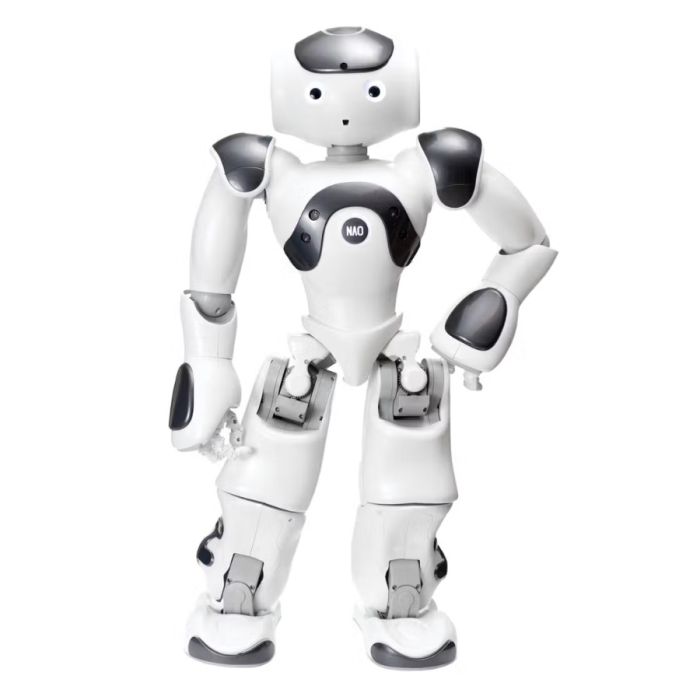
Softbank Robotics NAO V6 Humanoid Robot
In stock
- BRAND:
- SOFTBANK
- MODEL:
- NAO
- AVAILABILITY:
- SUBJECT TO AVAILABILITY
- SKU:
- SoftBank-NAO
Softbank Robotics NAO V6 Humanoid Robot
Code that runs perfectly on a laptop tells a student very little about how a machine behaves when a person walks into the room. The Softbank Robotics NAO V6 Humanoid Robot closes that gap. It is a humanoid small enough to stand on a desk, built to interact naturally with people, so that a line of Python becomes a turn of the head, a spoken reply or a step forward. For educators, researchers and teams working in healthcare and elderly care settings, it turns human-robot interaction from a topic on a slide into something that can be observed, measured and repeated in front of an audience.
Robots Europa, based in Dublin, supplies the NAO V6 to schools, universities, research laboratories and care-sector organisations across the EU and the DACH region. Robots Europa prepares each quotation, coordinates delivery to the customer's site and remains the point of contact for technical questions and support once the robot is in use. This gives institutions a single European partner from the first enquiry to the robot's everyday work in the classroom or laboratory.
Background
From Aldebaran to Softbank Robotics
NAO was created by the French robotics company Aldebaran, which was later acquired by Softbank Robotics. The robot has since become one of the best-known small humanoids in academic and educational use, and the V6 is the current generation of the platform. For buyers, this lineage matters less as history than as continuity. A platform that has been in use for several generations tends to have a body of teaching material, published research and community experience behind it, which shortens the time between unpacking the robot and doing useful work with it.
A humanoid built for interaction
Most robots are designed around a task: moving a load, inspecting a pipe or mapping a building. NAO is designed around people. Its humanoid form, with a head, arms and legs, makes its behaviour legible to anyone watching, whether that is a first-year student, a research participant or an older adult in a care setting. Humanoid robots of this class are typically used where the reaction of the person matters as much as the action of the machine. They are deployed for studying engagement, rehearsing social interaction, demonstrating programming concepts or testing how people respond to speech and gesture from a machine. Two front cameras, four microphones, two speakers and sonar give NAO V6 the senses that this kind of work depends on.
Technical Specifications
| Specification | Value |
|---|---|
| Height | 574 mm |
| Dimensions | 574mm x 275mm x 311mm |
| Weight | about 5.48 kg |
| Degrees of freedom | 25 |
| Processor | Intel Atom E3845 (1.91 GHz) |
| Memory | 4 GB DDR3 |
| Storage | 32 GB eMMC |
| Cameras | 2 front cameras (OV5640 sensor, 5 MP) |
| Camera resolution and frame rate | Up to 2560*1920 at 1 fps or 640*480 at 30 fps |
| Audio | 4 microphones; 2 speakers (2 W input) |
| Sonar frequency | 40kHz |
| Sonar detection range | 0.20 m - 0.80 m |
| Connectivity | Ethernet (RJ45), Wi-Fi (802.11a/b/g/n), Bluetooth 4.0 (LE) |
| Battery | Li-ion 21.6 V / 2.9 Ah (62.5 Wh) |
| Battery runtime | ~60 min (active use) / ~90 min (standard use) |
| Programming | Python, C++ (via SDK); scenario design via Choregraphe |
| Software supplied | Complete software suite (Choregraphe, Monitor & SDK) |
Specifications as published by the manufacturer; confirmed against the datasheet at quotation.
The manufacturer has not published the payload, the IP rating, the walking speed, the charging time or the operating noise level; Robots Europa confirms these points at quotation.
What does NAO V6 offer developers beyond its hardware?
A humanoid robot is only as useful as the ease with which people can tell it what to do. NAO V6 is supplied with a complete software suite comprising Choregraphe, Monitor and the SDK, and this is where much of its value in teaching and research lies.
Choregraphe is the scenario design environment. It allows behaviours to be assembled visually, which makes it suitable for learners who are meeting robotics for the first time and for researchers who need to prototype an interaction quickly before refining it. Monitor complements this by giving users a view of what the robot is perceiving and doing. For more advanced work, the SDK opens the robot to Python and C++, the two languages most likely to be taught in computer science and engineering courses. A group can therefore begin with visual scenarios and move to written code on the same robot, without changing platform as its skills grow.
On board, the Intel Atom E3845 processor running at 1.91 GHz, 4 GB of DDR3 memory and 32 GB of eMMC storage give the robot the resources to run its behaviours locally. Ethernet, Wi-Fi to 802.11a/b/g/n and Bluetooth 4.0 (LE) allow it to be connected to a development workstation, a campus network or other devices used in an experiment. For a research group, this combination means a single robot can serve as a self-contained demonstrator and as a networked node in a larger set-up.
How long does NAO V6 run on a single charge?
Session planning is a practical question for any school or laboratory, and the battery figures answer it directly. NAO V6 carries a Li-ion battery rated at 21.6 V / 2.9 Ah, or 62.5 Wh. The stated runtime is ~60 min in active use and ~90 min in standard use.
In practice, this suits the rhythm of a lesson, a workshop or an experimental session. Where movement-heavy behaviours are planned, such as walking demonstrations or extended gesture sequences, the shorter active-use figure is the sensible basis for planning. Interaction studies built mainly around speech, listening and observation are closer to the standard-use profile. Institutions that intend to run back-to-back sessions should describe their schedule to Robots Europa when requesting a quotation, so that the day can be planned accordingly.
Who is the Softbank Robotics NAO V6 Humanoid Robot for?
Schools and colleges form the first group. For them, NAO V6 makes programming tangible: students see their code take physical form, and Choregraphe offers a gentle starting point before Python is introduced. Universities and research institutes form the second, using the robot as a shared platform for work on human-robot interaction, perception and behaviour design, where the SDK and C++ support give researchers the depth they need.
A third group works in healthcare and elderly care environments, which the manufacturer names explicitly among the robot's intended settings. Here the interest lies in how people respond to a sociable machine, and in exploring the role such a robot can play alongside professional staff. Innovation teams, science centres and technology demonstrators may also find a humanoid of this size easy to transport and set up for audiences.
The sources name two versions: the NAO V6 Standard Edition and the NAO AI Edition. Robots Europa explains the differences in configuration and supplied software, and advises which edition fits the intended work. Related equipment can be found in the Shop category.
What is the Softbank Robotics NAO V6 Humanoid Robot used for?
- Programming education — learners move from visual scenarios in Choregraphe to Python on the same robot.
- Robotics courses — 25 degrees of freedom give students a full humanoid body to study motion and control.
- Human-robot interaction research — cameras, microphones and speakers support studies of how people respond to a sociable machine.
- Healthcare and elderly care projects — the robot is designed for interaction in these environments, which makes it a candidate for pilot programmes.
- Computer vision experiments — two 5 MP cameras let researchers trade resolution against frame rate according to the task.
- Public demonstrations — a desk-sized humanoid draws an audience at open days, exhibitions and outreach events.
Pricing and Availability
Robots Europa supplies the Softbank Robotics NAO V6 Humanoid Robot on the basis of a written quotation prepared for each institution. This allows the edition, the software suite and any accompanying services to be matched to the intended use, whether that is a single robot for a classroom or several units for a research programme. Delivery, customs and support are arranged with the quotation. To begin, please describe your project and the setting in which the robot will be used, using the quotation request available on this page.
Frequently Asked Questions
How tall is NAO V6 and how much does it weigh?
NAO V6 stands 574 mm tall and weighs about 5.48 kg. Its dimensions are 574mm x 275mm x 311mm.
Which programming languages does NAO V6 support?
The robot can be programmed in Python and C++ via the SDK. Behaviours can also be designed as scenarios in Choregraphe.
What software is supplied with the robot?
NAO V6 comes with a complete software suite comprising Choregraphe, Monitor and the SDK.
How long does the battery last?
The 62.5 Wh Li-ion battery provides ~60 min in active use and ~90 min in standard use.
How does NAO V6 perceive its surroundings?
It has two front cameras with OV5640 sensors, four microphones and sonar with a detection range of 0.20 m - 0.80 m. The cameras deliver up to 2560*1920 at 1 fps or 640*480 at 30 fps.
How is NAO V6 connected to a network?
The robot offers Ethernet (RJ45), Wi-Fi (802.11a/b/g/n) and Bluetooth 4.0 (LE).
Where can I buy the Softbank Robotics NAO V6 Humanoid Robot and what does it cost?
Robots Europa supplies NAO V6 across the EU and the DACH region. The cost depends on the edition and the services required, and is set out in a written quotation, which you can request from this page.
Summary
The distance between code on a screen and behaviour in a room is where students learn and where interaction research happens. The Softbank Robotics NAO V6 Humanoid Robot is built for that distance. It is a humanoid designed to interact naturally with people, with 25 degrees of freedom, cameras, microphones and sonar, and a software suite that runs from Choregraphe scenarios to Python and C++. Robots Europa supplies it from Dublin to institutions across the EU and the DACH region, with the edition, delivery and support agreed in a single quotation. For a classroom, a laboratory or a care-sector pilot that needs a robot people can actually engage with, this page is the starting point.


