Topsky Dragon Conquest D4 Explosion-Proof Firefighting And Scouting Robot (RXR-MC80BD)

In stock
- BRAND:
- TOPSKY
- PART #:
- Dragon Conquest D4 RXR-MC80BD
- ORIGIN:
- China
- AVAILABILITY:
- SUBJECT TO AVAILABILITY
- SKU:
- Topsky-RXR-MC80BD
Topsky Dragon Conquest D4 Explosion-Proof Firefighting And Scouting Robot (RXR-MC80BD)
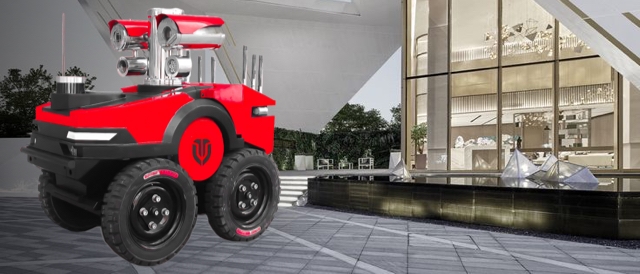
When a storage tank catches fire at a refinery, the hardest decision is rarely between water and foam. It is about distance: how close someone must stand to put the monitor where it counts, and how long that person can stay there while vapour drifts and the heat builds. The Topsky Dragon Conquest D4 Explosion-Proof Firefighting And Scouting Robot (RXR-MC80BD) settles that question differently. It sends the nozzle, the cameras and the gas sensors into the danger zone and leaves the crew at the controls, well outside it. The result is a tracked machine that drags charged hose lines, cools itself behind its own water curtain and reports what the air contains while it works.
Robots Europa, based in Dublin, supplies the RXR-MC80BD to fire services, industrial operators and safety contractors across the European Union and the DACH region. Robots Europa prepares each quotation, arranges delivery to site and remains your point of contact for support once the robot enters service.
Background
Topsky and the RXR line
Topsky is the brand of Beijing Topsky Intelligent Equipment Group Co., Ltd., whose RXR designation covers firefighting and reconnaissance robots for industrial emergencies. The Dragon Conquest D4 occupies the explosion-proof end of that line. It is intended for sites where a stray spark could prove as dangerous as the fire itself. Further machines from the same manufacturer are listed in the Topsky range, and the wider class of tracked and wheeled platforms is collected under UGVs.
Industrial fire brigades have adopted robots of this kind because petrochemical incidents tend to be long, hot and unpredictable. A ground robot can hold a monitor position for an extended period and carry sensors into smoke that would blind a human observer. It can then be withdrawn without anyone having entered the hazardous area. That makes it a means of keeping people out of the most dangerous positions, not a replacement for the crew.
Built to work inside the hazard
The RXR-MC80BD is designed and certified for fire-extinguishing and reconnaissance in explosive environments. These include petrochemical refining, oil and fuel gas storage, and other chemical manufacturing, storage and transportation sites. The robot is explosion-proof certified and sealed to IP67 and IP68. Its tracks use heat tolerant, fire retardant rubber with a metal lining. An automatic water curtain cooling system shields the machine as it closes on the fire. An integrated gas detection platform measures gas and environmental parameters, so the robot that fights the fire also tells the incident commander what is in the air around it. Its basic functions cover firefighting, audio and video reconnaissance, reconnaissance of toxic and hazardous gases, and environmental reconnaissance in disaster areas.
Technical Specifications
| Specification | Value |
|---|---|
| Explosion protection | Explosion-proof certified |
| Ingress protection | IP67 & IP68 |
| Size | 1305*800*1065mm |
| Weight | 529kg |
| Traction | 3800N |
| Speed | 0-1.81m/s |
| Work time | 2-6hrs |
| Obstacle crossing | 220mm |
| Wading depth | 500mm |
| Hose towing | Two 100M lengths DN80 fire hoses filled with water |
| Track | Heat tolerant, fire retardant rubber and metal lining |
| Cooling | Automatic water curtain cooling system |
| Gas detection | Integrated gas detection platform for gas and environmental parameters |
Specifications as published by the manufacturer; confirmed against the datasheet at quotation.
The manufacturer has not published the battery capacity, the motor power, the flow rate or range of the fire monitor, the remote control distance, the camera resolution, the operating temperature range or the contents of the delivery; Robots Europa confirms these at quotation.
How does the RXR-MC80BD hold its ground while the monitor is spraying?
Any monitor discharging water at volume pushes back against whatever carries it. On a tracked robot, the drive has to resist that recoil. Topsky's answer is a driving motor of a specified type that switches from driving mode to generating mode while water is being sprayed. The motor does not simply brace against the reaction force; it converts it into charge for the battery. Recoil restraint and energy management are therefore handled by the same component. That matters on a battery-powered machine that may be expected to stay on station for hours.
The monitor itself is operated remotely for rotation and pitching. The operator can change between multiple spraying modes and switch easily between water and foam. With traction of 3800N, the robot can drag two 100M lengths DN80 fire hoses filled with water. It can therefore advance a charged supply line to a position the crew could not safely reach, and then hold it there. The robot also collects site sound in real time for rescue purposes, which gives the operator an audio channel alongside the video picture.
What does the RXR-MC80BD - M version change?
The sources name a second version, the RXR-MC80BD - M. It carries an explosion-proof grade of Exd[ib] II BT4Gb for the whole machine and Exd[ib] II CT6Gb for the battery. It is powered electrically by a ternary lithium battery. These markings belong to the RXR-MC80BD - M and should not be read across to the standard RXR-MC80BD, which is explosion-proof certified in its own right. Where a site's permit regime requires a documented marking, the two versions should be compared side by side before ordering. Robots Europa can set out the differences against the zone in which the robot will operate.
Who is the RXR-MC80BD for?
The clearest fit is the in-house fire brigade at a refinery or petrochemical complex. Process units, tank farms and loading areas there create exactly the explosive atmosphere the robot is certified for. Operators of oil and fuel gas storage terminals are a second group. For them, the ability to drag charged hose lines across a bund and keep a monitor trained on a tank wall shortens the time anyone spends in the exposure zone.
Chemical manufacturers and logistics operators, from production sites to transport hubs, will value the reconnaissance side as much as the extinguishing side. Gas detection, video and live sound let a response team assess a leak or a smouldering load before deciding whether to commit people. Public fire and rescue services covering industrial districts, and specialist safety contractors who provide cover for shutdowns and turnarounds, complete the picture.
Buyers whose safety case or site permit calls for a specific explosion-proof grade should look closely at the RXR-MC80BD - M, because that version carries the Exd[ib] markings for the machine and its battery. Robots Europa can advise which version matches the documentation your site requires.
What is the RXR-MC80BD used for?
- Tank and process fires — directing water or foam from a remotely controlled monitor at a fire too hot or too volatile to approach on foot.
- Advancing supply lines — dragging two charged 100M DN80 hoses forward so that the attack position moves without the crew.
- Toxic and hazardous gas reconnaissance — measuring gas and environmental parameters with the integrated detection platform before people are committed.
- Audio and video reconnaissance — sending back live images and site sound to support search and rescue decisions.
- Environmental survey in disaster areas — assessing conditions at an incident site once the fire is out but the atmosphere remains uncertain.
- Cooling exposed plant — holding a sustained water stream on neighbouring tanks and structures to limit the spread of an incident.
Pricing and Availability
Robots Europa quotes the RXR-MC80BD on request, because the version, configuration and site requirements shape every order. Delivery, customs and support are arranged with the quotation. To begin, send us your site details and intended use through the quotation request available on this page.
Frequently Asked Questions
Is the RXR-MC80BD suitable for explosive atmospheres?
Yes. The robot is designed and certified for fire-extinguishing and reconnaissance in explosive environments and is explosion-proof certified, with IP67 and IP68 sealing.
How long can the robot work on a single charge?
The work time is 2-6hrs, depending on how the robot is deployed.
Can the monitor switch between water and foam?
Yes. The monitor is controlled remotely for rotation and pitching, offers multiple spraying modes and switches easily between water and foam.
How much hose can the RXR-MC80BD pull?
It can drag two 100M lengths DN80 fire hoses filled with water, supported by traction of 3800N.
What terrain can it handle?
The robot crosses obstacles of 220mm, wades to a depth of 500mm and travels at 0-1.81m/s on tracks of heat tolerant, fire retardant rubber with a metal lining.
What is the difference between the RXR-MC80BD and the RXR-MC80BD - M?
The RXR-MC80BD - M carries an explosion-proof grade of Exd[ib] II BT4Gb for the whole machine and Exd[ib] II CT6Gb for the battery, and runs on a ternary lithium battery. Robots Europa compares the two versions against your site's requirements when preparing the quotation.
Where can I buy the RXR-MC80BD and what does it cost?
Robots Europa supplies the RXR-MC80BD across the EU and the DACH region. Pricing is provided by individual quotation, which you can request from this page.
Summary
The RXR-MC80BD is built around one idea: the person directing the attack on an industrial fire should not have to stand inside it. The robot puts explosion-proof certification, IP67 and IP68 sealing, a self-cooling water curtain and fire retardant tracks between that hazard and your crew. It drags charged hose lines, turns monitor recoil into battery charge and reads the atmosphere as it goes. For sites that need a specific explosion-proof grade, the RXR-MC80BD - M is the version to examine. Robots Europa quotes, delivers and supports both across the EU and the DACH region. For a refinery, terminal or chemical site weighing how to keep distance between its people and its worst day, this page is the starting point.