
UBTECH WASSI Smart Trainer
In stock
- BRAND:
- UBTECH
- PART #:
- WASSI
- ORIGIN:
- China
- AVAILABILITY:
- SUBJECT TO AVAILABILITY
- SKU:
- UBTECH-WASSI
UBTECH WASSI Smart Trainer
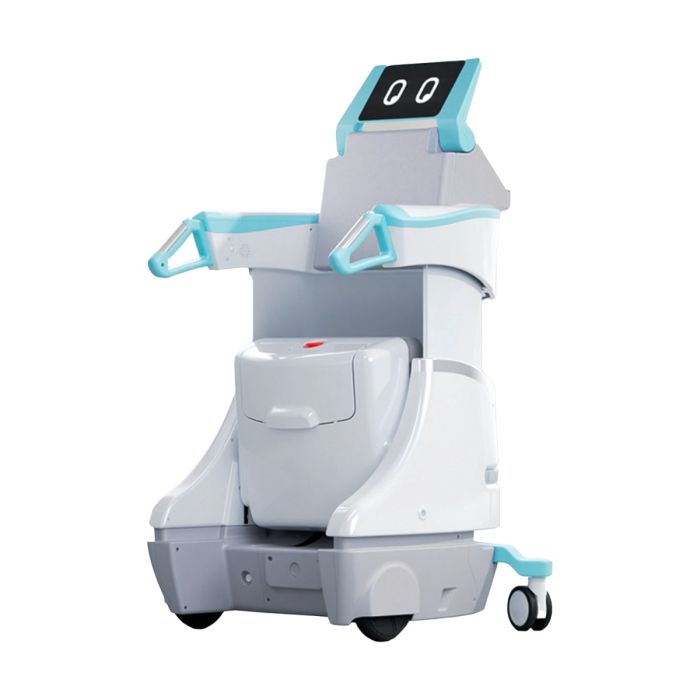
Every walking session in rehabilitation carries a quiet negotiation: the patient wants to move under their own steam, and the clinician wants to be certain that they will not fall while doing so. The UBTECH WASSI Smart Trainer is designed to sit in the middle of that negotiation. It gives the user a frame to hold, a pace to set and spoken guidance to follow, while keeping a seat, a one-button call for help and real-time physical monitoring within reach. Independence and supervision, in other words, travel together on the same chassis.
Robots Europa, based in Dublin, supplies the WASSI Smart Trainer to hospitals, rehabilitation centres and care providers across the European Union and the DACH region. We prepare each quotation for the individual project, arrange delivery to your site and remain your point of contact for support once the trainer is in service on the ward.
Background
UBTECH Robotics and its move into care
UBTECH Robotics is a Chinese robotics company best known for humanoid and service robots, ranging from educational platforms to commercial reception robots. Its portfolio has since broadened into healthcare, with delivery robots, cleaning robots and mobility devices developed for hospitals and care facilities. The WASSI Smart Trainer belongs to that healthcare line and sits alongside the other products in our Healthcare range. What these products share is a focus on taking routine, repetitive tasks off clinical staff so that their time goes where it is most needed.
A walking trainer that moves by itself
A conventional walking frame waits in a corridor until someone fetches it. WASSI uses navigation and obstacle avoidance technology to deliver itself to the user and to return for recharging afterwards. Its perception rests on a broad sensor suite: Lidar, an ultrasonic sensor, front and rear infrared sensors, a 3D camera, a top RGB camera, an IMU inertial sensor, an optical sensor and a microphone array. A built-in intelligent controlling system adjusts the handles to the user's height and preference, and a touch screen with animation and audible exercise instruction turns the session into an interactive programme rather than an unguided walk.
Technical Specifications
| Specification | Value |
|---|---|
| Dimensions | 750 x 645 x (930-1430, adjustable) mm |
| Weight | 65 kg |
| Seat load bearing | 100 kg |
| Speed | 0 to 0.8 m/s (adjustable) |
| Handle height | 660 to 930 mm (electrically adjustable) |
| Seat height | 0 to 75° (electrically adjustable) |
| Screen angle | 0 to 130° (adjustable) |
| Obstacle crossing height | 15 mm |
| Trench width | 35 mm |
| Climbing slope | 5° |
| Sensors | Lidar, ultrasonic sensor, front and rear infrared sensors, 3D camera, top RGB camera, IMU inertial sensor, optical sensor, and microphone array |
| Accessories | Infusion support can be mounted on the left or right handle |
Specifications are as published by the manufacturer and are confirmed against the datasheet at quotation.
UBTECH has not published the battery capacity, battery runtime, charging time, connectivity, IP rating, package contents, the specific vital signs measured, independent certifications, noise level or display size; Robots Europa confirms these with you at quotation.
How does the WASSI Smart Trainer keep a walking session safe?
Safety on WASSI is not a single feature but a series of layers, each addressing a different moment in a session. The first is pace. As an intelligent walking trainer, WASSI adjusts its speed within a range of 0 to 0.8 m/s and gives clear voice prompts, so the user is never left guessing what the device is about to do. The second is posture: handles that adjust autonomously to the user's height and preference, across an electrically adjustable range of 660 to 930 mm, encourage an upright stance rather than a stooped grip on a frame set for someone else.
The third layer covers the moment something goes wrong. In an emergency the user presses one button to call for help, and the seat opens and closes autonomously, giving a tired or unsteady person somewhere to sit at once instead of searching for a chair. The seat has a load bearing of 100 kg. Running beneath all of this is real-time physical monitoring, which keeps the user's condition under continuous observation for the duration of the exercise.
Finally, there is the route itself. WASSI crosses obstacles up to 15 mm, spans trenches up to 35 mm and climbs slopes of 5°. Those figures are worth setting against the thresholds, floor joints and ramps of your own building when planning where sessions will take place, and our team is glad to work through a floor plan with you during the quotation.
What does WASSI record, and why does that matter to a ward?
Rehabilitation depends on progression, and progression depends on knowing where a patient started. WASSI customises a library of exercises according to each user's gait and limb movement ability, and users can select different training modes by preference. Instruction arrives through touch screen animation and spoken guidance, which helps patients follow a programme consistently even when a therapist is attending to someone else.
Each session also leaves a record. WASSI automatically collects user performance data and generates training reports, which UBTECH positions as support for asset management and user scheduling. For a department manager, that means a clearer picture of how often the trainer is in use and which patients are due for their next session; for a therapist, it means a written trail of performance to discuss with the patient and with colleagues. The question to raise at quotation is how those reports are exported and stored, so that they fit your documentation and data protection practice.
Who is the UBTECH WASSI Smart Trainer for?
The clearest fit is the hospital rehabilitation department, where demand for supervised walking practice routinely exceeds the number of staff available to provide it. A trainer that delivers itself, guides the exercise and documents the result allows therapists to oversee more sessions without lowering the standard of care. Geriatric wards and residential care homes form a second group: here the aim is often to maintain mobility over months rather than to restore it over weeks, and the combination of a seat, a help button and voice prompts suits residents who tire quickly.
Private rehabilitation clinics and specialist centres are a third audience, particularly those that wish to show patients and referrers measurable progress through training reports. Facility and innovation managers evaluating a wider fleet of service robots will also find WASSI alongside delivery and cleaning robots in our Hospital Robots category. UBTECH lists WASSI as a single model, so the decision is less about choosing a version and more about confirming that your users, floors and workflows match the published specifications.
What is the UBTECH WASSI Smart Trainer used for?
- Structured gait training — exercise programmes built around each user's gait and limb movement ability.
- Early mobilisation — supervised first walks after surgery or illness, with a seat available the moment the user needs a rest.
- Mobility maintenance in residential care — regular, guided walking that helps residents keep the mobility they have.
- Walking with an infusion line — the infusion support mounts on the left or right handle so treatment need not interrupt exercise.
- Progress documentation — automatically generated training reports that record performance session by session.
- Ward scheduling and asset management — usage and performance data that help managers plan sessions and deploy equipment.
Pricing and Availability
Robots Europa does not publish prices for the WASSI Smart Trainer, because every installation differs in the number of units, the layout of the site and the level of service required. Request a quotation and we will prepare a proposal for your facility in the EU or the DACH region. Delivery, customs and after-sales support are arranged with the quotation, so you receive one coordinated offer rather than a set of separate arrangements. It helps to include a brief description of your ward layout, the user groups you have in mind and any documentation your procurement process requires. The form to request your quotation is available on this page.
Frequently Asked Questions
Can the WASSI Smart Trainer travel to a patient by itself?
Yes. WASSI uses navigation and obstacle avoidance technology to deliver itself to the user and then returns for recharging.
How fast does WASSI move during training?
Speed is adjustable from 0 to 0.8 m/s, and WASSI gives clear voice prompts so the user knows what to expect.
Can patients on an infusion use the trainer?
An infusion support can be mounted on either the left or the right handle, allowing patients to keep their infusion with them while they walk.
What happens if a user needs to stop suddenly?
The user presses one button to call for help, and the seat opens and closes autonomously so they can sit down straight away. The seat load bearing is 100 kg.
How does WASSI adapt to users of different heights?
Its handles adjust autonomously to the user's height and preference across an electrically adjustable range of 660 to 930 mm, and the screen angle adjusts from 0 to 130°.
Can WASSI cope with thresholds and ramps?
WASSI crosses obstacles up to 15 mm, spans trenches up to 35 mm and climbs slopes of 5°. We recommend checking these figures against your building during the quotation.
Where can I buy the UBTECH WASSI Smart Trainer and what does it cost?
You can buy the WASSI Smart Trainer from Robots Europa, which supplies customers across the EU and the DACH region. The cost depends on your project, so please request a quotation and we will prepare an offer that includes delivery, customs and support.
Summary
The UBTECH WASSI Smart Trainer addresses the tension at the heart of walking rehabilitation: the wish to let patients move on their own, and the duty to keep them safe while they do. It resolves that tension with a trainer that comes to the user, fits itself to their height, sets a pace they can manage, guides them with screen and voice, and keeps a seat and a call for help close at hand, all while recording the session for the care team. For hospitals, clinics and care homes in Europe that want supervised walking practice to reach more people, this page is the starting point.


