
UBTECH Smart Companion Robot WELLI
In stock
- BRAND:
- UBTECH
- PART #:
- WELLI
- ORIGIN:
- China
- AVAILABILITY:
- SUBJECT TO AVAILABILITY
- SKU:
- UBTECH-WELLI
UBTECH Smart Companion Robot WELLI
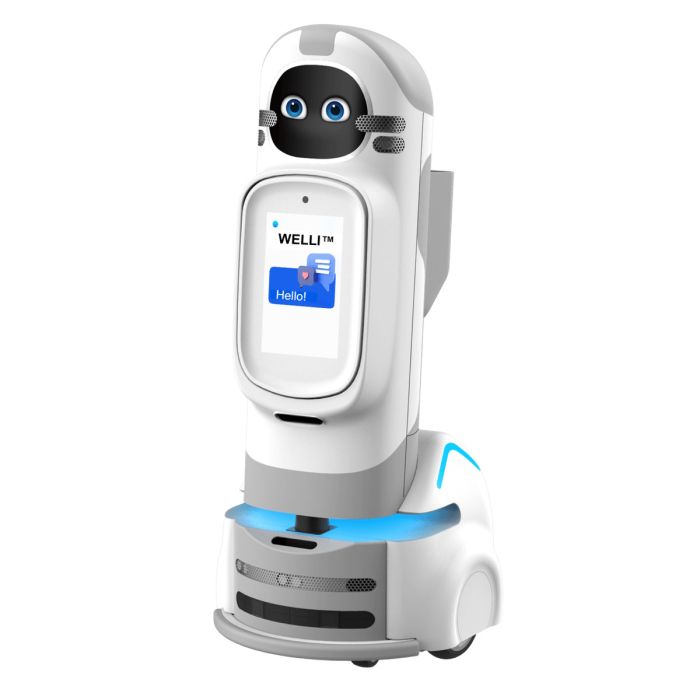
Every care residence asks two different things of whoever stands in its hallway: patience for the person who lives there, and clear directions for the person who has just walked in. The UBTECH Smart Companion Robot WELLI is designed to answer both from one mobile body. For a resident, it recognises the face, greets them with a customised menu and follows their cognitive status through hospital admission information and regular evaluations, then offers daily training intended to counter the decline of cognitive capability. For a visitor, the same robot switches to guidance: it navigates autonomously, avoids obstacles on the way and leads the person to their destination, answering questions from a preset Q&A base. One screen carries the service content, while a second, smaller screen gives WELLI a face of expressions. It is a companion and a host in the same frame.
Robots Europa, based in Dublin, supplies the UBTECH Smart Companion Robot WELLI to care homes, hospitals, clinics and assisted-living operators across the European Union and the DACH region. Robots Europa prepares each quotation for the specification set you select, coordinates delivery to your site and remains your point of contact for support once the robot is in service, so that procurement, facilities and care teams work with a single European partner from the first enquiry onwards.
Background
UBTECH Robotics
Ubtech Robotics Corp Ltd was incorporated in 2012 and is headquartered in Shenzhen, China. The company builds service robots for public and professional settings, and WELLI is its answer to a question many care operators are now asking: how can technology add attention and continuity to a resident's day without adding to the workload of staff? On our site WELLI sits within the Healthcare category, alongside other UBTECH robots aimed at clinical and care environments.
Proactive care as the design principle
Most service robots wait to be asked. WELLI is positioned differently: UBTECH describes it as a companion that meets daily psychological needs by providing proactive care. In practice this rests on three capabilities working together. Facial recognition lets the robot confirm who is in front of it and greet that person with a menu or voice command tailored to them. Care management draws on admission information and regular evaluations so that the daily training it offers matches the individual's cognitive status. Family communication helps seniors reach their relatives more easily, so that the robot strengthens existing relationships rather than replacing them. The dual-screen layout supports this approach: the main screen presents the content of the service, while the sub-screen shows expressions, giving residents something to respond to beyond a list of menu items.
Technical Specifications
| Specification | Spec set with 10.1" main screen | Spec set with 13.3" main screen |
|---|---|---|
| Display | Dual-screen display: 10.1" main screen for service content, 5.5" sub-screen for expressions | Dual-screen display: 13.3" main screen for service content, 5.5" sub-screen for expressions |
| Dimensions | 47.5 x 44 x 102 cm | 48.3 x 43 x 100 cm |
| Weight | 31 kg | 25kg |
| Speed | Up to 1 m/s | — |
| Obstacle crossing | 2 cm high obstacle; 3.5 cm gap | — |
| Lidar | Small-sized measuring Lidar with a 270° scanning angle, 0.33° angle resolution and a scanning frequency of 15 Hz | — |
| Camera | 1080p; output format: JPEG/YUV | — |
| Network | 802.11 B/G/N/AC + BT4.2 | — |
| Audio/Speaker | 5 W hi-fi speaker x 2 | — |
| Battery | 20 Ah lithium battery, compliant with UL1642, UN38.3, IEC62133, UL2054 | — |
Specifications are as published by the manufacturer and are confirmed against the datasheet at quotation. The manufacturer has not published the IP rating, the battery runtime, the charging time, the payload, the operating temperature, the operating software or the contents of the box; Robots Europa confirms these details with your quotation.
How do the 10.1" and 13.3" specification sets differ?
The two sets share the same idea and the same layout: a dual-screen display in which a 5.5" sub-screen shows expressions and a larger main screen carries the service content. The difference that is visible at once is the size of that main screen, 10.1" in one set and 13.3" in the other. For residents who read menus, follow training exercises or look at content from a little distance, a larger main screen can make the experience more comfortable.
The figures also show different bodies. The 10.1" set measures 47.5 x 44 x 102 cm and weighs 31 kg; the 13.3" set measures 48.3 x 43 x 100 cm and weighs 25kg. Both are therefore of a similar footprint and height, and the larger-screen set is the lighter of the two.
Where the sets differ most for a buyer is the depth of technical data. Speed, obstacle crossing, Lidar, camera, network, speakers and battery figures are given for the 10.1" set only, and they belong to that set rather than to the 13.3" set. If your tender requires a complete technical sheet for the larger-screen version, Robots Europa requests the corresponding datasheet from the manufacturer as part of the quotation.
How does WELLI support cognitive care and family contact?
Cognitive decline rarely announces itself in one moment; it shows in small changes noticed over weeks. WELLI is built around that reality. It understands the cognitive status of its owner through hospital admission information and regular evaluations, and it intervenes positively through daily training. Rather than a single assessment, this gives a repeated, structured routine that fits naturally into the rhythm of a residence or a home.
The social side matters just as much. Loneliness and loss of contact with relatives are among the most common concerns in senior care, and WELLI is designed to help seniors communicate more easily with their family members. Combined with facial recognition, which lets the robot address the right person with the right menu, and with voice commands, the interaction is meant to stay simple for people who are not comfortable with tablets or smartphones.
Who is the UBTECH Smart Companion Robot WELLI for?
The first group is residential care: nursing homes, memory-care units and assisted-living communities that want to give residents regular, personalised engagement between scheduled activities. Here the combination of facial recognition, daily cognitive training and easier contact with family is the core of the case.
The second group is hospitals and clinics, particularly geriatric and rehabilitation departments, where WELLI can use admission information to understand a patient's starting point and where reception areas benefit from a robot that guides visitors to wards, rooms or offices by autonomous navigation.
A third group is operators of larger senior-living campuses and day-care centres, where visitors arrive throughout the day and the same questions are asked repeatedly. A preset Q&A base and a guiding robot can take some of that load from staff.
When choosing between the two sets, operators who place most weight on screen readability will look first at the 13.3" main screen. Projects that require a fully documented technical specification today are better served by the 10.1" set, for which speed, sensor, network and battery data are documented.
What is the UBTECH Smart Companion Robot WELLI used for?
- Personal greetings – recognising a resident's face and opening a customised menu or voice command for them.
- Cognitive training – offering daily exercises matched to the owner's cognitive status from admissions data and evaluations.
- Family communication – helping seniors stay in touch with relatives more easily.
- Visitor guidance – leading guests to their destination with autonomous navigation and obstacle avoidance.
- Reception questions – answering common enquiries from a preset Q&A base.
- Proactive companionship – initiating care that meets daily psychological needs instead of waiting to be called.
Pricing and Availability
The UBTECH Smart Companion Robot WELLI is supplied on quotation, because the specification set, the software configuration and the support arrangement differ from one project to the next. Tell Robots Europa which set interests you, where the robot will operate and how you plan to use it, and we will prepare a proposal for your organisation. Delivery, customs and support are arranged with the quotation. To begin, request a quotation using the enquiry form available on this page.
Frequently Asked Questions
How does WELLI know which resident it is talking to?
WELLI uses facial recognition to confirm the intended user and then greets them with a customised menu or voice command.
Which screen sizes are available?
The sources name two specification sets: one with a 10.1" main screen and one with a 13.3" main screen. Both use a 5.5" sub-screen to show expressions.
How much does WELLI weigh?
The set with the 10.1" main screen weighs 31 kg, and the set with the 13.3" main screen weighs 25kg.
Can WELLI move around a building on its own?
Yes. It guides visitors to their destination using autonomous navigation and obstacle avoidance. The 10.1" set has a Lidar with a 270° scanning angle, a speed of up to 1 m/s and crosses a 2 cm high obstacle and a 3.5 cm gap.
What battery does WELLI use?
The 10.1" set uses a 20 Ah lithium battery compliant with UL1642, UN38.3, IEC62133 and UL2054.
How does WELLI connect to a facility network?
The 10.1" set connects via 802.11 B/G/N/AC + BT4.2. Robots Europa discusses integration with your IT environment as part of the project.
Where can I buy the UBTECH Smart Companion Robot WELLI and what does it cost?
Robots Europa supplies WELLI across the EU and the DACH region on quotation. Send us your requirements through the enquiry form on this page, and we will reply with a proposal covering the configuration, delivery and support.
Summary
The UBTECH Smart Companion Robot WELLI answers the two demands of a care hallway with one machine. For the people who live there, it offers recognition, daily cognitive training shaped by admission information and evaluations, and easier contact with family, all in a spirit of proactive care. For the people who come through the door, it becomes a guide that navigates autonomously and answers questions from a preset Q&A base. Two specification sets, with a 10.1" or a 13.3" main screen, let operators balance screen size against the depth of available technical data. Robots Europa quotes, delivers and supports WELLI from Dublin for organisations across Europe, and if you are considering a companion robot for your residence or clinic, this page is the starting point.


