
Unitree G1-D Ultimate D U9 Wheel Base Dual-Arm Humanoid Robot
In stock
- BRAND:
- UNITREE ROBOTICS
- MODEL:
- U9
- PART #:
- G1-D-U9
- ORIGIN:
- China
- Warranty:
- 12 MONTHS
- AVAILABILITY:
- SUBJECT TO AVAILABILITY
- SKU:
- Unitree-G1-D-U9
Unitree G1-D Ultimate D U9 Wheel Base Dual-Arm Humanoid Robot
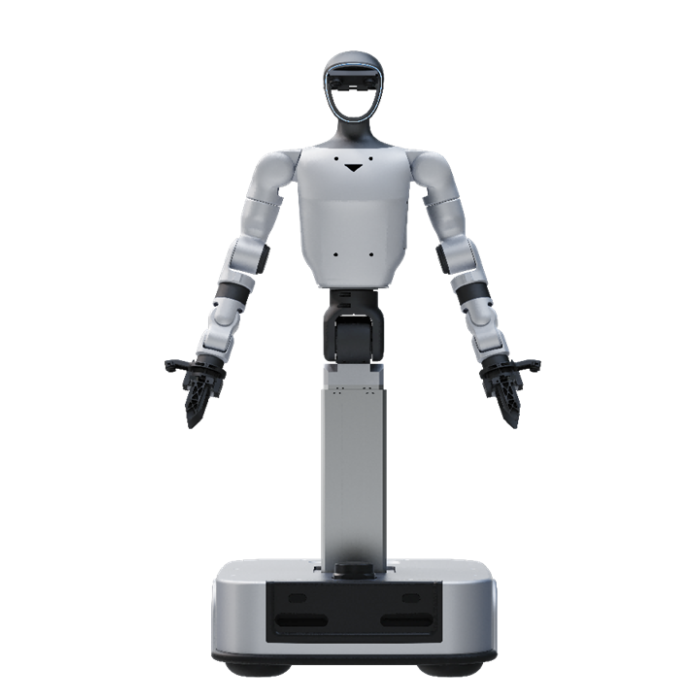
Most work in a laboratory or a stockroom is spread across height and floor space. The lowest tray sits at floor level, the top shelf sits well above head height, and the next workstation is across the room. A robot that only covers a band of that space leaves the rest to people. The Unitree G1-D Ultimate D U9 Wheel Base Dual-Arm Humanoid Robot is built to cover far more of it. A humanoid torso with two seven-axis arms sits on a lifting column, and the column stands on a differential-drive chassis that can turn on the spot. The machine can travel to a task, then raise or lower its upper body to the height the task needs.
Robots Europa, based in Dublin, supplies this G1-D configuration to research institutions, integrators and industrial teams throughout the European Union and the DACH region. Robots Europa prepares the quotation, arranges delivery and provides after-sales support. Questions about configuration, compute options and deployment are handled by the same team that prepares your offer.
Background
Unitree Robotics and the G1 lineage
Unitree Robotics made its name with agile quadruped robots before moving into humanoids. The G1 became one of its best-known platforms for research and development. The company focuses on robots that universities, laboratories and developers can buy and program, rather than one-off showpieces. The G1-D family carries that approach into a new form. It keeps the humanoid upper body that makes the G1 useful for manipulation research but replaces walking with a more practical mobile or fixed base for work that happens at benches, shelves and workstations.
Positioning: a humanoid upper body on a mobile lifting base
The G1-D range is divided into fixed-base Standard versions and wheel-base Ultimate versions. The Ultimate D U9 belongs to the wheel-base group. Three elements define its design. The first is a pair of arms with seven degrees of freedom each. The second is a waist with two degrees of freedom combined with a lifting column with one. The third is a chassis with two base degrees of freedom. Together they give the robot a vertical workspace of 0-2m and let it move between stations at up to 1.5m/s. Chassis sensing combines LiDAR, depth cameras, collision sensors and low-obstacle detection. Perception for manipulation comes from a binocular head camera and a camera in each wrist.
Technical Specifications
| Specification | Value |
|---|---|
| Arm degrees of freedom | 7×2 |
| Waist degrees of freedom | 2 |
| Column degrees of freedom | 1 |
| Base degrees of freedom | 2 |
| Dimensions at minimum column height | 1260x525x570mm |
| Dimensions at maximum column height | 1680x525x570mm |
| Vertical workspace | 0-2m |
| Waist range of motion | Z-axis: ±155°, Y-axis: -2.5° to +135° |
| Lifting accuracy | ±0.5mm |
| Maximum mobility speed | 1.5m/s |
| Chassis drive type | Differential drive, supports 360° in-place rotation |
| Chassis sensors | LiDAR *1 + Depth Camera *2 + Physical Collision Sensor *2 + Low-Obstacle Detection Sensor *2 |
| Perception sensors | Head HD Binocular Camera *1 + Wrist HD Camera *2 |
| Basic computing power | 8-core High-performance CPU |
| Optional high computing power module | Multiple brands and models available such as Orin NX 16GB (100TOPS), etc. |
| Connectivity | Wi-Fi 6, Bluetooth 5.2 |
| System teleoperation latency | ﹤100ms |
| Teleoperation sampling rate | 60Hz |
Specifications are as published by the manufacturer and are confirmed against the datasheet at quotation.
The manufacturer has not published the IP rating, the hand weight, the operating temperature, the charging time or the arm reach; these details are confirmed with your quotation.
What does the wheel base add to a dual-arm humanoid?
A fixed dual-arm station is efficient as long as the work comes to it. Once tasks are spread across a room, either the parts must be moved to the robot or a second robot is needed. The differential-drive chassis of the Ultimate D U9 removes that limit. It moves at up to 1.5m/s and can rotate 360° in place. That second point matters in narrow aisles and between benches, where a vehicle that must turn in an arc would need more floor space than it has.
Mobility near people requires sensing near the floor as well as at eye level. The chassis has one LiDAR, two depth cameras, two physical collision sensors and two low-obstacle detection sensors. This layered set-up is typical of mobile platforms intended for shared indoor spaces. The LiDAR and depth cameras build a picture of the surroundings. The low-obstacle sensors look for items the main sensors may miss, such as a box or a cable on the floor. The collision sensors act as the final physical safeguard.
How does the lifting column change what the robot can reach?
The column is what makes the robot's height variable. At its minimum height the robot measures 1260x525x570mm. At full extension it measures 1680x525x570mm, while the footprint stays the same. Combined with the waist, the system covers a vertical workspace of 0-2m, from the floor to above a typical shelving unit. The waist rotates ±155° about the Z-axis and bends from -2.5° to +135° about the Y-axis. The robot can therefore turn its torso towards a neighbouring surface, or bend forward over a low container, without moving the chassis.
The column positions the torso to within ±0.5mm. This figure matters wherever a task must be repeated at the same height. Examples include picking from a rack, placing items into a fixture, or recording demonstration data in which each episode should start from the same position.
Who is the Unitree G1-D Ultimate D U9 Wheel Base Dual-Arm Humanoid Robot for?
The first group of buyers is university and corporate research laboratories working on mobile manipulation and embodied AI. For these teams, a humanoid upper body on a mobile lifting base is a realistic stand-in for the human-shaped tasks they want to automate. The second group is teams collecting teleoperation data for learning-based control. A system latency below 100ms and a sampling rate of 60Hz describe a teleoperation link suitable for recording demonstrations. The head and wrist cameras provide the views such datasets usually need.
Systems integrators and industrial innovation teams make up the third group. They can use the platform to test pick-and-place, handling and inspection tasks across several stations before committing to a dedicated cell. Where heavier perception or AI models must run on the robot itself, the optional high computing power module, such as Orin NX 16GB (100TOPS), extends the standard 8-core CPU.
Not every buyer needs the mobile base. If your work stays at a single bench, the fixed-base versions, such as the Unitree G1-D Standard A U1 Fixed base Dual-Arm Humanoid Robot or the Unitree G1-D Standard D U4 Fixed base Dual-Arm Humanoid Robot, may be a more direct match. Buyers who want the wheel base in a different package can compare the Unitree G1-D Ultimate A U6 Wheel Base Dual-Arm Humanoid Robot. The full range is listed in the Unitree G1-D category.
What is the Unitree G1-D Ultimate D U9 Wheel Base Dual-Arm Humanoid Robot used for?
- Mobile manipulation research: studying how a robot combines navigation, torso positioning and dual-arm grasping in a single task.
- Teleoperation and data collection: recording human demonstrations through the low-latency teleoperation link to train manipulation policies.
- Shelf and rack handling: picking and placing items across a vertical range from floor level to upper shelves.
- Laboratory automation trials: moving between benches and instruments to test multi-station workflows.
- Embodied AI development: running perception and decision-making models on the optional high computing power module.
- Teaching and demonstration: showing students and stakeholders a complete mobile humanoid system, from sensing to motion.
Pricing and Availability
Robots Europa supplies the Unitree G1-D Ultimate D U9 Wheel Base Dual-Arm Humanoid Robot on a quotation basis, so that the offer reflects the exact configuration, compute option and support you need. Delivery, customs and support are arranged together with your quotation. To start the process, please send your requirements using the quotation request available on this page.
Frequently Asked Questions
How high can the Unitree G1-D Ultimate D U9 reach?
Its vertical workspace is 0-2m. The lifting column changes the robot's height from 1260mm at minimum to 1680mm at maximum.
How does the robot turn in narrow spaces?
The chassis uses differential drive and supports 360° in-place rotation, so it can change direction without needing room to manoeuvre.
Which cameras does the robot carry for manipulation?
It has one HD binocular camera in the head and one HD camera in each wrist. The chassis adds two depth cameras and one LiDAR for navigation.
Can the onboard computing be upgraded?
Yes. In addition to the 8-core high-performance CPU, optional high computing power modules are available from several brands, for example Orin NX 16GB (100TOPS).
Is the robot suitable for teleoperation?
The system teleoperation latency is below 100ms at a sampling rate of 60Hz, which supports remote control and the recording of demonstrations.
What are the IP rating and the charging time?
The manufacturer has not published either figure. Robots Europa confirms both, together with the operating temperature, the arm reach and the hand weight, at quotation.
Where can I buy the Unitree G1-D Ultimate D U9 Wheel Base Dual-Arm Humanoid Robot and what does it cost?
You can buy it from Robots Europa, which supplies customers across the EU and the DACH region. The cost depends on the configuration and options you choose, so it is set out in a personal quotation that you can request on this page.
Summary
The problem described at the start, with work spread from the floor to the top shelf and across the room, is what the Ultimate D U9 is designed to address. Its wheel base takes the robot to the task. The lifting column and waist bring the torso to the right height with ±0.5mm lifting accuracy. Two seven-axis arms, supported by head and wrist cameras, then carry out the work. For laboratories, integrators and data-collection teams that want a single humanoid platform able to cover a whole room, this page is the starting point.