
Unitree R1-A5 Fixed Base Dual-Arm Humanoid Robot
In stock
- BRAND:
- UNITREE ROBOTICS
- MODEL:
- R1-A5
- ORIGIN:
- China
- Warranty:
- 12 MONTHS
- AVAILABILITY:
- SUBJECT TO AVAILABILITY
- SKU:
- Unitree-R1-A5
Unitree R1-A5 Fixed Base Dual-Arm Humanoid Robot
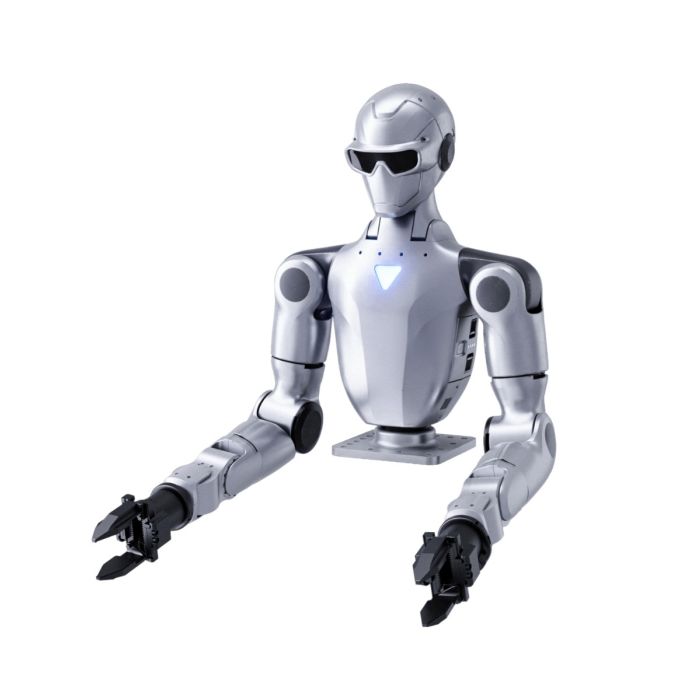
Put a humanoid robot on a laboratory bench and something changes in the room: the robot is suddenly at the eye level of the people working with it, turning its head towards a voice and reaching across the same surface they use. The Unitree R1-A5 Fixed Base Dual-Arm Humanoid Robot is built for exactly that position. It has no legs to manage and no floor to cross; every one of its joints is spent on looking, turning and handling objects within arm's reach, which makes it a very different research and teaching instrument from a single industrial arm bolted beside a camera.
Robots Europa, based in Dublin, supplies the Unitree R1-A5 Fixed Base Dual-Arm Humanoid Robot to universities, research institutes, integrators and businesses throughout the European Union and the DACH region. Robots Europa prepares the quotation for the configuration you need, arranges delivery to your site and remains your point of contact for support once the robot is in service.
Background
Unitree and the R1 family
Unitree Robotics has built its reputation on legged machines, first quadrupeds and later full-size and compact humanoids, and it has become one of the most visible names in affordable, developer-accessible robotics. The R1 line brings that experience into dual-arm humanoid platforms. Unitree extended its R1 dual-arm humanoid robot family with the R1-A5 and R1-A7 models, and the published specification table also lists R1-A5-D and R1-A7-D versions. The R1-A5 is the compact, fixed-base member of that group, and the wider family is presented in the Unitree R1 category.
A humanoid upper body on a fixed base
The R1-A5 is a fixed-base dual-arm humanoid with 13 degrees of freedom: 5 in each arm, 1 in the waist and 2 in the head. Its forearm and upper arm together measure 420mm, and each arm carries a payload of about 2 kg. The joints use crossed roller and deep groove ball output bearings with local air cooling. Perception comes from a binocular camera, with an optional wrist camera, while a 4-array microphone and dual speakers allow spoken interaction. For heavier on-board processing, an NVIDIA Jetson Orin module is offered as an option, and the end effector can be chosen from a two-finger gripper, a three-finger dexterous hand or a five-finger dexterous hand.
Technical Specifications
| Specification | Value |
|---|---|
| Configuration | Fixed-base dual-arm humanoid |
| Total degrees of freedom | 13 (5 per arm, 1 waist, 2 head) |
| DOF per arm | 5 |
| Waist DOF | 1 |
| Head DOF | 2 |
| Forearm + upper arm length | 420mm |
| Payload per arm | About 2 kg |
| Dimensions | 700×357×190mm |
| Joint motion range | Waist: Yaw ±150°; Head: Yaw ±115°, Pitch ±36° |
| Joint output bearing | Crossed Roller + Deep Groove Ball |
| Cooling system | Local Air Cooling |
| Power supply | External Power or Li-ion Battery |
| High-computing module | Optional NVIDIA Jetson Orin (40-100 TOPS) |
| End effector | Optional two-finger gripper / three-finger dexterous hand / five-finger dexterous hand |
| Camera module | Binocular Camera + Optional Wrist Camera |
| Microphone | 4-Array |
| Speaker | Dual Speakers (3W×2) |
| WiFi 6 & Bluetooth 5.2 | Yes |
| Secondary development | Yes |
| Smart OTA update | Yes |
Specifications are as published by the manufacturer and are confirmed against the datasheet at quotation.
The manufacturer has not published the battery capacity, power consumption, IP rating, repeatability, operating temperature, maximum arm speed or the contents of the box; these are confirmed with your quotation.
What does the R1-A7 add over the R1-A5?
The two fixed-base models share the same waist and head layout, the same joint bearings, the same cooling, the same microphone array and speakers, and the same wireless, development and update features. The difference lies in the arms. The R1-A7 has 7 degrees of freedom per arm and a forearm and upper arm length of 555mm, with overall dimensions of 835×357×190mm. The R1-A5 keeps 5 degrees of freedom per arm with a 420mm forearm and upper arm length and a footprint of 700×357×190mm.
In practice, additional joints in an arm give a manipulator more freedom to choose how it approaches a point: it can reach the same position with different elbow and wrist postures, which matters when working around obstacles or orienting a tool precisely. A five-joint arm is simpler to model, to calibrate and to teach, and for a great deal of pick-and-place, demonstration and interaction work that simplicity is an advantage rather than a compromise. The R1-A5 is therefore the more compact, more approachable choice, while the R1-A7 suits work in which reach and arm posture are the limiting factors.
Why choose a fixed-base humanoid rather than a single robot arm?
A conventional collaborative arm is an excellent tool for one repeated task, but it does not look, listen or coordinate two hands. The R1-A5 combines two arms, a waist that turns through ±150° of yaw and a head with ±115° of yaw and ±36° of pitch, so that the robot can direct its binocular camera towards the work before acting on it. That arrangement is close to how a person sits at a table, which is why platforms of this kind are popular for bimanual manipulation research, teleoperation studies and the collection of demonstration data for learning-based control.
The choice of power supply adds flexibility: the R1-A5 can run from external power on a permanent bench, or from a Li-ion battery where it is moved between rooms, classrooms or exhibition stands. With WiFi 6 and Bluetooth 5.2, secondary development support and smart OTA updates, it is designed to be programmed and kept current by its owners rather than treated as a closed appliance.
Who is the Unitree R1-A5 Fixed Base Dual-Arm Humanoid Robot for?
The first group is universities and research institutes working on embodied AI, manipulation and human-robot interaction. A fixed base removes locomotion from the experiment, so that teams can concentrate on perception, grasping and coordination, and the optional Jetson Orin module allows heavier models to run on the robot itself.
The second group is teaching. Technical colleges and university departments can use the R1-A5 to introduce kinematics, sensor fusion and robot programming on a humanoid form that students find engaging, with the five-joint arms keeping the mathematics manageable for coursework.
Integrators and corporate innovation teams form a third group. They can prototype assistance, sorting or demonstration tasks on the bench and assess which end effector suits the application before committing to a larger deployment. Museums, showrooms and reception areas, finally, can make use of the microphone array, speakers and expressive head for interactive installations.
Where an application depends on longer reach or more flexible arm posture, the R1-A7 with its seven-joint, 555mm arms is the better fit. The R1-A5-D and R1-A7-D versions are listed with separate shrunk and raised dimensions, and buyers who need to work at different heights should discuss them with us. The available R1-A5 packages are collected in the Unitree R1-A5 category.
What is the Unitree R1-A5 Fixed Base Dual-Arm Humanoid Robot used for?
- Bimanual manipulation research – studying how two arms coordinate to hold, pass and assemble objects on a work surface.
- Demonstration data collection – recording teleoperated or guided task demonstrations for imitation learning and robot foundation models.
- Grasping and hand studies – comparing the two-finger gripper with the three-finger and five-finger dexterous hands on the same platform.
- Robotics education – teaching kinematics, vision and programming on a humanoid that students can work with at a desk.
- Human-robot interaction – exploring speech, gaze and gesture using the microphone array, speakers and articulated head.
- Exhibitions and visitor engagement – running interactive demonstrations at trade fairs, museums and innovation centres.
Pricing and Availability
Robots Europa supplies the Unitree R1-A5 Fixed Base Dual-Arm Humanoid Robot on quotation, because the final configuration depends on choices such as the end effector, the optional wrist camera, the optional Jetson Orin module and the power arrangement. Tell us how you intend to use the robot and we will prepare a quotation for the matching configuration, together with any documentation your procurement process requires. Delivery, customs and support are arranged with the quotation. The request form for your personal quotation is available on this page.
Frequently Asked Questions
Can the R1-A5 walk or move around?
No. The R1-A5 is a fixed-base dual-arm humanoid, so it works from a stationary position, and its mobility comes from the waist, head and arm joints.
Which hands can be fitted to the R1-A5?
Unitree lists an optional two-finger gripper, three-finger dexterous hand and five-finger dexterous hand. The choice is agreed as part of your quotation.
Does the R1-A5 need a mains connection?
It can be operated from external power or from a Li-ion battery. The battery capacity has not been published and is confirmed at quotation.
Can I develop my own software for it?
Yes. Secondary development is supported, and the robot receives smart OTA updates over its WiFi 6 connection.
What computing power is available on board?
An NVIDIA Jetson Orin high-computing module with 40-100 TOPS is available as an option for running perception and AI models on the robot.
How does the R1-A5 differ from the R1-A7?
The R1-A5 has 5 degrees of freedom per arm and a 420mm forearm and upper arm length, while the R1-A7 has 7 degrees of freedom per arm and a 555mm length. The waist, head, sensing and connectivity are the same on both.
Where can I buy the Unitree R1-A5 Fixed Base Dual-Arm Humanoid Robot and what does it cost?
You can buy it from Robots Europa, which supplies customers across the EU and the DACH region. The cost depends on the configuration you select, so we provide it in a personal quotation.
Summary
The Unitree R1-A5 Fixed Base Dual-Arm Humanoid Robot belongs on the bench beside the people who work with it. By leaving out locomotion, it spends its 13 degrees of freedom on a turning waist, an articulated head and two five-joint arms, supported by binocular vision, a microphone array, speakers, a choice of hands and optional on-board computing. That makes it a compact, approachable platform for manipulation research, teaching, interaction studies and demonstrations, with the R1-A7 available when longer, more flexible arms are needed. To configure your robot and receive a quotation from Robots Europa, this page is the starting point.