
Unix AI Wanda 2.0 Universal Wheeled Humanoid Robot
In stock
- BRAND:
- UNIXAI
- MODEL:
- WANDA 2.0
- ORIGIN:
- China
- AVAILABILITY:
- SUBJECT TO AVAILABILITY
- SKU:
- Unix-AI-Wanda-2.0
Unix AI Wanda 2.0 Universal Wheeled Humanoid Robot
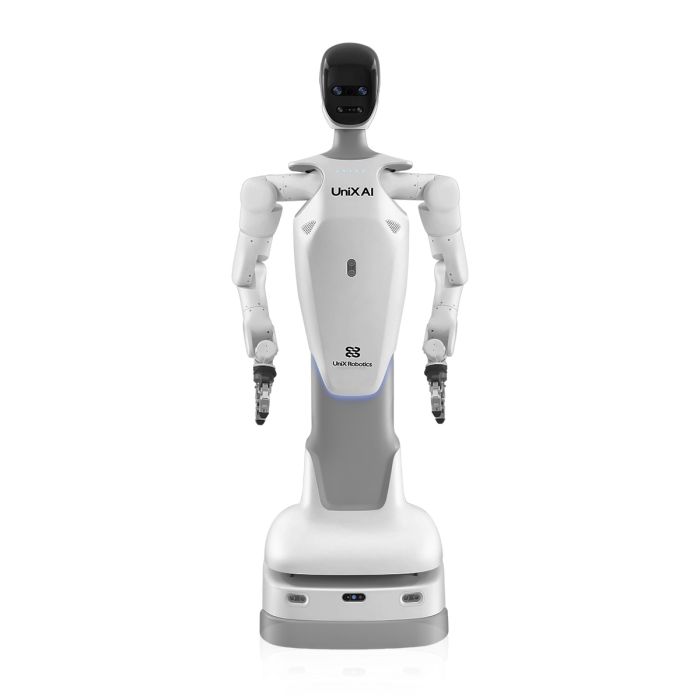
Most buildings were designed around people rather than machines: corridors, lift doors and the gap between a counter and a shelf all assume a body of roughly human size. The Unix AI Wanda 2.0 Universal Wheeled Humanoid Robot accepts that brief instead of resisting it. It combines a humanoid upper body carrying two bionic arms, a head packed with cameras and microphones, and a wheeled base that needs a passage only 75 cm wide. It can therefore go where staff go and handle objects much as staff handle them. Rather than asking a site to be rebuilt around automation, Wanda 2.0 is built to fit the site.
Robots Europa, based in Dublin, supplies the Wanda 2.0 to research institutes, system integrators and businesses across the European Union and the DACH region. We prepare your quotation, arrange delivery to your premises and remain your point of contact for support once the robot is in service.
Background
UniX AI and the general-purpose humanoid
UniX AI builds full-size humanoid robots intended for general-purpose work rather than a single scripted task. Its range spans different forms of locomotion, from wheeled dual-arm platforms to bipedal designs, and Wanda belongs to the wheeled side of that family. The idea behind a general-purpose humanoid is straightforward. If a robot shares the proportions and reach of a person, it can use the shelves, worktops and handles already in place, and the same machine can be redeployed from one job to another through software rather than new hardware. Wanda 2.0 is the manufacturer's full-size general-purpose humanoid in this wheeled configuration.
An arm built for production, a learning framework built for variety
The centrepiece of Wanda 2.0 is the world's first mass-produced 8-DoF bionic arm, paired with adaptive intelligent grippers. Each arm follows a "4+1+3" shoulder-elbow-wrist layout, which divides the joints between the shoulder, the elbow and the wrist for optimal motion planning. The arms are made from high-strength, low-density materials. Around this hardware, UniX AI uses multimodal semantic keypoints and an efficient trajectory imitation learning framework. In practical terms, imitation learning means the robot learns manipulation skills from demonstrated movements instead of relying solely on hand-coded trajectories. This approach suits a machine expected to meet an ever-changing variety of objects. The robot is also preloaded with popular L4-level applications, giving operators a starting point before any custom development begins.
Technical Specifications
| Specification | Value |
|---|---|
| Product type | Full-size general-purpose humanoid robot |
| Arm design | 8-DoF bionic arm, "4+1+3" shoulder-elbow-wrist configuration |
| Dual-arm load capacity | 12 kg |
| Single-arm payload | 6kg |
| Single-arm reach | 982mm |
| Repeatability | ±0.5 mm |
| End effector | Biomimetic Two-Finger Gripper (adaptive intelligent grippers) |
| Head | 2-DoF, Yaw ±90°, Pitch ±30° |
| Perception system | Head mounted dual RGB & RGBD camera, 6-mic circular array |
| Chassis | Differential Drive Chassis, hub motor base, silent chassis with obstacle avoidance |
| Chassis sensors | 360° LiDAR, ultrasonic sensor, RGBD camera |
| Minimum passage width | 75 cm |
| Battery life | 8-16h |
| Computing power | Up to 275 TOPs |
| Software | Preloaded with popular L4-level applications |
Specifications are as published by the manufacturer and are confirmed against the datasheet at quotation.
The manufacturer has not published the weight, IP rating, charging time, battery capacity, package contents, operating system, connectivity, operating temperature or noise level; we confirm these with you at quotation.
What makes the Wanda 2.0 different from a fixed robotic arm?
A conventional robotic arm is bolted to a bench, and the work is brought to it. Wanda 2.0 reverses that relationship. Its two 8-DoF arms sit on a mobile humanoid torso, so the robot travels to the task. Each arm has a single-arm reach of 982mm and repeatability of ±0.5 mm, and together the arms carry a dual-arm load of 12 kg. That combination lets the robot work with both hands on one object, or hold an item in one gripper while the other operates a handle, lid or drawer. Bimanual work of this kind is difficult to replicate with a single stationary arm.
The eighth degree of freedom in each arm also matters. A redundant joint gives the motion planner more than one way to reach the same point. This helps when a shelf edge, a door frame or a person is in the way, and it is one reason the "4+1+3" arrangement suits motion planning so well. The biomimetic two-finger grippers adapt to the object they close on, which is useful where the items to be handled are not identical parts arriving on a conveyor.
How does the Wanda 2.0 find its way around a building?
Navigation rests on a sensor suite split between the base and the head. The differential drive chassis, built on hub motors, carries a 360° LiDAR, ultrasonic radar and an RGBD camera for precision navigation and obstacle avoidance in complex environments. LiDAR maps the surroundings and localises the robot within them. Ultrasonic sensing covers surfaces such as glass that optical sensors can find difficult, and the depth camera adds detail close to the floor. Because the chassis is designed to run quietly, the robot suits spaces shared with guests, customers or colleagues.
Above the base, the 2-DoF head turns through ±90° of yaw and ±30° of pitch. It carries dual RGB and RGBD cameras, so the robot can look at what its hands are doing rather than relying on a fixed viewpoint. A 6-mic circular array supports spoken interaction. All of this is processed on board with computing power of up to 275 TOPs, and the battery life of 8-16h covers a working shift or more, depending on the workload.
Who is the Wanda 2.0 for?
The first group is research. University laboratories and corporate research teams working on embodied AI, manipulation and imitation learning need a platform with human-like arms that can collect demonstration data in realistic settings. A wheeled humanoid with dual arms and head-mounted depth cameras fits that need without the balance-control overhead of a legged robot.
The second group is service operators: hotels, retailers, care providers and facility managers who want to evaluate how a humanoid could take on repetitive fetching, carrying and handling in spaces built for people. The 75 cm minimum passage width is directly relevant here, because it determines which corridors and aisles the robot can use.
The third group is system integrators and innovation teams who build applications on top of a capable base, starting from the preloaded L4-level applications and extending them for a customer's site.
If your project calls specifically for walking on legs rather than rolling, the Unix AI Martian Bipedal General Purpose Humanoid Robot is the bipedal member of the range. Buyers comparing wheeled dual-arm platforms may also wish to review the Unix AI Panther Next-gen Full-size Wheeled Dual-arm Humanoid Robot, or browse our full selection of Wheeled Humanoids and Humanoids. Robots Europa can help you compare these options against your requirements.
What is the Wanda 2.0 used for?
- Embodied AI research – testing perception, planning and manipulation algorithms on a full-size humanoid platform.
- Imitation learning data collection – recording demonstrated trajectories to train new manipulation skills.
- Fetch-and-carry tasks – moving items between rooms, shelves and counters in buildings designed for people.
- Hospitality and front-of-house trials – piloting guest-facing service tasks with spoken interaction through the microphone array.
- Retail and back-of-store handling – evaluating shelf work and item handling with two adaptive grippers.
- Human–robot interaction studies – exploring how people respond to a humanoid working alongside them in shared spaces.
Pricing and Availability
Robots Europa supplies the Wanda 2.0 on quotation, so that the offer reflects your configuration, your site and your intended application. Tell us what you plan to use the robot for, and we will tailor the offer to that application. Delivery, customs and support are arranged with the quotation. To begin, the quotation request is available on this page.
Frequently Asked Questions
Is the Wanda 2.0 a walking robot?
No. It is a full-size humanoid on a wheeled, differential drive chassis with hub motors. For a bipedal alternative, see the Unix AI Martian.
How much can the Wanda 2.0 lift?
Its dual-arm load capacity is 12 kg, and each arm has a single-arm payload of 6kg.
Can the Wanda 2.0 pass through ordinary doorways?
Its minimum passage width is 75 cm, which determines the narrowest corridor or aisle it can use. We recommend checking this against your site layout before ordering.
How long does the battery last?
Battery life is 8-16h, depending on the workload.
What sensors does the Wanda 2.0 use?
The head carries dual RGB and RGBD cameras and a 6-mic circular array. The chassis uses a 360° LiDAR, ultrasonic sensing and an RGBD camera for navigation and obstacle avoidance.
Does the Wanda 2.0 come with software?
Yes. It is preloaded with popular L4-level applications, and it uses an imitation learning framework for acquiring manipulation skills.
Where can I buy the Unix AI Wanda 2.0 and what does it cost?
Robots Europa, based in Dublin, supplies the Wanda 2.0 across the EU and the DACH region. The cost is set out in a quotation prepared for your project, which you can request on this page.
Summary
The Wanda 2.0 starts from a simple premise: automation should fit the buildings people already use. Two 8-DoF bionic arms with adaptive grippers give it human-like reach and dexterity. A quiet chassis with LiDAR, ultrasonic and depth sensing lets it move through passages as narrow as 75 cm, and on-board computing of up to 275 TOPs ties perception and motion together. For research teams, service operators and integrators who want a humanoid that comes to the work rather than waiting for it, Robots Europa can quote, deliver and support the robot across Europe, and this page is the starting point.


