
X1 Eve Wheeled Humanoid Robot
In stock
- BRAND:
- X1
- MODEL:
- EVE
- AVAILABILITY:
- SUBJECT TO AVAILABILITY
- SKU:
- X1-Eve
X1 Eve Wheeled Humanoid Robot
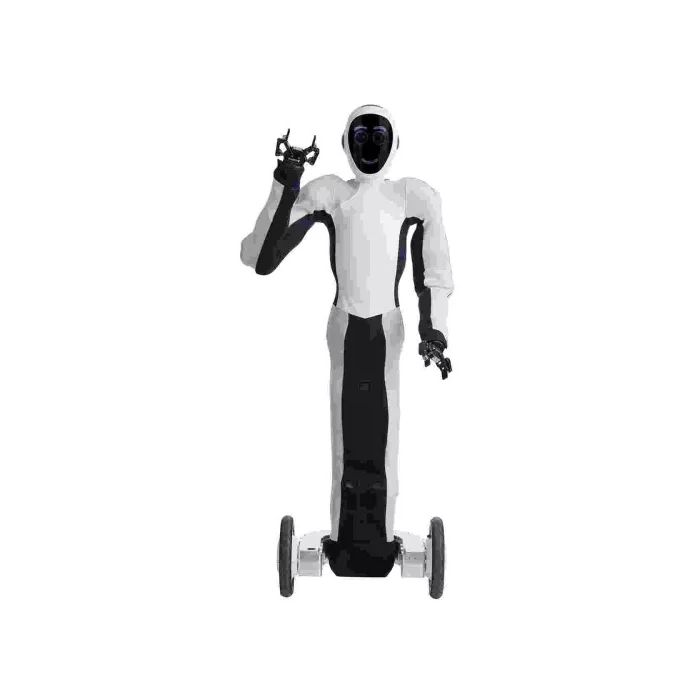
Most robots arrive finished; EVE arrives still learning. The X1 Eve Wheeled Humanoid Robot stands 6 foot 2 inches tall and rolls through corridors on multi-terrain wheels. It treats every corner it turns and every lift it rides as material for the next shift. 1X describes EVE as the smarter working humanoid collecting data from the real world. That phrase captures the tension at the heart of the machine: it is expected to do useful work today while gathering the experience that makes it better tomorrow. For organisations weighing humanoid robotics, this dual character is the reason to look closely.
Robots Europa, based in Dublin, supplies the X1 Eve Wheeled Humanoid Robot to businesses, public institutions and research groups across the European Union and the DACH region. Our team prepares each quotation, arranges delivery to your site and remains your point of contact for support once EVE is in service. One partner therefore handles the project from the first enquiry to daily operation, in English or in German.
Background
From Halodi Robotics to 1X
EVE's maker, 1X, was founded in 2014 by Bernt Øivind Børnich and was formerly known as Halodi Robotics. Under both names the company has concentrated on humanoid machines intended to share space with people rather than to work behind safety fences. For a buyer, that lineage matters. EVE is not a concept study. It is the product of a company that has spent its existence on one question: how to build a robot body capable enough for real work and gentle enough for the people around it.
Revo1 actuation and a body that learns
EVE's joints are driven by 1X Technologies Revo1 quasi direct-drive technology. In general engineering terms, quasi direct-drive actuators use low gear reduction, so a joint responds readily to external force. Robotics engineers value this property when a machine has to work near people. 1X combines it with human-inspired musculature and soft, organically-inspired mechanics. The result is durable enough for work but safe enough to operate with trained teams. Advanced embodied learning models sit on top of this hardware. EVE operates autonomously by default, uses artificial intelligence to navigate the workspace and grows more efficient at everyday tasks over time.
Technical Specifications
| Specification | Value |
|---|---|
| Product type | Working humanoid collecting data from the real world |
| Height | 6 foot 2 inches |
| Weight | 192 pounds |
| Top speed | 9 miles/hour |
| Carry capacity | 33 pound |
| Run time (manufacturer) | Up to 6 hours on a 1-hour charge |
| Battery (third-party listing) | 1.05-kWh lithium-ion battery pack, 4 hours of operation |
| Degrees of freedom | 25 (Neck: 1 DoF; Arm: 7 DoF x 2; Leg: 6 DoF x 1; Hand: 1 DoF x 2; Wheels 1 DoF x 2) |
| Actuators | 1X Technologies Revo1 quasi direct-drive technology |
| Cameras | Two front cameras and one rear camera |
| Compute | Intel i7 for real-time control and Nvidia Xavier for AI inference |
| Drive | Multi-terrain wheels; navigates around corners and takes elevators |
| Operation | Autonomous by default; fleet control by a human operator |
| Materials | Plastic, aluminium, fabric |
Specifications are as published by the manufacturer and, where marked, by a third-party listing; every figure is confirmed against the datasheet at quotation. The manufacturer has not published the overall dimensions beyond height, the IP rating, connectivity, the operating temperature range, the hand and gripper type, the package contents or the power consumption; we confirm all of these at quotation.
How does EVE combine autonomy with human oversight?
EVE is designed to work on its own first. Out of the box it operates autonomously, using artificial intelligence to find its way around your workspace. It perceives and interacts with its surroundings through cameras and sensors, with two cameras facing forward and one facing to the rear. Autonomy alone does not make EVE an unsupervised machine, however. A human operator can control a fleet of EVEs, tap into their cameras and steer their movement to take action from a distance. For your organisation, this means that one trained person can take over a situation that falls outside the robot's learned behaviour, without walking to the site.
The computing architecture reflects the same division of labour. An Intel i7 handles real-time control, the time-critical work of keeping joints and wheels coordinated. An Nvidia Xavier runs AI inference, the perception and decision-making that let EVE interpret what its cameras see. Separating these two duties is a common design pattern in mobile robotics: the learning layer can grow more capable without competing for processing time with the systems that keep the robot stable and controlled. 1X also tests every EVE in real-world scenarios before it is deployed. Each unit has therefore already worked outside the laboratory by the time it reaches your premises.
Why would a working humanoid choose wheels over legs?
Most interiors where people work, such as offices, hospitals, laboratories and warehouses, have level floors, doorways and lifts. On such ground, wheels are generally simpler and more energy-efficient than walking, and they let a robot spend its effort on the task rather than on its balance. EVE's multi-terrain wheels navigate around corners and take elevators, so a multi-storey building remains within reach without stairs. EVE reaches a top speed of 9 miles/hour.
The distribution of EVE's 25 degrees of freedom shows where the engineering effort lies. Each arm carries 7 DoF, fourteen in total, which leaves the upper body with the articulation needed to reach and handle objects. A leg section with 6 DoF, a 1 DoF neck, a 1 DoF hand on each arm and two driven wheels complete the count. Combined with a carry capacity of 33 pound, this makes EVE a torso-and-arms worker on a mobile base: a humanoid shaped for the buildings people already use.
Who is X1 Eve Wheeled Humanoid Robot for?
EVE suits organisations whose work happens indoors, across floors and alongside staff. Facilities and logistics managers in multi-storey sites will value a robot that rides lifts and handles routine carrying without new infrastructure. Operators of several locations gain a remote presence: one supervisor can direct a fleet and see through each robot's cameras. Research groups in embodied AI and robotics developers are a natural fit as well, because EVE is built around collecting data from the real world rather than from simulation.
The fact sheet names a single version, EVE, so there is no sibling model to steer you towards. If you are still comparing approaches, our Wheeled Humanoids category gathers similar wheeled platforms. The wider Humanoids range includes walking designs for sites where stairs or uneven ground make legs the better choice.
What is X1 Eve Wheeled Humanoid Robot used for?
- Indoor transport between floors: EVE carries items through corridors and takes lifts to move goods across a building.
- Remote presence and inspection: an operator taps into the robot's cameras to check a site and act from a distance.
- Real-world data collection: every task generates experience for embodied learning models, which suits AI development programmes.
- Fleet operation pilots: organisations trial how one human operator can supervise several robots across a facility.
- Routine handling tasks: the articulated arms take on repetitive fetching and carrying work within the carry capacity.
- Human-robot collaboration research: soft, organically-inspired mechanics make EVE a platform for studying robots that work with trained teams.
Pricing and Availability
Robots Europa supplies the X1 Eve Wheeled Humanoid Robot on quotation, so that the offer reflects your configuration, site and intended use. When you send an enquiry, tell us about the environment, the tasks and the number of units you are considering. Delivery, customs and support are arranged with the quotation, so you receive one complete offer for your location in the EU or the DACH region. To begin, the quotation request for the X1 Eve Wheeled Humanoid Robot is available on this page.
Frequently Asked Questions
Does EVE need a human operator to work?
No. EVE operates autonomously by default and uses artificial intelligence to navigate the workspace. A human operator can still control a fleet of EVEs and take over their movement from a distance when required.
How long does EVE run on a charge?
EVE runs for up to 6 hours on a 1-hour charge. The battery listing from a third party appears in the specification table above.
Can EVE move between floors?
Yes. Its multi-terrain wheels navigate around corners and take elevators, so it can move between floors of a building by lift.
What cameras and computers does EVE use?
EVE has two front cameras and one rear camera, along with further sensors. An Intel i7 handles real-time control and an Nvidia Xavier runs AI inference.
How much can EVE carry?
EVE has a carry capacity of 33 pound. Each of its two hands has 1 DoF.
Is EVE safe to use around staff?
1X designs EVE with soft, organically-inspired mechanics and human-inspired musculature intended for operation with trained teams. Every EVE is tested in real-world scenarios before deployment.
Where can I buy X1 Eve Wheeled Humanoid Robot and what does it cost?
You can buy it from Robots Europa, which supplies customers across the EU and the DACH region from Dublin. The cost depends on your configuration and project, so we provide it in a tailored quotation that you can request on this page.
Summary
EVE is a robot that works and learns at the same time. Its Revo1 quasi direct-drive joints and soft mechanics are built for sharing space with people. Multi-terrain wheels carry it through corridors and into lifts, and an architecture split between an Intel i7 and an Nvidia Xavier keeps control steady while the AI grows more capable. Autonomy is the default, and a human operator can always step in across a whole fleet. For organisations that want a humanoid which improves on the job rather than one that stays fixed on delivery, the X1 Eve Wheeled Humanoid Robot is a serious candidate. Robots Europa handles the quotation, delivery and support, and this page is the starting point.


