
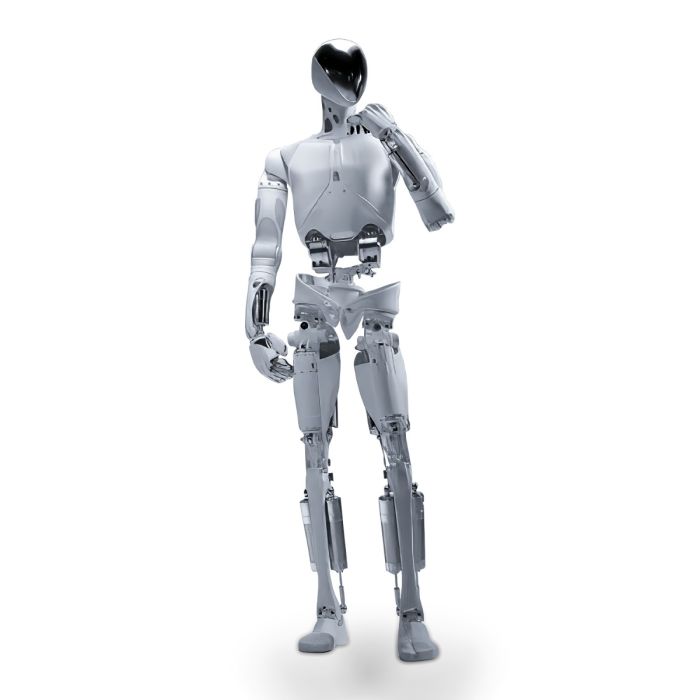
Xpeng Iron Humanoid Robot
In stock
- BRAND:
- XPENG
- MODEL:
- IRON
- AVAILABILITY:
- SUBJECT TO AVAILABILITY
- SKU:
- Xpeng-Iron
Xpeng Iron Humanoid Robot
Most humanoid robots make their public debut on a stage, under careful lighting and with an engineer close at hand. The Xpeng Iron Humanoid Robot made its most telling appearance somewhere far less glamorous: at the end of a factory line, walking off it under its own control once assembly was complete. That image explains what separates IRON from many of its peers. It comes from a company that builds vehicles at industrial scale and now intends to build humanoids the same way, with the robot's intelligence running on the machine itself rather than on a remote operator's console.
Robots Europa, based in Dublin, supplies the Xpeng Iron Humanoid Robot to businesses, venues, developers and research organisations across the European Union and the DACH region. Robots Europa prepares each quotation, arranges delivery to the customer's site and remains the point of contact for support after the robot is in service, so that European buyers deal with a single partner from the first enquiry onwards.
Background
IRON did not appear in a single step. The sources describe three stages of the programme, and understanding them helps a buyer read the specifications correctly.
XPENG: from electric vehicles to Physical AI
XPeng Inc., listed in New York as XPEV and in Hong Kong as 9868, is headquartered in Guangzhou and is widely known for its electric vehicles. The company now describes itself as a leading global Physical AI company, a term for artificial intelligence that perceives and acts in the physical world rather than only on a screen. Its humanoid work draws on the same disciplines as its automotive business: in-house AI chips, large AI models and volume manufacturing. On 8 September 2026 XPENG announced that its humanoid robot production lines had gone into operation, and that the robot had walked off the line autonomously after completing production.
Three stages of IRON
The sources name a first-generation IRON from 2024, a Next-Gen IRON revealed in November 2025 and the production-line IRON of September 2026. The Next-Gen reveal introduced a humanoid spine, bionic muscles, fully covered flexible skin, support for customisation to different body shapes and the industry's smallest harmonic joint, which gives the hand a 1:1 human size. It also introduced all-solid-state batteries: lightweight, of ultra-high energy density and safe. The production-line IRON is an advanced humanoid robot combining a highly human-like form and movement with AI-driven intelligence, designed to meet the highest safety standards, and it uses a proprietary fully enclosed flexible lattice structure intended to balance aesthetics and safety. Because the figures differ between the 2025 reveal and the 2026 production release, the table below keeps each figure with its version.
Technical Specifications
| Specification | Next-Gen IRON | Production-line IRON |
|---|---|---|
| Degrees of freedom, body | 82 | 76 |
| Degrees of freedom, hand | 22 | 21 in each hand |
| AI processors | 3 Turing AI chips | Three Turing AI chips |
| Effective computing power | 3000 TOPS | Up to 2,250 TOPS |
| Onboard AI | XPENG's first-generation physical world large model; VLT + VLA + VLM combination for conversation, walking and interaction | Physical AI foundation model deployed directly on the robot |
| Body and outer structure | Humanoid spine, bionic muscles, fully covered flexible skin; customisation for different body shapes | Proprietary fully enclosed flexible lattice structure |
Specifications are as published by the manufacturer and are confirmed against the datasheet at quotation.
The manufacturer has not published the height, weight, overall dimensions, payload, battery runtime, walking speed, IP rating, charging method, the battery chemistry of the production version or the contents of the delivery; all of these are confirmed at quotation.
How does the production-line IRON differ from the Next-Gen IRON revealed in 2025?
The two published versions share the same architecture: three Turing AI chips, a large AI model running on the robot and a body designed to look and move like a person. The numbers, however, are not the same. The November 2025 reveal gives 82 degrees of freedom in the body, 22 in the hand and 3000 TOPS of effective computing power. The September 2026 production release gives 76 degrees of freedom across the body, 21 in each hand and up to 2,250 TOPS.
Whatever the engineering reasons behind the change, what matters for a buyer is which figures describe the robot that is actually supplied. The production-line figures are the more recent and relate to the robot coming off XPENG's own line, so they are the natural reference point for a commercial evaluation. Robots Europa states the exact version and configuration in each quotation, so that the figures in a project plan match the unit that arrives.
The outer structure also reads differently between the two releases. The 2025 reveal speaks of bionic muscles and fully covered flexible skin; the 2026 release describes a fully enclosed flexible lattice structure. Both describe a closed, soft-surfaced body rather than exposed mechanics, which is relevant wherever the robot will work close to members of the public.
Why does on-robot AI matter for a humanoid in public spaces?
Many humanoid demonstrations rely in part on teleoperation, with a person guiding the robot from elsewhere. XPENG takes the opposite approach. On the production-line IRON, the computing power of the three Turing AI chips allows the Physical AI foundation model to run directly on the robot, so that IRON performs complex tasks autonomously without remote operation, with low-latency inference and enhanced data security.
Low latency matters because a robot that greets visitors, answers questions and moves through a crowd has to respond in conversational time. Data security matters because a robot in a shop or a museum sees and hears people continuously. With the Next-Gen IRON, XPENG added a Fourth Law to the Three Laws of Robotics: privacy data does not leave the robot. For European operators, who are accustomed to careful scrutiny of how personal data is handled, that design principle is a sensible starting point for discussions with their own data protection officers, although each deployment still requires its own assessment.
Who is the Xpeng Iron Humanoid Robot for?
The clearest audience is commercial operators. XPENG has stated that IRON will first enter commercial scenarios such as guided tours, shopping guides and traffic diversion, which points to retailers, shopping centres, museums, exhibition venues, corporate visitor centres and transport hubs that want a human-like presence to inform and direct people.
The second audience is developers. XPENG has said that IRON will open its SDK and build a humanoid robot application ecosystem with global developers, which makes the platform relevant to software houses and system integrators that build customer-facing applications, as well as to university and corporate research groups studying human-robot interaction.
A third audience is organisations planning ahead. XPENG aims to achieve large-scale mass production of high-level humanoid robots by the end of 2026, and innovation teams that want early experience with a production humanoid can use IRON to build that knowledge. The sources do not present the IRON versions as alternative trims for different buyers, so there is no sibling version to recommend for a particular segment. Buyers who want to compare IRON with other platforms will find further options among our Humanoids and in the Bipedal Humanoids category.
What is the Xpeng Iron Humanoid Robot used for?
- Guided tours – leading visitors through museums, showrooms or campuses and explaining what they see.
- Shopping guidance – helping customers find products and answering questions on the shop floor.
- Traffic diversion – directing the flow of visitors in busy venues, entrances and event spaces.
- Application development – building and testing customer-facing applications through the SDK XPENG has announced.
- Human-robot interaction research – studying how people respond to a humanoid that converses, walks and interacts on its own.
- Brand and visitor experience – giving corporate headquarters and flagship stores a striking, interactive point of contact.
Pricing and Availability
Robots Europa prices the Xpeng Iron Humanoid Robot by individual quotation, reflecting the version, configuration and scope of each project. Delivery, customs clearance and support are arranged together with the quotation. Each quotation also sets out the exact version and configuration to be supplied, so that planning rests on clear terms from the outset. To begin, simply send your enquiry using the quotation request available on this page.
Frequently Asked Questions
How many degrees of freedom does IRON have?
The production-line IRON of September 2026 has 76 degrees of freedom across the body and 21 in each hand. The Next-Gen IRON revealed in November 2025 was presented with 82 in the body and 22 in the hand.
What computing hardware does IRON use?
The production-line IRON uses three Turing AI chips delivering up to 2,250 TOPS of effective computing power. The Next-Gen IRON reveal stated 3000 TOPS from 3 Turing AI chips.
Does IRON need a remote operator?
No. The Physical AI foundation model runs directly on the robot, allowing IRON to perform complex tasks autonomously without remote operation.
Which commercial scenarios will IRON enter first?
XPENG has said that IRON will first enter commercial scenarios such as guided tours, shopping guides and traffic diversion. These are the settings where a human-like, conversational robot is most immediately useful.
How does IRON handle personal data?
With the Next-Gen IRON, XPENG added a Fourth Law to the Three Laws of Robotics: privacy data does not leave the robot. On-robot processing on the production-line IRON also provides enhanced data security.
Can developers build their own applications?
XPENG has said that IRON will open its SDK and build an application ecosystem with global developers. Robots Europa can discuss SDK access as part of your enquiry.
Where can I buy the Xpeng Iron Humanoid Robot and what does it cost?
Robots Europa supplies the Xpeng Iron Humanoid Robot across the EU and the DACH region. The price depends on version and configuration and is provided in an individual quotation requested through this page.
Summary
A robot that walks off its own production line makes a statement that no stage demonstration can: it suggests a product rather than a prototype. The Xpeng Iron Humanoid Robot backs that statement with a human-like, fully enclosed body, dexterous hands, three Turing AI chips and an AI model that runs on the robot itself, with XPENG pointing it first at guided tours, shopping guidance and visitor flow. For a buyer, the essential next step is a quotation that fixes version and configuration. For European organisations that want to evaluate a production humanoid with Robots Europa as their partner for supply, delivery and support, this page is the starting point.


