
Astribot T1 Wheeled Humanoid Robot
In stock
- BRAND:
- ASTRIBOT
- MODEL:
- T1
- ORIGIN:
- China
- AVAILABILITY:
- SUBJECT TO AVAILABILITY
- SKU:
- Astribot-T1
Astribot T1 Wheeled Humanoid Robot
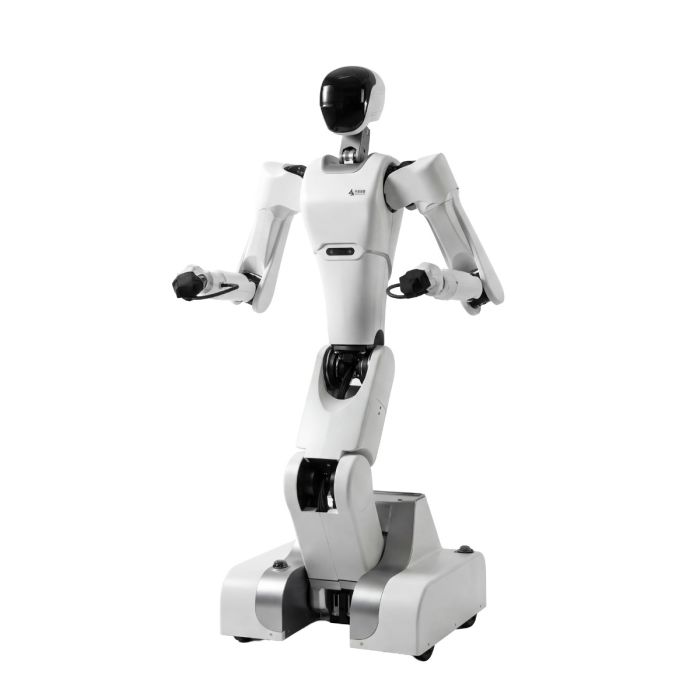
Buy an industrial arm and you choose its gripper once; with the Astribot T1 Wheeled Humanoid Robot, the question of what kind of hand the machine should have becomes a decision you can revisit task by task. Simple grippers for routine handling, full five-fingered dexterous hands for delicate work, extra sensors or computing modules when a project demands them: the T1 is designed less as a finished appliance and more as a compact, mobile body on which a team builds its own capability. It rolls rather than walks, it stands at roughly the height of an adult at a worktop, and the manufacturer aims it at homes, shops, laboratories and industrial floors alike.
Robots Europa, based in Dublin, supplies the Astribot T1 to customers across the European Union and the DACH region. We prepare each quotation for the specific configuration requested, arrange delivery and customs to the destination country, and provide support after installation, so that research groups, integrators and businesses can evaluate and deploy the platform with a single point of contact.
Background
Stardust Intelligence and the Astribot brand
Astribot is the product brand of Stardust Intelligence, the company's formal name. The business was founded in Shenzhen in December 2022 by Lai Jie, who had previously worked at Tencent's Robotics X lab and at Baidu. That background, spanning applied robotics research and large-scale AI engineering, shows in how the T1 is presented: hardware, developer interfaces, teleoperation and a foundation model are offered together as one system rather than as separate parts for the buyer to assemble. Within the wider family of Humanoids, Astribot concentrates on wheeled designs whose strength lies in the upper body and the hands.
Cable-driven architecture and the Lumo-2 model
The T1 is built around Astribot's cable-driven architecture, which the manufacturer designed to support dexterous manipulation, compliant interaction and high-speed movement. In cable-driven designs generally, force is transmitted to the limbs through cables rather than through a motor sitting at every joint, which tends to keep the moving parts light and the interaction with people and objects more forgiving. On the software side, the T1 is equipped with the Lumo-2 base model. With it, the robot has demonstrated autonomous tidying of miscellaneous items into a backpack, combining decision-making with dexterous manipulation of deformable objects, one of the more demanding everyday tasks for any robot because soft items change shape as they are handled.
Technical Specifications
| Specification | Value |
|---|---|
| Product type | Wheeled humanoid robot built for fine manipulation |
| Height | 1.55 m |
| Weight | About 66 kg |
| Chassis footprint | 0.55 × 0.56 m |
| Degrees of freedom (excluding end effectors) | 23 |
| Degrees of freedom, hands | 16 |
| Single-arm payload | 5 kg |
| Maximum speed | 5 km/h |
| Runtime per charge | 4–6 hours |
| Charging time | Less than 1 hour |
| Power management | Automatic charging; quick battery replacement |
| Connectivity | Ethernet, Wi‑Fi |
| Main structural material | Aluminium alloy frame with polymer covers |
| Drive architecture | Cable-driven |
| End effectors | Interchangeable: simple grippers or five-fingered dexterous hands |
| Modularity | End effectors, computing modules and sensors can be added for different tasks |
| AI model | Lumo-2 base model |
| Developer access | SDK and API: joint control, Cartesian motion, whole-body coordination, sensor data |
| Teleoperation | VR-based |
Specifications are as published by the manufacturer and are confirmed against the datasheet at quotation.
The manufacturer has not published the battery capacity, the IP rating, the onboard compute, the camera and sensor specifications, the package contents, the details of the wheeled base drive, the operating system details or the operating noise level; all of these are confirmed at quotation.
What does the modular design of the Astribot T1 mean in practice?
Most service robots are bought for one job and stay that way. The T1 takes a different position: its modular design allows different end effectors, computing modules and sensors to be added for different tasks, and its hands swap between simple grippers and full five-fingered dexterous hands. For a buyer, that changes the economics of experimentation. A laboratory can begin with grippers for pick-and-place trials, move to dexterous hands when a study turns to fine manipulation, and add sensing or processing capacity as its models grow, all on the same body.
The developer layer supports this. Through the SDK and API, programmers reach joint control, Cartesian motion and whole-body coordination, as well as sensor data, which means the robot can be driven at the level a project needs: individual joints for low-level control research, Cartesian targets for task programming, or coordinated whole-body motion for behaviours that involve both arms and the base. VR-based teleoperation adds a further route, letting an operator guide the robot directly, which is how many teams gather demonstration data for training learning-based controllers.
How does the Astribot T1 cope with a full working day?
Endurance is often where compact robots disappoint, and the T1 addresses it in three ways. Runtime per charge is 4–6 hours, charging time is less than 1 hour, and the robot supports both automatic charging and quick battery replacement. Together these allow long-duration continuous operation and switching between scenarios: a battery swap keeps the robot working through a shift, while automatic charging lets it top up between tasks without an operator stepping in.
Mobility is matched to indoor work. A maximum speed of 5 km/h is in the range of a walking pace, suitable for moving between workstations, rooms or shelves, and a chassis of 0.55 × 0.56 m keeps the footprint modest enough for corridors, kitchens and laboratory aisles. Ethernet and Wi‑Fi cover both fixed and wireless integration into existing networks.
Who is the Astribot T1 Wheeled Humanoid Robot for?
The clearest fit is the research community: university laboratories and corporate AI teams working on embodied intelligence, manipulation and learning from demonstration. For them, the combination of open developer access, VR teleoperation and a pre-installed foundation model shortens the path from hardware delivery to first experiment.
System integrators and innovation departments form a second group. They need a platform that can be reconfigured for a pilot in retail, hospitality or light industrial handling, then reconfigured again for the next customer, and the T1's interchangeable end effectors and add-on modules suit that pattern of work.
A third group is organisations exploring service robotics in homes and commercial spaces, where a compact, wheeled body and compliant interaction matter more than raw lifting capacity. Buyers who are comparing several Astribot platforms can also review the Astribot S1 Wheeled Humanoid Robot and the Astribot S1-U Upper Body Humanoid Robot (S1-U), or browse the full range of Wheeled Humanoids; Robots Europa will advise on which configuration matches the task.
What is the Astribot T1 used for?
- Embodied-AI research: a platform for developing and testing manipulation policies on top of the Lumo-2 base model.
- Demonstration data collection: VR-based teleoperation lets operators record the movements that learning systems are trained on.
- Household tasks: tidying and handling soft, irregular objects of the kind found in everyday homes.
- Commercial service: fetching, arranging and handling items in shops, offices and hospitality settings.
- Industrial handling pilots: light pick-and-place work at workstations, with grippers or dexterous hands as the job requires.
- Robotics teaching: SDK and API access lets students work at joint, Cartesian and whole-body level on a single robot.
Pricing and Availability
Robots Europa supplies the Astribot T1 on the basis of a written quotation, prepared for the end effectors, modules and use case you specify. Delivery, customs and support are arranged together with the quotation, so the figure you receive reflects the complete supply to your site. To begin, send us your intended application and destination country through the quotation request available on this page.
Frequently Asked Questions
How many degrees of freedom does the Astribot T1 have?
The T1 has 23 degrees of freedom excluding end effectors, and its hands have 16 degrees of freedom.
How much can each arm lift?
The single-arm payload is 5 kg.
How long does the robot run on one charge?
Runtime per charge is 4–6 hours, and charging takes less than 1 hour. The robot also supports automatic charging and quick battery replacement.
Can the hands be changed?
Yes. The hands swap between simple grippers and full five-fingered dexterous hands, and the modular design also accepts additional computing modules and sensors.
Can developers programme the T1 directly?
Yes. The SDK and API provide access to joint control, Cartesian motion, whole-body coordination and sensor data.
Which AI model does the T1 use?
The T1 is equipped with the Lumo-2 base model, with which it has demonstrated autonomously tidying miscellaneous items into a backpack.
Where can I buy the Astribot T1 Wheeled Humanoid Robot and what does it cost?
Robots Europa supplies the T1 across the EU and the DACH region. The cost depends on the configuration and destination, so we provide it in a quotation that also covers delivery, customs and support.
Summary
The Astribot T1 Wheeled Humanoid Robot is built on the idea that a robot's usefulness should not be fixed on the day it is delivered. A cable-driven body designed for dexterous, compliant motion, hands that change from grippers to five-fingered dexterous hands, room for additional sensors and computing modules, and open access from individual joints up to whole-body coordination make it a platform that develops alongside the team using it. Practical endurance and a compact footprint carry that flexibility from the laboratory into homes, shops and workshops. For organisations in the EU and the DACH region that want to shape a humanoid around their own tasks, with Robots Europa handling quotation, delivery and support, this page is the starting point.


