
Dexforce W1 Core General Purpose Embodied Intelligence Wheeled Humanoid Robot
In stock
- BRAND:
- DEXFORCE
- PART #:
- W1 Core
- ORIGIN:
- China
- AVAILABILITY:
- SUBJECT TO AVAILABILITY
- SKU:
- DexForce-W1-Core
Dexforce W1 Core General Purpose Embodied Intelligence Wheeled Humanoid Robot
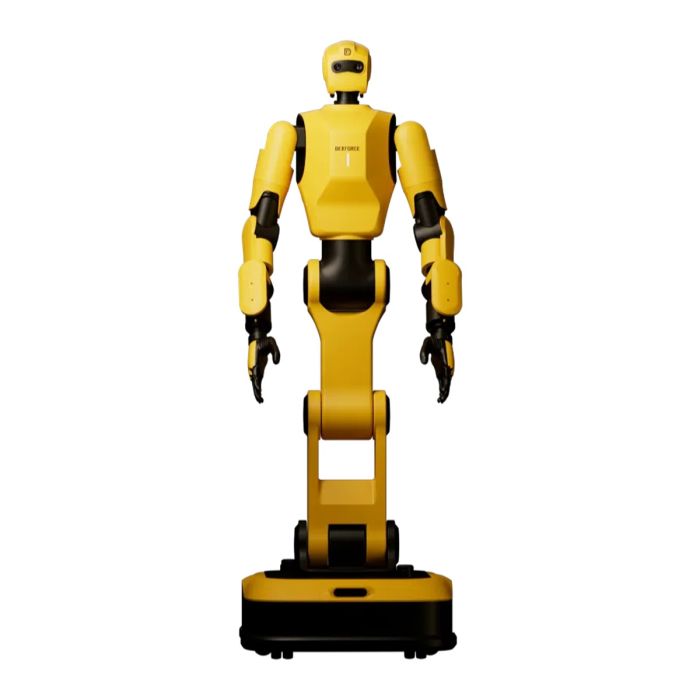
In a laboratory, the most useful robot is often the one that stays exactly where it is placed. A machine that holds its position at a fixed station produces demonstrations that can be compared, repeated and fed back into training without the added variable of a moving base. The Dexforce W1 Core General Purpose Embodied Intelligence Wheeled Humanoid Robot takes that principle seriously. It is built for stationary operation, with an upper body that carries a pair of seven-axis arms, a binocular head and on-board AI computing, and it leaves full-body work to its sibling. The result is a humanoid that trades travel for concentration: every joint and every sensor is committed to the task in front of it.
Robots Europa, based in Dublin, supplies the Dexforce W1 Core to universities, research institutes and companies across the European Union and the DACH region. We prepare a written quotation for each configuration, arrange delivery to your site and remain your point of contact for support after installation, so that a laboratory in Munich, a production line in Linz or a university department in Galway deals with a single European supplier from first enquiry to commissioning.
Background
DexForce Technology and the W1 platform
The W1 Core is designed and built by DexForce Technology Co., Ltd., a robotics company headquartered in Shenzhen, China. W1 is a general-purpose platform for embodied intelligence, the field in which AI models learn to act through a physical body rather than through text or images alone. The platform comes in two versions: the W1 Pro, a full-body configuration, and the W1 Core, an upper-body configuration. Both belong to the same line; they differ in how much of the body is put to work.
Embodied intelligence research depends on large quantities of real interaction data. Platforms of this class are typically used in two ways: to record human demonstrations, often through teleoperation, and to test the policies that are later trained on those recordings. A robot that serves both purposes needs consistent kinematics, reliable perception and enough computing power on board to run modern models close to the hardware.
An upper-body configuration for stationary work
The W1 Core concentrates its articulation where manipulation happens. Each arm offers 7 degrees of freedom, arranged as three at the shoulder, one at the elbow and three at the wrist, which gives the redundancy needed to approach an object from several angles. The torso adds 2 degrees of freedom at the neck, 2 at the waist and 2 at the leg, allowing the robot to direct its gaze and shift its working posture without relocating. Joint control runs at 1kHz, and the head carries humanoid binocular vision with a 6cm baseline, paired with a large-model binocular algorithm. The application type is stationary operation, which defines the W1 Core as a robot for a workstation rather than a robot for a corridor.
Technical Specifications
| Specification | Dexforce W1 Core |
|---|---|
| Form factor | Upper-Body |
| Dimensions (L×W×H) | 682mm*550mm*1636mm |
| Weight | 110kg |
| Torso DOF | Neck: 2 DOF, Waist: 2 DOF, Leg: 2 DOF |
| DOF of single arm | 7 DOF (Shoulder: 3; elbow: 1; wrist: 3) |
| Max payload (single arm) | 10kg |
| Arm repeatability (without hand) | ±0.5 mm |
| End-effector type | Standard: 2-Finger Gripper; Optional: Dexterous Hand |
| Head vision | 6cm Baseline Humanoid Binocular Vision + Large-Model Binocular Algorithm |
| Wrist vision | Standard: N/A; Optional: Supports RGBD Cameras on both wrists |
| Computing & AI power | Standard: Single-PC Architecture (≥150 TOPS); Optional: Dual-PC Architecture (≥300 TOPS) |
| High-frequency motion control | 1kHz |
| Application type | Stationary Operation |
| Typical industries | Data Collection & Training, Research & Education, Commercial Services, Industrial Manufacturing |
Specifications are as published by the manufacturer and are confirmed against the datasheet at quotation.
The manufacturer has not published the battery life, battery capacity, power consumption, connectivity, IP rating, operating temperature, the details of the wheeled chassis or the contents of the box; these are confirmed at quotation.
How does the W1 Core differ from the W1 Pro?
The two versions differ in form factor. The W1 Core is the upper-body configuration of the platform, built for stationary operation; the Dexforce W1 Pro General Purpose Embodied Intelligence Wheeled Humanoid Robot is the full-body configuration. In practical terms, the Core directs the platform's engineering towards the arms, the head and the computing that serves them, whereas the Pro covers the whole body.
For a buyer, the question is therefore less about which version is better and more about where the work takes place. If the tasks happen at a bench, a counter or a test cell, and the value lies in what the hands and eyes do there, the Core addresses that scenario directly. If the application calls for the full body, the Pro is the version to examine. The figures in the table above belong to the W1 Core only; the specifications of the Pro are set out on its own page, and Robots Europa can prepare comparative quotations for both.
Which options can be added to the W1 Core?
The standard W1 Core is a capable starting point, and three options allow it to be tailored to the task. The first concerns the hands. As standard, each arm ends in a 2-finger gripper, which suits pick-and-place work, the handling of rigid parts and most structured assembly steps. A dexterous hand is available as an option for projects that need finer grasps, in-hand manipulation or research into human-like grasping.
The second option concerns perception. The binocular head is standard, while RGBD cameras on both wrists are optional. Wrist cameras give the robot a close view of what each hand is doing, which matters when demonstrations are recorded for training or when a part must be aligned precisely before it is grasped.
The third option concerns computing. The standard single-PC architecture delivers at least 150 TOPS; the optional dual-PC architecture raises this to at least 300 TOPS. Teams that intend to run larger models on board, or to separate perception from control workloads, will find the dual-PC configuration worth discussing at quotation.
Who is the Dexforce W1 Core for?
The W1 Core serves four typical industries, and each corresponds to a distinct type of buyer. Data collection and training teams are the most natural fit: a stationary dual-arm humanoid with binocular vision and optional wrist cameras is well suited to recording consistent demonstrations at scale. Research and education groups form the second segment, from university laboratories investigating manipulation and learning to teaching departments that need a humanoid platform students can program and observe at close range.
Commercial services make up the third segment. Organisations exploring humanoids at counters, in showrooms or in other customer-facing settings can compare the W1 Core with the wider range in our Retail Robots category. Industrial manufacturing is the fourth: engineering teams evaluating humanoid manipulation for assembly or handling stations can use the Core to test tasks before they are committed to a production line.
Buyers whose application calls for the full body, rather than an upper body at a fixed station, should look at the Dexforce W1 Pro. Those still comparing platforms across manufacturers will find further options in our Wheeled Humanoids category.
What is the Dexforce W1 Core used for?
- Demonstration data collection – recording repeatable two-handed demonstrations at a fixed station for model training.
- Policy testing and evaluation – running trained models on real hardware to measure how well they transfer from data to action.
- University teaching – giving students a humanoid platform for coursework in manipulation, perception and control.
- Manipulation research – studying grasping and bimanual coordination, with the optional dexterous hand for finer work.
- Assembly and handling trials – testing industrial tasks at a workstation before they move to a production line.
- Commercial service pilots – evaluating how a humanoid performs at a counter or in a customer-facing setting.
Pricing and Availability
Robots Europa quotes the Dexforce W1 Core on request, because the final configuration depends on the choices you make: gripper or dexterous hand, with or without wrist RGBD cameras, and single-PC or dual-PC computing. Each quotation sets out the chosen configuration in writing. Delivery, customs and support are arranged with the quotation, so that the terms for your site in the EU or the DACH region are clear before you place an order. To begin, please use the quotation request available on this page.
Frequently Asked Questions
What does Core mean in the Dexforce W1 Core?
Core denotes the upper-body configuration of the DexForce W1 platform, built for stationary operation. The full-body configuration is sold as the W1 Pro.
How much can each arm of the W1 Core carry?
The maximum payload of a single arm is 10kg. Arm repeatability without a hand fitted is ±0.5 mm.
Does the W1 Core come with a dexterous hand?
The standard end effector is a 2-finger gripper. A dexterous hand is available as an option and can be specified in your quotation.
How much computing power does the W1 Core have on board?
The standard single-PC architecture provides at least 150 TOPS. An optional dual-PC architecture provides at least 300 TOPS.
How large and heavy is the W1 Core?
The W1 Core measures 682mm*550mm*1636mm (L×W×H) and weighs 110kg. These dimensions are worth checking against the space at your workstation before installation.
Is the W1 Core suitable for teaching and research?
Yes, research and education is one of the typical industries for the W1 Core. Its 7 DOF arms, binocular head and optional wrist cameras make it a practical platform for coursework and laboratory projects.
Where can I buy the Dexforce W1 Core and what does it cost?
You can buy the Dexforce W1 Core from Robots Europa, which supplies customers across the EU and the DACH region. The cost depends on the configuration you choose and is set out in a written quotation that you can request on this page.
Summary
The Dexforce W1 Core is built on the idea that, for a great deal of embodied-intelligence work, staying in place is an advantage rather than a limitation. By designing an upper-body humanoid for stationary operation, DexForce has put its engineering into the parts that matter at a workstation: two 7 DOF arms with a 10kg single-arm payload, a torso that can turn and lean, binocular vision in the head, optional RGBD cameras at the wrists and up to the dual-PC computing option on board. For data collection teams, laboratories, teaching departments and engineers trialling industrial tasks, that concentration translates into consistent, repeatable work. Robots Europa supplies, delivers and supports the W1 Core across Europe, and for anyone weighing this platform for their next project, this page is the starting point.


