
LimX Oli EDU Full-Size General Purpose Open Source Humanoid Robot
In stock
- BRAND:
- LIMX
- MODEL:
- Oli EDU
- ORIGIN:
- China
- Warranty:
- 12 MONTHS
- AVAILABILITY:
- SUBJECT TO AVAILABILITY
- SKU:
- LimX-Oli-EDU
LimX Oli EDU Full-Size General Purpose Open Source Humanoid Robot
Most humanoid research begins as code that has never touched a floor. A gait policy converges in simulation and a reaching controller looks flawless on screen. Then comes the real test: will that work hold up inside a body of human proportions, standing in a room built for people? The LimX Oli EDU Full-Size General Purpose Open Source Humanoid Robot belongs at the far end of that journey. It is the physical platform where work developed in simulators and written in Python is asked to stand up, move and respond.
Robots Europa, based in Dublin, supplies the Oli EDU to universities, research institutes and corporate laboratories across the European Union and the DACH region. Robots Europa prepares each quotation, arranges delivery to your site and remains your point of contact for support once the robot is in service.
Background
LimX Dynamics and its legged-robotics lineage
The Oli series comes from LimX Dynamics, a Shenzhen-based company focused on embodied intelligence and legged robotics. That focus shapes the product. A company whose work centres on legged machines treats balance, locomotion and whole-body control as core engineering problems rather than features added later. Oli is the company's full-size, general-purpose humanoid. It takes that legged-robotics experience to human scale and pairs it with a software environment intended for people who build their own behaviours.
Shenzhen is one of the world's densest hardware ecosystems, and robotics companies there tend to iterate quickly across several product lines. LimX Dynamics offers legged and humanoid platforms of different sizes and purposes. Oli is the line aimed at tasks and research questions that only make sense when the robot shares human dimensions.
Where the EDU sits in the Oli series
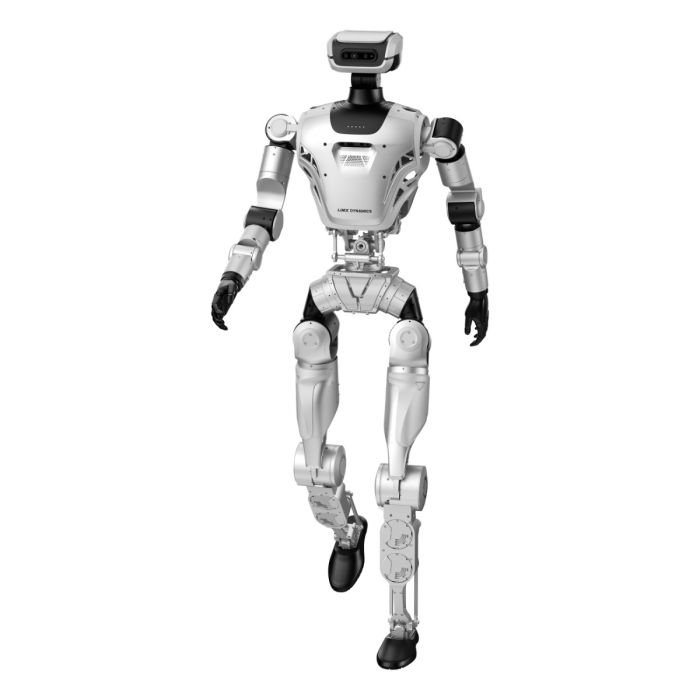
The Oli series comes in three versions: Lite, EDU and Super. The EDU is the version oriented towards education and research. It is the one discussed on this page, and every figure below belongs to it unless it is marked as a series-level value. At series level, LimX Dynamics describes Oli as a full-size humanoid standing 165 cm tall, with up to 31 degrees of freedom across the range. The company presents this as the basis for more human-like postures and a wider range of motion.
Three characteristics define the EDU for a laboratory. It supports full Python development. It works with the major simulation platforms, including NVIDIA Isaac Sim, Mujoco and Gazebo. It also has a self-developed voice interaction system that handles natural bilingual conversation in Chinese and English, as well as voice-based control. Together these make the EDU a platform to programme rather than a finished appliance.
Technical Specifications
| Specification | Value |
|---|---|
| Product type | Full-Size General-Purpose Humanoid Robot |
| Height | 165 cm / 5′5″ |
| Shoulder width | 55 cm / 21.7 in |
| Arm length | 70 cm / 27.6 in |
| Battery capacity | 9,500 mAh |
| Charger | 58.8 V / 10 A |
| Degrees of freedom (Oli series) | Up to 31 DoF |
| Software development | Full Python development |
| Simulation platforms | NVIDIA Isaac Sim, Mujoco, Gazebo, etc. |
| Voice interaction | Natural bilingual (Chinese and English) conversation and voice-based control |
| Manufacturer | LimX Dynamics, Shenzhen |
Specifications are as published by the manufacturer and are confirmed against the datasheet at quotation. The manufacturer has not published the ingress protection rating, the charge time, the combined payload of both arms, the operating temperature range, the walking speed, the shipping dimensions or the operating system; Robots Europa confirms these at quotation.
Why does a full-size humanoid matter for research?
A smaller humanoid is easier to handle, but it lives in a scaled-down world. Door handles sit at the wrong height, workbenches are out of reach and a person standing nearby towers over it. The Oli EDU stands 165 cm tall, with a shoulder width of 55 cm and an arm length of 70 cm. These proportions let it meet the environment on human terms. A study of how a humanoid approaches a table, reaches across a counter or stands beside a person produces results that transfer directly to real buildings, with no adjustment for scale.
Scale also matters for the questions researchers can ask about posture and motion. LimX Dynamics links the series' degrees of freedom to more human-like postures and wider motion possibilities. For groups working on whole-body control, imitation of human movement or ergonomic interaction, a body that resembles a person's is the experimental variable itself. There is also a practical side. A full-size platform shows students and stakeholders what deployed humanoid robotics actually looks like, which a desktop model cannot do.
How does the Oli EDU fit into a simulation-first workflow?
Modern humanoid development rarely starts on hardware. Policies are trained and stress-tested in simulation first, because a fall in software costs nothing. The Oli EDU supports NVIDIA Isaac Sim, Mujoco and Gazebo, among other platforms. A laboratory can therefore keep the simulator its team already knows rather than rebuilding its toolchain around a single vendor's environment. Reinforcement-learning groups often favour Isaac Sim or Mujoco, while robotics teaching frequently relies on Gazebo. Supporting all three widens the range of departments that can adopt the robot without friction.
The second half of the workflow is the language the code is written in. Full Python development means students and researchers can work in the language that dominates machine learning, data analysis and much of academic robotics. Python lowers the barrier for a postgraduate arriving from a computer-science background and shortens the path from a trained model to a running experiment. The voice interaction system adds another layer. Spoken commands and bilingual conversation open a route to research in human-robot interaction alongside locomotion and manipulation.
Who is the LimX Oli EDU for?
The clearest fit is the university laboratory. Departments of robotics, mechanical engineering, computer science and artificial intelligence need a human-scale platform for both teaching and published research. A single Oli EDU can support a taught module on humanoid control during the term and a doctoral project on sim-to-real transfer outside it. Because the robot works with the simulators those groups already use, coursework can begin in software well before students queue for time on the hardware.
Research institutes and corporate innovation laboratories form the second segment. Teams evaluating embodied AI need a humanoid on which to test their own models. For them, an open development environment matters more than a catalogue of pre-built behaviours. A third group consists of technical schools and science centres that want a full-size humanoid for advanced programmes and demonstrations. For these buyers, the voice interaction system makes the robot approachable for audiences who will never read its source code.
The Oli series also includes the LimX Oli Lite Full-Size General Purpose Humanoid Robot and the LimX Oli Super Full-Size General Purpose Humanoid Robot. If you are weighing the EDU against them, Robots Europa will set out the differences in writing with your quotation. For a wider view, the Bipedal Humanoids and Research Robots categories gather the related platforms.
What is the LimX Oli EDU used for?
- Humanoid locomotion research — developing and validating walking and balance controllers on a body of human proportions.
- Sim-to-real transfer — moving policies trained in NVIDIA Isaac Sim, Mujoco or Gazebo onto physical hardware and measuring the gap.
- Teaching robotics in Python — giving students hands-on experience with a full-size humanoid in the language they already use for machine learning.
- Human-robot interaction studies — using bilingual voice conversation and voice-based control to research how people instruct and respond to humanoids.
- Human-scale task research — studying reaching, posture and whole-body motion in spaces designed around people.
- Demonstration and outreach — showing visitors, funders and prospective students what contemporary embodied AI looks like in practice.
Pricing and Availability
Robots Europa supplies the Oli EDU on quotation. Each quotation reflects the configuration, the destination and the support your project requires. Delivery, customs and support are arranged together with the quotation, so your institution receives one clear proposal covering everything needed to put the robot into service. If you are preparing a grant application or an internal procurement case, Robots Europa can provide the documentation those processes usually ask for. To begin, request a quotation using the form available on this page.
Frequently Asked Questions
How tall is the LimX Oli EDU?
The Oli EDU stands 165 cm / 5′5″ tall. Its shoulder width is 55 cm / 21.7 in and its arm length is 70 cm / 27.6 in.
Which programming language does the Oli EDU support?
The Oli series supports full Python development. This suits teams whose machine-learning and control work is already written in Python.
Which simulators can I use with it?
The series supports the major simulation platforms, including NVIDIA Isaac Sim, Mujoco and Gazebo. Teams can develop and test behaviours in their preferred environment before running them on the robot.
Can the robot understand spoken commands?
Yes. Oli uses a self-developed voice interaction system that supports natural bilingual conversation in Chinese and English, together with voice-based control.
What battery and charger does it use?
The Oli EDU has a battery capacity of 9,500 mAh and uses a 58.8 V / 10 A charger.
How does the EDU differ from the Lite and Super versions?
The EDU is the version aimed at education and research. Robots Europa provides a written comparison of the three versions on request.
Where can I buy the LimX Oli EDU and what does it cost?
Robots Europa supplies the Oli EDU across the European Union and the DACH region. The cost is set out in a quotation tailored to your configuration and delivery destination; please request it through the form on this page.
Summary
A humanoid controller is only proven once it leaves the simulator and meets a real body in a real room. The Oli EDU is built for that moment. It offers human proportions that fit human spaces, Python development that matches the way researchers already work, and support for NVIDIA Isaac Sim, Mujoco and Gazebo, so experiments can move from screen to floor without a change of toolchain. Bilingual voice interaction extends its reach into human-robot interaction research. Its origins at LimX Dynamics, a company built around legged robotics, explain why locomotion and posture sit at the centre of its design. For laboratories in the EU and the DACH region ready to give their simulated work a physical test, with Robots Europa handling the quotation, delivery and support, this page is the starting point.


