
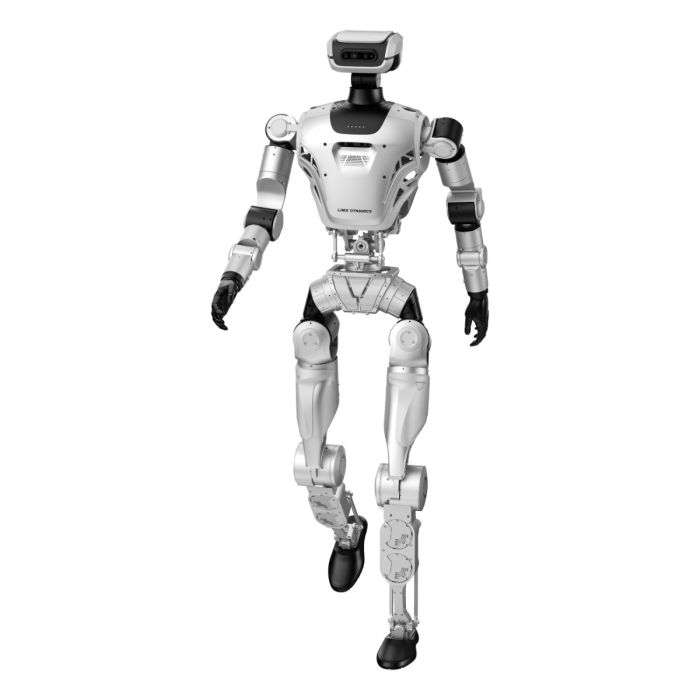
LimX Oli Super Full-Size General Purpose Humanoid Robot
In stock
- BRAND:
- LIMX
- PART #:
- Oli Super
- ORIGIN:
- China
- AVAILABILITY:
- SUBJECT TO AVAILABILITY
- SKU:
- LimX-Oli-Super
LimX Oli Super Full-Size General Purpose Humanoid Robot
Every humanoid research team knows the moment: a walking policy that looked flawless in simulation meets a real floor, real friction and a real battery, and the gap between the two worlds suddenly becomes the whole project. The LimX Oli Super Full-Size General Purpose Humanoid Robot is built for teams who intend to close that gap on hardware that is large and capable enough to matter. It is the top edition of the LimX Oli family, a full-size bipedal platform with 43 active degrees of freedom, two dedicated onboard computers and support for the simulation environments that most embodied-AI groups already work in.
Robots Europa, based in Dublin, supplies the Oli Super to research institutes, universities and companies across the European Union and the DACH region. We prepare the quotation, arrange delivery to your site and remain your point of contact for support once the robot is in service, so that a project team deals with one European partner from the first enquiry through to commissioning and beyond.
Background
LimX Dynamics and its roots in legged robotics
LimX Dynamics is a Shenzhen-based company focused on embodied intelligence and legged robotics. That focus shapes the Oli programme. A company whose core discipline is balance, gait and locomotion approaches a humanoid from the legs upwards: the robot must first stand, walk and recover reliably before its arms, hands and cameras can be put to productive use. The Oli family is the manufacturer's answer to the question of how a general-purpose humanoid should be packaged for people who write their own software rather than buy a finished application.
Three editions, one architecture
LimX Oli is offered in three editions: Lite, EDU and Super. They share the same overall concept of a full-size humanoid with modular end-effectors, and they differ in configuration. The Super is the fullest of the three, with the joint count, compute and payload described in the table below. Its modular wrists accept multiple end-effectors, including two-finger grippers and dexterous five-finger hands, which allows the same robot to move from simple pick-and-place studies to fine manipulation research without changing platform.
Technical Specifications
| Specification | Value |
|---|---|
| Edition | Oli Super |
| Height | 175cm |
| Weight | 60kg |
| Shoulder width | 60cm |
| Single-arm payload | 5kg |
| Maximum joint torque | 250 N·m |
| Total active degrees of freedom | 43 |
| Maximum walking speed | 5km/h |
| Battery | 9,500mAh Lithium-ion polymer, swappable |
| Battery life | ~1.5h |
| Motion control compute | RK3588 with 16G RAM and 256G storage |
| Perception compute | Orin NX (100TOPS)/16G |
| Head and chest depth cameras | Intel RealSense D435i |
| Connectivity | Wifi 6, Bluetooth 5.4, USB 3.0 / 3.2, 1,000Mbps RJ45 Ethernet |
| Supported end-effectors | Two-finger grippers; dexterous five-finger hands |
| Simulation platforms | NVIDIA Isaac Sim, MuJoCo, Gazebo |
Specifications are as published by the manufacturer and are confirmed against the datasheet at quotation.
The manufacturer has not published the packed dimensions, the IP rating, the charging time for the Super, the operating temperature range, the list of included accessories or the noise level; Robots Europa confirms these details at quotation.
Why does the Oli Super use two separate onboard computers?
A humanoid has two very different jobs to do at once. It must keep itself upright, which calls for fast, predictable control loops running close to the motors, and it must understand its surroundings, which calls for heavy parallel processing of camera data and learned models. Mixing both workloads on one processor is a common source of trouble in research robots: a demanding perception model can starve the balance controller at exactly the wrong moment.
The Oli Super separates the two. Motion control runs on an RK3588 with 16G RAM and 256G storage, while perception runs on an Orin NX (100TOPS)/16G module. For a research group this division matters in practice. Locomotion engineers can work on the control side with confidence that a vision experiment will not disturb gait timing, while the perception team has a dedicated GPU-class module for detection, segmentation or vision-language models fed by the Intel RealSense D435i depth cameras in the head and chest.
Connectivity supports the development routine around this architecture. Wifi 6 and Bluetooth 5.4 cover wireless operation, while USB 3.0 / 3.2 and 1,000Mbps RJ45 Ethernet provide wired links for logging large datasets, flashing software or tethered debugging on the bench.
How does the Oli Super move work from simulation to the real robot?
Modern humanoid control is increasingly trained rather than hand-tuned, and training happens first in simulation. The Oli platform supports NVIDIA Isaac Sim, MuJoCo and Gazebo, which means a team can keep its existing toolchain rather than adopt a proprietary environment. Reinforcement-learning researchers tend to favour one simulator, classical robotics groups another; support for all three lowers the barrier for both.
Once a policy leaves simulation, the real robot has to keep pace with the testing schedule. The Super runs on a 9,500mAh Lithium-ion polymer battery with a battery life of ~1.5h, and the battery is swappable. For a lab running a full day of trials, a spare pack turns battery changes into a short pause rather than an end to the session. The 43 active degrees of freedom and 250 N·m maximum joint torque give whole-body controllers room to work, and a maximum walking speed of 5km/h lets locomotion experiments go beyond slow, cautious stepping.
Who is the LimX Oli Super for?
The Super is aimed at organisations whose research questions need the most complete configuration in the family. University laboratories and research institutes working on whole-body control, loco-manipulation or embodied foundation models are the clearest fit: the joint count, the dedicated perception module and the choice of grippers or dexterous hands allow one robot to serve several research lines at once. Corporate R&D groups and solution integrators running early pilots in logistics, manufacturing or service settings will value a human-scale body that can work at benches, shelves and doorways designed for people.
Not every buyer needs the full configuration. Where the main purpose is teaching and student projects, the LimX Oli EDU Full-Size General Purpose Open Source Humanoid Robot is worth comparing, and teams seeking a lighter configuration of the same platform may prefer the LimX Oli Lite Full-Size General Purpose Humanoid Robot. Buyers still surveying the market can browse our wider ranges of Humanoids and Bipedal Humanoids.
What is the LimX Oli Super used for?
- Embodied AI research: training and evaluating policies that link perception, language and action on a full-size body.
- Locomotion studies: developing and validating gait, balance and recovery controllers on bipedal hardware.
- Dexterous manipulation: testing grasping and in-hand manipulation with dexterous five-finger hands.
- Sim-to-real transfer: moving policies trained in NVIDIA Isaac Sim, MuJoCo or Gazebo onto a physical robot.
- Industrial pilots: trialling humanoid tasks in workspaces built around human proportions before wider deployment.
- Advanced teaching: giving postgraduate students hands-on experience with a research-grade humanoid platform.
Pricing and Availability
The Oli Super is supplied on quotation, because configuration choices such as end-effectors and spare batteries shape every order. Delivery, customs and support are arranged together with your quotation, so that the robot reaches your laboratory or facility ready for commissioning. To start the process with Robots Europa, use the quotation request available on this page.
Frequently Asked Questions
How many degrees of freedom does the Oli Super have?
The Oli Super has 43 total active degrees of freedom, the configuration intended for whole-body research and dexterous manipulation.
Which end-effectors can be fitted?
The platform supports multiple end-effectors, including two-finger grippers and dexterous five-finger hands.
Which simulators does the Oli Super support?
The Oli platform supports NVIDIA Isaac Sim, MuJoCo and Gazebo, so teams can keep their existing simulation workflow.
How long does the battery last, and can it be changed?
The Super has a battery life of ~1.5h from a 9,500mAh Lithium-ion polymer battery, and the battery is swappable. A spare pack allows longer test sessions without waiting for a recharge.
What computing hardware is on board?
Motion control runs on an RK3588 with 16G RAM and 256G storage, and perception runs on an Orin NX (100TOPS)/16G module.
Which depth cameras does the Oli Super use?
The Oli Super uses Intel RealSense D435i depth cameras in the head and chest, feeding the dedicated perception computer.
Where can I buy the LimX Oli Super and what does it cost?
Robots Europa supplies the Oli Super across the EU and the DACH region on quotation. Request a quotation on this page and we will reply with a tailored offer covering configuration, delivery and support.
Summary
The distance between a policy that works in simulation and a robot that works on a real floor is where most humanoid projects spend their time. The LimX Oli Super is designed to shorten that distance: a full-size body of 175cm with 43 active degrees of freedom, separate computers for motion control and perception, Intel RealSense D435i depth cameras, swappable batteries and support for NVIDIA Isaac Sim, MuJoCo and Gazebo. It is the most complete edition of the Oli family and the natural choice for research groups and pilot teams that need one platform to carry several lines of work. For a configuration and delivery offer from Robots Europa, this page is the starting point.


